Human Trafficking = Modern-Day Slavery
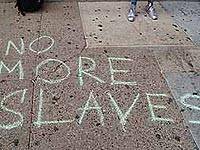 An estimated 800,000 people, of which approximately 80 percent are women and up to 50 percent are minors, are trafficked across national borders. This number does not include the millions of people who are trafficked within their countries of origin. (Trafficking in Persons Report, U.S. Department of State, 2008). Human trafficking is the recruitment, harboring, transporting, providing or obtaining by any means any person for forced labor, slavery or servitude in any industry or site such as agriculture, construction, prostitution, manufacturing, begging, domestic service or marriage.
Affirming that Jesus Christ came that “they may have life, and have it abundantly” (John 10:10b), the General Assembly of the Presbyterian Church (U.S.A.) has convened a roundtable from among its ministries to address human trafficking together with synods, presbyteries and local congregations. The roundtable includes representatives from the Advocacy Committee for Women’s Concerns, Office of the General Assembly- Immigration Issues, Office of Public Witness, Presbyterian Disaster Assistance, Presbyterian Men, Presbyterian Ministry at the United Nations, Presbyterian Peacemaking Program, Presbyterian Women, Self Development of People, World Mission.
A Toolkit for Action: Modern Slavery—Use the resources contained withing this 40-page packet to explore modern-day slavery and learn how you can help.
Download
“Together in Action” bulletin insert.
Download
Pray and take action during National Slavery and Human Trafficking Prevention Month and every month. Here is a seven-day program that you can use any time to raise awareness and work to end this form of abuse.
Day One—Building Awareness
-
-
- Resources: “What Is Modern Slavery?”; “Sex Trafficking: It’s Their Problem, Not Ours”
- Prayer: God of love and mercy, you see every trouble, every cause for grief; you hear the desires of the vulnerable and strengthen their heart. Now, incline your ear to do justice for the exploited and objectified, so that your people will no longer strike terror on your—and our—earth. Amen. (Prayer based on Psalm 10, adapted from prayer of Interfaith Community and Justice Center, Seattle)
Day Two—Looking Ahead
-
-
-
- Action: Plan for prayer and action in your worshiping community. Join the conversation onTwitter: #endtrafficking.
- Consider: Does it make a difference where trafficking occurs? As we are God’s beloved community, is it ever “not our problem”?
- Resources: Office of Theology and Worship; A Toolkit for Action 2015: Modern Slavery; Together in Action to End Human Trafficking
- Prayer: Gracious God, we can hardly bear to read the headlines. We now know that human trafficking happens in our hometowns, at our truck stops, in our hotels, restaurants and nail salons. And there is more . . . so much more that we have not seen because of ignorance and because we want to believe that the evil of human trafficking is elsewhere. Forgive us, gracious God, for we see the world through a tiny lens in which we are good and “they” are bad. Make us wise and incisive in responding to the needs of the world. Empower us to work both in and outside of our borders to break the bonds of injustice. Amen. (Prayer by Shannon Beck)
Day Three—At Risk
-
-
- Action: Learn the signs of trafficking, learn to identify those at risk and learn what you can do. See www.polarisproject.org and “Identify and Assist a Trafficking Victim.” Join the conversation on Twitter: #trafficking.
- Consider: What puts people (especially children) at risk for human trafficking?
- Resources: “Identify and Assist a Trafficking Victim”; Together in Action to End Human Trafficking
- Prayer: Holy God who hears the cries of the oppressed, we come to you as if we were the ones held in slavery. There seems to be no light in this darkness, no hope for our future. Allow someone to see me, to look beyond my outward appearance and into my eyes. Give them the courage to ask, to help, to save me from this captivity. In the name of One love, One hope, we pray. Amen. (Excerpted from “Human Trafficking: The Sale and Trade of God’s Children,” PC(USA) Office of Immigration Issues)
Day Four—Commercial Sexual Exploitation of Children
-
-
- Action: Participate in the work of ECPAT–USA. Use travel services that have signed on to the Code of Conduct for the travel industry. If you see children being checked into a hotel or flight who seem confused or disoriented, or don’t know where they’re going, alert hotel or airport staff. Join the conversation onTwitter: #childsextrafficking.
- Consider: In what ways are we as U.S. citizens complicit in the international crisis of human trafficking?
- Resources: ECPAT-USA; The Code; “In Los Angeles, sex trafficking doesn’t look like it does in the movies”
- Prayer: Let us join the psalmist in Psalm 106, who asks, “Who can proclaim the mighty acts of the Lord or fully declare his praise? Blessed are those who act justly, who always do what is right. Remember me, Lord, when you show favor to your people; come to my aid when you save them . . . .” Lord, we know that it is from you that all goodness comes. May you work through us, and may we work together, to share your love. Amen. (Ryan Smith, Presbyterian Representative to the United Nations)
Day Five—Child Soldiers
-
-
- Action: Work to end the use of child soldiers. Have your congregation or circle make red hands to take a stand against the use of child soldiers. Join the conversation on Twitter: #childsoldiers.
- Consider: What is a child soldier? What can be the future for children who are forced to kill?
- Resources: “Presbyterians Say ‘No Child Soldiers’”; Red Hand Day
- Prayer: Loving God, who welcomes children as honored members of your family, turn the hearts of those who would crush tender spirits, forcing them to do what no child should ever have to do. Help us restore balance in your world and bring equity and justice to all corners of the globe. Be with children in war zones who face the unthinkable. Shield their souls and deliver them from the horrors that surround them. We ask this in the name of your Son, who said “’Let the little children come to me . . . for it is to such as these that the kingdom of heaven belongs’” (Mt. 19:4). Amen. (Yvonne Hileman, staff, Presbyterian Women Justice and Peace Committee)
Day Six—Working with Partners
-
-
- Action: Learn about Freedom Network USA, a national alliance of experienced advocates working with survivors of all forms of human trafficking to ensure that trafficked persons have access to justice, safety and opportunity. Join the conversation on Twitter: #humantrafficking.
- Consider: How can experts help your community more effectively address human trafficking?
- Resources: Freedom Network USA; social service agencies, universities, task forces, coalitions in your community
- Prayer: God of life, truth and freedom, we ask you to hear us as we pray for child laborers, child soldiers and children exploited in pornography. Liberate them from oppression. We pray that the perpetrators and organizers of human trafficking turn away from their unjust ways. We pray that government leaders, corporate directors and all that serve the public will address the systems that make human trafficking possible. We come as a people of hope. We believe that in working together as a community, we can stop the demand for human trafficking. Lead us into justice. God, give us the wisdom and courage to stand in solidarity, so that together we will find ways to the freedom that is your gift to all of us. Amen. (Adapted from a prayer of the Interfaith Community and Justice Center, Seattle)
Day Seven—Labor Exploitation
-
-
- Action: Learn how all of us are part of unjust systems of commerce and exploitative patterns of life that feed human trafficking. Join the Campaign for Fair Food and support just labor practices. Find out how many exploited workers work for you at www.slaveryfootprint.org. Join the conversation on Twitter: #labortrafficking and #fairfood.
- Consider: With knowledge of your slavery footprint, what behaviors or purchases could you change to decrease your footprint?
- Resources: www.slaveryfootprint.org; Coalition of Immokalee Workers; The Freedom Commons; “Global Supermarkets Selling Shrimp Peeled by Slaves”
- Prayer: Loving God, you created us in love for life together. And yet we have turned away from you and from our neighbor. As we remember the women, children and men who have been trafficked for profit, production and pleasure, we realize we know little about the circumstances under which our food, our clothing, our jewelry, our lumber or our toys have been produced. And we confess that there is a part of us that would rather not know. People harvest crops, serve us food, clean our homes and yards, paint our nails, service our hotel rooms; but we confess that too often we reduce them to the service they provide and so they remain hidden in plain sight. Children here and around the world are sold, pimped and forced to labor out of desperation, for the comfort or convenience of those who can pay. We are ill at the thought and ill-equipped to respond. Forgive us God. And help us join with our sisters and brothers who have been trafficked to create life-giving patterns of community and commerce. We ask this in the name of Jesus Christ, who came that we might have life in all its fullness. Amen. (Prayer by Rev. Noelle Damico)
A Violation of Human Rights
Violations of human rights are both a cause and a consequence of human trafficking. Trafficking is a grave violation of human rights, the right to liberty and human dignity and the right not to be held in slavery or involuntary servitude. But trafficking is related to a wide range of other human rights violations as traffickers prey on those who are poor, under- or unemployed or who face discrimination. The PC(USA) promotes the integration of a human rights perspective into all antitrafficking laws, policies and procedures, domestic and international, so as to ensure the rights and well-being of children, women and men who have been trafficked. To learn more about how human trafficking is a violation of human rights, download the most current report from the U.N. Special Rapporteur on Trafficking in Persons, Especially Women and Children.