PC NEWS - Presbyterian News Service
PC (USA) Seal PC(USA) Homepage


04252
May 26, 2004

Risky business

PC(USA) pondering Colombian’s request for ‘accompanier’

by Alexa Smith


LOUISVILLE — When Milton Mejia called the Presbyterian Center last week asking for an “accompanier” for the Presbyterian Church of Colombia, he reopened an old debate about Christian responsibility and risk.

      Mejia said he needs a North American in Colombia — “Pronto.”

      It may sound like a simple request, but it’s not.

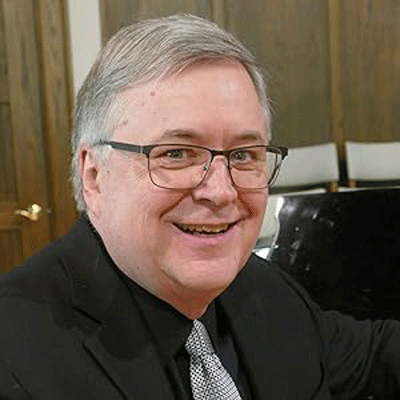
Milton Mejia recently learned that his office is under surveillance.
Photo by the Presbyterian Church of Colombia
 
      Colombia is the undisputed kidnapping capital of the world. Leftist guerrillas and common criminals have turned hostage-taking into a sophisticated industry to bankroll their activities, holding captives for ransom, often targeting foreign employees of large corporations.

      So “safe” is a relative term there — for North Americans, absolutely. But more so for Colombians. That’s why Mejia is asking for help.

      But when a church’s mission agency puts personnel into a dangerous place, there are realities — and liabilities — to consider: How unsafe is too unsafe? When is actually choosing unsafe foolish or irresponsible? And what level of risk is acceptable when weighed against the Christian calling to be one worldwide body even when that may be costly?

      What’s foolish? What’s faithful?

      It’s a dilemma — for the church, and especially for Maria Arroyo, the denomination’s liaison to Colombia, who is weighing Mejia’s request and who has to persuade the division’s prioritization team that it’s probably time to switch strategies. The question is: What is the best strategy?

 
pull quote

     Arroyo is familiar with the risks of accompaniment. With her husband, Peter Kemmerle, she did her share of accompanying churches in Nicaragua in the 1980s, and she doesn’t scare easily.

        But she understands that answers to these tough questions, like everything in Colombia, come in shades of grey, never in black and white.


      Insurgents tend to target rich corporate victims. But who’s to say that a North American church won’t be perceived as a “deep pocket”? Or is the more dangerous party the Colombian government itself, the cause of Mejia’s current fear? How much protection can the government of President Alvaro Uribe provide, when it clearly cannot control factions in its own military with ties to brutal paramilitaries?

      Does the government really want to protect church officials who are among the staunchest critics of its crackdown on civil liberties, part of its campaign against insurgents? That’s why Mejia wants an accompanier; he says church workers’ rights are being violated by the government, and need North American help.

      What’s foolish? What’s faithful?

      The Presbyterian Church (USA) acted decisively in 2000 after kidnappers in Colombia stepped up their activities and three Native American leaders there were killed. The church imposed a hiring freeze on mission personnel in the country.

       The spate of kidnappings and killings, Arroyo says, “really made us think.”

      The freeze is still in place. The Rev. Alice Winters, a Bible scholar with 30 years’ experience in Colombia, is the only U.S. citizen still there on the PC(USA)’s dime. She chose to stay.

      The Colombian church has asked for accompaniment before, but never with this much urgency. Mejia has been drafting a job description, which he says will arrive in Louisville this week. The theory of accompaniment is that witnesses deter violence — not by doing anything; just by their presence.

    Killings are less likely when outsiders are present. Soldiers and police are less likely to harass. Image-conscious paramilitaries, guerrillas and governments know that the international community is watching, close enough to send an eyewitness. And savvy accompaniers document what they see: Detentions and other abuses and make them known to the outside world.

      It’s a common strategy of churches and other peace groups worldwide, proven in Nicaragua, Palestine, Guatemala and elsewhere. At least three organizations — Christian Peacemaker Teams (CPT), of Chicago; Witness for Peace (WFP), of Washington, DC; and Peace Brigade International (PBI), of London — have accompaniers in Colombia now.

     
Mejia meets with PC(USA) officials in January.
Mejia meets with PC(USA) officials in January. (From left) Ervin Bullock of the Presbyterian Peacemaking Program; Moderator Susan Andrews; Maria Arroyo of Worldwide MInistries; and Mejia.
Photo by Alexa Smith

      So far, so good: No one has been seriously injured or killed, although one from the Chicago group was grazed by a bullet when he got into a crossfire in a remote area. It’s what CPT’s Chris Chupp jokingly calls “the grandmother effect … They just don’t do things that they wouldn’t do in front of their grandmother.”

 
    Mejia wants that kind of help now. He also wants someone to report the failures of U.S. policies, which in his opinion have worsened an already horrendous situation. He wants U.S. Presbyterians to lobby the Bush administration with the facts. 

    Mejia rejected an offer of a 24-hour bodyguard when his own life was threatened recently (see related story, “In the Valley of the Shadow”), because it would interfere with his pastoral work. But he says an accompanier might counter some of the fear and intimidation felt by human-rights workers.

    “We’ve discovered that our government ... is not interested in what one individual does,” Mejia says. “It is interested when two, three, four, five people, 10 people, get together. It wants to keep groups from forming.”

    An organization disintegrates when its leaders are intimidated, he says: “The point is, if you pick an individual who is key to an organization or institution ... (it threatens) to bring down the institution or organization.”

      Mejia said the last straw came last week when he learned that government personnel have conducted video surveillance of the church’s synod office in Barranquilla, where Mejia works.

     The church manages several programs that serve the poor people of Colombia, including some of the five million who have been run off their land by violence. The church offers revolving credit programs and legal assistance, and has a small human-rights office. Eleven internally displaced men arrested recently told Mejia that authorities showed them videotapes of the office during interrogations.

    That upped the ante. And the fear factor.

    Catholic and Protestant church leaders in Colombia say government repression is hindering their ministries. They say false testimony is marshalled against anyone who objects to official policy, including bishops, priests and nuns.

 
    The worst blow came when Uribe charged recently that human-rights workers and non-governmental agencies working in Colombia are disloyal to the state and in league with subversives. pull quote 2


      While he knows he could request an accompanier from PBI or CPT, Mejia would prefer  a fellow Presbyterian. “A Christian will better understand our work, identify with us in the way we see the world and the way we treat people.”

      So, is it best, in a time of tight money, to send a paid worker who accompanies as needed and also has another church job? Could the PC(USA) rotate short-term volunteers, as it did when pastors were threatened in Guatemala in the 1990s? In that case, the Colombian church would always be training someone new.

  And is it possible to speed up a ponderously slow mission placement system?

      Robin Kirk, the Colombia expert on the staff of Human Rights Watch says accompaniment has been “extremely effective — so far.” She’s been surprised, and pleased that  PBI has smoothly settled into houses in Medellin, Bogata and Barrancabermeja and near camps for internal refugees in rural Uraba and Magdalena.

      But she’s also clear that accompaniment in Colombia isn’t identical to the work U.S. Christians did in Central America in the 1980s. North Americans do not have protections that were assumed in Central America.

      Melinda St. Louis of Witness for Peace agrees with that analysis.

      “In Nicaragua, we operated on the premise that the Contra had a lot to lose by killing U.S. citizens,” she says now. “And since no one was killed, we must have been right … The Contra understood that, pretty much at every level, every soldier: The guns they carried, the boots they wore. It all came from the U.S. government.”

      But drugs and hostages help cover the costs of ideological war in Colombia.

      Rather than cause the civil conflict, the drug trade funds it. Left-wing guerrillas and right-wing paramilitaries tax growers and traffickers who work in regions under their control. And there are drug lords, too; smaller than the old cartels, they now outsource their low-key operations: It is global organized crime.

      “You’re dealing here with the Sopranos, not people who operate with a political compass,” says Kirk, referring to criminal enterprises that have no qualms about killing anyone, North American or not.

      “In Colombia, it’s not so much what you do as what people think you do,” Kirk says, describing a case in which a combatant from a paramilitary group misinterpreted a pediatrician’s reluctance to medicate a child (who wasn’t sick) as a politically motivated decision. The doctor had to flee the country.

      “That’s not logical thinking,” Kirk says. “You can be doing your job exactly as you should, and be misinterpreted. So you don’t die because of what you did. You die for what somebody believes you did.”


     More than 16,000 people have been kidnapped and held hostage in Colombia in the past decade — 15,678 of them Colombians.

      One rebel group, the FARC, even has special hostage-taking units, and has been known to “buy” kidnap victims from criminal gangs.

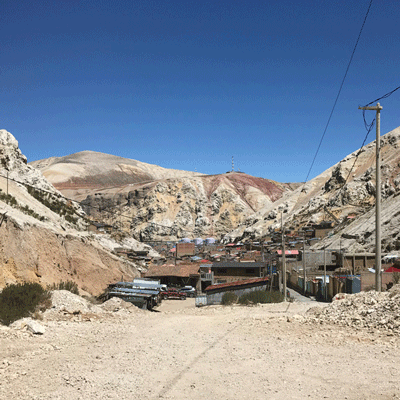
  Streets of Barranquilla.
Considered the safest city in Colombia, Barranquilla's quiet streets are not always safe.
Photo by Alexa Smith


      The Colombian Embassy in Washington says 322 foreigners, including 39 Americans, have been snatched in the past eight years. Sixteen foreigners have been murdered and three Americans are still known to be held. Embassy officials said they couldn’t say how many were ransomed or escaped.

      Arroyo says she will look at the job description Mejia is drafting and discuss it with him. If the PC(USA) does create such a position, it will have to be filled by a committed individual supported by a committed church.

       “This needs to be someone who has a call, who (is willing) to risk their life to do this,” she says, and the church must decide whether “we are willing to send people to risk their lives.”

      “If we want, as a church, to be incarnational, to be one body,” she says, “we have to respond.”

      Mejia understands that the PC(USA) must make a tough decision.

      “Its very hard not to have fear in a conflict like Colombia’s,” he says. “We who work in human rights, trying to support the victims of violence, we feel fear daily. But ... it pushes you out in faith, in contact with the God of life. ... Action is the way to overcome fear.”


PC(USA) Home (Link)
PC(USA) Search (link)

     
  subnavigation divider  
   
 
subnavigation divider


subnavigation divider


subnavigation divider


subnavigation divider


subnavigation divider
 
   
  subnavigation divider  
   
  subnavigation divider  
     
  GA216 - The 2004 Presbyterian General Assembly - News  
     
  Click here to download the news!  
     
  PC NEWS - PC(USA) - photo thoughts  


For more information contact the Presbyterian News Service - 100 Witherspoon Street - Louisville, KY - 40222 - Call (888) 728-7228 x5540 - Fax (502) 569-8073
 
     
  Link to Top of Page  
 
Contact PC(USA)
Copyright © 2001-2004 Presbyterian Church (USA). All Rights Reserved