PC NEWS - Presbyterian News Service
PC (USA) Seal PC(USA) Homepage


04336
July 28, 2004
 

Religious diversity is God’s plan, Cascades conferees told

Mutual respect is key to interfaith dialogue, says McCormick’s Campbell

by Jerry L. Van Marter


MCMINNVILLE, OR — Christians and people of other faiths are living more closely together today than ever before. This raises a critical question, says McCormick Theological Seminary President Cynthia Campbell: “How are going to negotiate this proximity?”

             There are three options, Campbell told more than 200 Presbyterians gathered for the 55th annual Cascades Presbytery Summer Conference on the campus of Linfield College here July 11-16. In a series of five lectures that will become a book sometime next year, Campbell posed the choices:

  • Conflict and competition — “We can wage a fight to the death among fundamentalisms.”
  • Resignation — “We can give up religion entirely as doing more harm than good.”
  • Mutual religious respect — “We can enter into the search for common ground by acknowledging all others as God’s beloved children.”

             Engaging her listeners in a Bible-page-turning frenzy, Campbell outlined two scriptural approaches to those she termed “the others.” For some, she said, “there is a scripture core — John 14:6, Acts 4:12, Phil. 2:10, Matt. 28:18 — that leads to the conclusion that Jesus is the only way to salvation, so others are excluded and/or condemned and our job is to convert them.” Campbell called this the “exclusivist” or “particularist” view.

             The “inclusivist” view, on the other hand, holds that “the fullness of God is revealed in Jesus Christ, but God’s love is extended to all whether they believe it or not.” Citing John 10:16, Col. 1:20 and Phil. 2 (“read eschatologically”), Campbell said, “We believe that it’s not our faith that saves us, but God’s grace, and God decides, not us.”

             In the struggle between those competing views, Campbell said, the fundamental question becomes: Is it possible to understand diversity of religions as part of God’s plan?

             Going back to the earliest Old Testament accounts, Campbell said, “The tradition is that God destroyed Babel for the sin of pride (in thinking they could become one with God by building a tower to heaven), so diversity is punishment and a sign of human sinfulness.”

             But recalling the covenant command to “be fruitful and multiply,” Campbell continued, “The problem was not the tower, but the people’s desire to settle down in one place….Their problem was their desire for uniformity. God is more broad-minded than the interpreters have let on….The Bible is never unclear that God is the creator of all, whether they know it or not. God is the God of all peoples and not knowing does not alter the fact.”

             Such a view gives fuller meaning to Pentecost, Campbell said. “Pentecost is better understood as a gift, the gift of multi-culturalism, the gift of communication across linguistic differences and different cultures.”

             Christians are far more threatened by religious diversity than by racial, cultural or linguistic diversity, Campbell said. “The Christian claim has always been that Jesus is the one way to salvation, the savior not just of Christians but of the world,” she said. But in the New Testament accounts of Jesus’ relationships with “the others,” Campbell insisted, “the others are consistently shown in a positive light, contrary to popular opinion, so what are the implications for us?”

             In Luke 4, she said, Jesus evokes Elijah and Elisha while teaching in the synagogue, pointing out that they were sent to Gentiles, not Jews. “They ran him out of town,” she said, because Jesus had the audacity to say that ‘the others’ are part of the promise.” In Matthew, the most Jewish of the gospels, the most stirring confession is spoken by a Roman centurion. “Jesus responds that many of ‘the others’ will come to the table,” Campbell said, “while insiders will be cast out.”

             Theologians have offered three approaches to the question of who will be saved, Campbell said:

  • Objectivist — “Salvation is God’s work, not ours; God’s act of redemption through Christ was present before creation, so Jesus is not ‘plan B’ because redemption was intended all along.”
  • Participationist — “We are justified by faith through grace, but our faith makes God’s grace effective in the world; we turn towards God’s grace through baptism, though faith itself is part of God’s grace.”
  • Subjectivist — “The effect of God’s grace, salvation, is available only to those who accept it; God is giving a choice and salvation is dependent on our response.”

             Campbell asserted that pure Calvinism argues for the objectivist position. “This answer embraces Calvin’s concept of ‘irresistable grace,’” she said, “which says that God is going to get us sooner or later — we only think we can say ‘no.’”

             The book of Acts “makes it clear that God is at work among all people,” Campbell said, “drawing them into a fuller understanding of the God they have known in other places and other ways.” The stories of Philip and the Ethiopian eunuch in chapter eight, Peter and Cornelius in chapter 10 and Paul in Athens in chapter 17 all point to an all-inclusive God, she said.

             When the Ethiopian eunuch asks what is to prevent him from being baptized, Philip “has to make a huge leap and is able because he sees the Holy Spirit in this man’s life,” Campbell said. Prior to his encounter with the Roman centurion Cornelius, Peter is instructed by the Spirit to eat “unclean” food and then is compelled to declare that “God shows no partiality” and that “all who love God and do what is right are acceptable.” And Paul’s encounter with the Athenians elucidates what has become Presbyterian missiology: “Rather than taking Christ ‘there’ he pointed out Christ’s presence already there.”

             “This doesn’t relativize truth,” Campbell said. “It relativizes responses to the truth….God is everywhere the creator and giver of life — to say otherwise is to put our limits on God’s activity.”

             The call to Christians living in a multi-faith world therefore, “is to look more deeply at our own faith, what it means to be a Christian and how to live it out,” Campbell said. “Openness to others can only happen when we’re clear about our own.”

            Christian practice begins with worship — “the community gathered to praise God and acknowledge and celebrate Jesus Christ” — and is then lived out in life in community, Campbell said, quoting Kathleen Norris: “As the faith cannot be practiced alone, I joined a church.”

             Campbell cited three “calls to relate to ‘the others’”:

  • “We are called to bear witness, to continue to nurture the vocabulary of our faith and to tell others what God in Jesus Christ has done for us and can do for all, pointing to the work of God that is operative everywhere and that pushes beyond boundaries to include ‘the other.’”
  • “We are called to work with others for justice, freedom and peace, with no qualifiers or foreclosures on others — as Christians we begin with the belief in the integrity and value of all human life.”
  • “We are called to engage in interreligious dialogue; we cannot escape it and we ignore it at our own peril. Religious people will either be the solution or the cause of the destruction of creation. We’ve got a choice.”

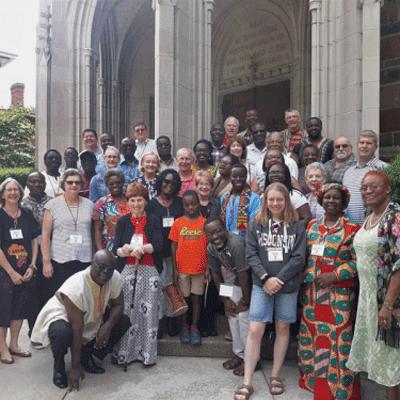
             The Cascades Presbytery Summer Conference — co-sponsored by the presbyteries of Olympia and Eastern Oregon and the Presbyterian Association of Musicians — provides an intergenerational time of rest and relaxation, continuing education for pastors and practical workshops for congregational leaders. This year’s theme was “A Wideness in God’s Mercy: Christian Faith in a Multi-Faith World.”


PC(USA) Home (Link)
PC(USA) Search (link)

     
  subnavigation divider  
   
 
subnavigation divider


subnavigation divider


subnavigation divider


subnavigation divider


subnavigation divider
 
   
  subnavigation divider  
   
  subnavigation divider  
     
  GA216 - The 2004 Presbyterian General Assembly - News  
     
  Click here to download the news!  
     
  PC NEWS - PC(USA) - photo thoughts  


For more information contact the Presbyterian News Service - 100 Witherspoon Street - Louisville, KY - 40222 - Call (888) 728-7228 x5540 - Fax (502) 569-8073
 
     
  Link to Top of Page  
 
Contact PC(USA)
Copyright © 2001-2004 Presbyterian Church (USA). All Rights Reserved