
|
05326
June 20, 2005
Loyal opposition?
80 unnamed PC(USA) congregations
join in 'New Wineskins' confederation
by Jerry L. Van Marter
EDINA, MN — About 80 dissident congregations of the Presbyterian Church (U.S.A.) have formally confederated as “New Wineskins.”
The “renewal” group has a constitution that includes doctrinal statements, a mission organization, a court system, and a governance model that lodges almost all power in local congregations.
New Wineskins leaders say the group is committed to “theological unity, missional faithfulness and structural effectiveness.”
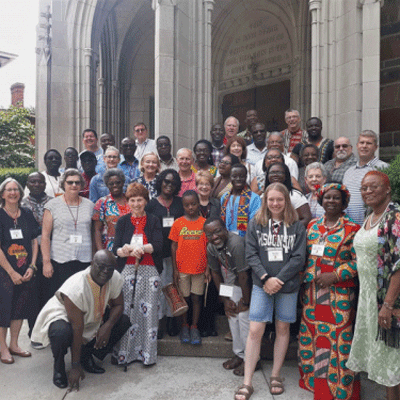
During a June 17-18 “delegates’ meeting” at the conclusion of a four-day convocation attended by more than 400 people, about 190 “voting delegates” approved the group’s constitution almost unanimously and elected a 13-member board of directors that eventually will grow to 15. The group has already incorporated as a not-for-profit organization.
While the directors’ names are known, the participating congregations have not been identified publicly.
“Some have been strongly discouraged from being here, so making their names public would not be politic,” explained the group’s moderator, the Rev. Dave Henderson, pastor of Covenant Presbyterian Church in West Lafayette, IN.
The Rev. Dean Weaver, the group’s vice moderator and pastor of Knox United Presbyterian Church in Kenmore, NY, said some supporters of New Wineskins are to be commissioners to next year’s General Assembly, “and that could be jeopardized if their names were made public.”
When the formal meeting began, most of the convocation participants traded their nametags for stickers identifying each as either a “voting delegate” or an “observer.”
“What has been implicit but which needs to be stated explicitly,” Henderson said, “is that endorsement of and involvement in the New Wineskins is in no way a sign of disloyalty to the PC(USA), nor is it any way a compromise of PC(USA) ordination vows.”
Henderson acknowledged that the group’s essential tenets (www.newwineconvo.com/tenetskin.doc) and ethical imperatives (www.newwineconvo.com/imperativeskin.doc) are “subscriptionist” — that is, endorsing congregations must agree to adhere to them or face disciplinary action by the group.
The New Wineskins constitution describes the PC(USA)’s confessions as “beneficial guides in our interpretation of the Bible.”
The constitution establishes three levels of “networks” above the congregation: Ministry Networks of three to eight congregations; Support Networks of from three to eight Ministry Networks; and a National Network. Every congregation must belong to at least one Ministry Network, and each Ministry Network must be part of a Support Network. These networks need not be geographic.
The constitution is silent on the networks’ relationship to PC(USA) governing bodies.
Each network will have its own court, called a Judicial Committee. The only committee mandated at the National Network level is the Judicial Committee.
Congregations will ordain elders and deacons and “certify” other congregational leaders. Support Networks will “guide, train, examine and certify/ordain pastors and lay pastors for congregations.”
The constitutional provision that provoked the most debate confers on sessions the authority to ratify constitutional amendments; in the PC(USA), that power is held by the presbyteries. Bob Howard, an elder from Wichita, KS, a former chair of the Presbyterian Lay Committee’s board of directors, said: “Sessions need to have control of the constitutional process” to address “the fundamental flaw in our current system.”
If New Wineskins has its way, congregations will be owners of the property they occupy. That runs directly counter to the PC(USA) constitution’s “trust clause,” which says that congregations hold property “in trust” for the denomination. Litigation over the trust clause is flaring up around the country. Howard predicted that it eventually will be overturned in civil court.
So the New Wineskins congregations are still in the PC(USA) … for now.
Henderson said reform of the PC(USA) is possible if the denomination will replace its constitution with the New Wineskins version, and abandon the trust clause. Such action, he said, would be "a miracle."
Another option, he said, is “restructure” — in which the denomination would give congregations the option of affiliating with New Wineskins or some other confederated model.
“The PC(USA) as we know it only dates back to 1983, and is for all intents and purposes gone already,” Henderson said, “so there could be two or three entities (within a broader denominational framework) created in its place.”
Another possibility, Henderson said, is some “precipitating event” that “would cause us to split off and become a whole new entity.”
He cited three possible examples:
- The removal of the General Assembly’s “authoritative interpretation/definitive guidance” of 1978, which forbids the ordination of “self-affirming, practicing homosexuals” as church officers;
- The removal of section G-6.0106b from the PC(USA)’s Book of Order. That’s the constitutional provision that requires church officers “to live either within the covenant of marriage between a man and a woman or chastity in singleness”;
- “Any weakening of our historic Reformed understanding of Christology.” Said Henderson: “If in the sexualization of the 2006 Assembly, something like this sneaks in the back door, that would be a precipitating event.”
Throughout the convocation, speaker after speaker characterized New Wineskins as a faithful remnant of a Presbyterian church that has gone astray.
The Rev. Doug Pratt, a New Wineskins founder who is pastor of First Presbyterian Church in Bonita Springs, FL, said his involvement in the group is evidence of “a profound loyalty” to the denomination.
“All people in all organizations have trouble reforming their own organizations, so real substantive movement for change must come from outside,” Pratt said. “I’m being profoundly loyal to the faith passed down to us by seeking to restore our church to Biblical faithfulness.
“Evangelicals have had a hard time agreeing on anything, except what we’re against,” Pratt said. “Finally, with New Wineskins, we have something to be for, embracing change while holding on to that which will never change.”
The New Wineskins directors (elders were identified only by state):
Elder Kevin Kauffman of Indiana, Elder Rod Olson of Oregon; Elder John van Geuderen of California; Elder Renee Guth of Arizona; Elder Peggy Hedden of Ohio; Henderson; Weaver; the Rev. John Crosby, pastor of Christ Presbyterian Church, Edina, MN (the church that hosted the convocation and delegates’ meeting); the Rev. Jerry Van Auken, pastor of First Presbyterian Church, Kokomo, IN ; the Rev. Ken Mulder, associate pastor of Sunset Presbyterian Church, Portland, OR; the Rev. Russ Wilkins, pastor of Trinity Presbyterian Church, Texarkana, TX; the Rev. Randy Jenkins, pastor of Central Presbyterian Church, Huntsville, AL; and the Rev. Kay George, associate pastor of Oreland (PA) Presbyterian Church. |