
PC NEWS - Presbyterian News Service
PC (USA) Seal PC(USA) Homepage


08066
January 28, 2008

Presbyterian Army chaplains defend former School of the Americas

They say arguments for closing controversial military institute a ‘house of cards’ that doesn’t stack up

by Evan Silverstein
Presbyterian News Service

Photo of Ridgway Hall
Ridgway Hall is home to the Western Hemisphere Institute for Security Cooperation, formerly known as the School of the Americas. (U.S. Army photo)

LOUISVILLE — Chaplain (Major) John W. Kiser starts each day at the U.S. Army’s Fort Benning by walking to work.

The 43-year-old former infantry officer turned Presbyterian minister departs his house on the grounds of the sprawling military base near Columbus, GA, at 6:30 a.m.

As a young Princeton seminarian in the 1990s, Kiser studied under Fr. Gustavo Gutiérrez, a founder of Latin American liberation theology. The Missouri native has served in combat operations in both Iraq wars and peacekeeping operations in Bosnia and Kosovo. He was awarded the Bronze Star medal for meritorious service for combat in Iraq.

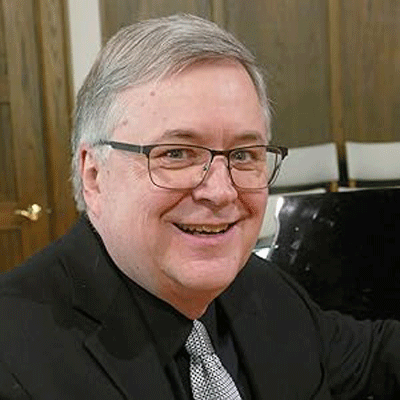
Photo of Chaplain (Major) John W. Kiser
Chaplain (Major) John W. Kiser

Kiser’s five-minute “commute-by-boot” to work takes him across Fort Benning’s Field of the Four Chaplains, past the infantry chapel where he has regular pastoral duties before ending up at a majestic Spanish-style building called Ridgway Hall.

The historic two-story structure with a terra-cotta roof is named for Gen. Matthew B. Ridgway, who became the Army’s Chief of Staff after leading U.S. forces in Normandy and United Nations troops in Korea.

Ridgway Hall is also a lightning rod for controversy since it is home to the Western Hemisphere Institute for Security Cooperation (WHINSEC).

The U.S. Department of Defense-operated facility, formerly known as the School of the Americas (SOA), is a Spanish-language training school for military and law enforcement officers and, in some cases, civilians, from Central and South America.
 
Kiser, who completed a course there last year, is now both the command chaplain and ethics instructor at WHINSEC. Class rolls include students from Bolivia, Brazil, Colombia, Costa Rica, Ecuador, Honduras, Mexico, Nicaragua, along with more than a dozen other countries in the Western Hemisphere, including Canada.

Each year thousands of pacifist protesters, Presbyterians among them, descend on the base to demonstrate against the school, which they blame for assassinations, torture and other human rights abuses in Latin America.

The campaign against the Fort Benning school began after the 1989 massacre of six Jesuit priests, their housekeeper and her teenage daughter in El Salvador.

A group calling itself the School of the Americas Watch, which claims some of those responsible for the massacre were trained at the school, organizes annual protests outside the gates of Fort Benning in an effort to shut down the controversial training program.

Two Presbyterians, one of them a pastor, were arrested after crossing onto the Army base during the most recent demonstration in November. Charged with trespass on a military reservation — a misdemeanor punishable by up to six months in prison and a $5,000 fine — they’re expected to go on trial Jan. 28.

Kiser, a member of Heartland Presbytery, disputes activists’ claims about the school and calls their accusations slanderous and absurd. He has been engaging church groups and visitors to the school in dialogue to dispel the myths that keep protesters coming back year after year.

“Here’s the problem that I see,” Kiser told the Presbyterian News Service, recently. “Bits and pieces of different things have been glued together and false conclusions drawn. It’s the old line that two-plus-two does not equal five.”

The Army chaplain is also troubled by action of the Presbyterian Church (U.S.A.) General Assembly regarding the institution.

The denomination’s 206th General Assembly in 1994 approved an overture calling for the school’s closure. The action was upheld a year later despite a move to overturn it by the Flint River Presbytery in Georgia, where Fort Benning is located.

“The basis of the charges against the school are simply not true,” Kiser said during a telephone interview. “It upsets me that people in the church actually believe there’s an Army school where U.S. personnel would teach torture to international students.”

Opponents argue the school should be closed down because many of its former students have committed human rights abuses in their home countries using techniques learned at the institution.

Kiser called that position a “house of cards” that doesn’t stack up.

He said no link has ever been established between training received at the school and subsequent human rights abuses by former students. He said former students who have committed human rights abuses are individually responsible for their actions.

“A school should not be held accountable for the moral failings of a few of its graduates,” Kiser said.

The Army has acknowledged that some students — fewer than 600, they say, out of more than 60,000 soldiers who have passed through the school in the last 60 years have been implicated in a crime. One hundred have been convicted of a criminal action within their home nations.

Kiser said the numbers make a case that the school has enjoyed a 99 percent success rate among its alumni.

“Fewer than one percent of the students that have attended the school have been convicted or even implicated in a crime.” Kiser said. “I think any kind of human endeavor that has that type of success rate, 99 percent, should be commended and not condemned.”

Photo of Chaplain (Colonel) James S. Boelens
Chaplain (Colonel) James S. Boelens

Army Chaplain (Colonel) James S. Boelens, who is also a Presbyterian minister, agrees that the Fort Benning training facility should not be judged based on a few extreme cases that are the result of individual criminal conduct.

He said doing so would be the same as suggesting that Harvard University be held accountable for the murderous acts of convicted Unabomber Theodore Kaczynski — the Harvard graduate who between 1978 and 1995 sent letter bombs that killed three people and injured 29.

“The inductive fallacy would be to say that everybody that graduates from Harvard is a criminal,” Boelens told the Presbyterian News Service. “It’s not logical to say that. I think you can apply that to what is happening in the arguments against WHINSEC. Individuals need to be accountable for their action. The good news is that WHINSEC, I think, stands alone as a model in providing guidance and instruction to military leaders on the importance of the rule of law.”            

Boelens, 53, is the son of a Presbyterian minister and serves as the command chaplain at the U.S. Army South in San Antonio, TX. He works with his staff to coordinate religious support for soldiers and Department of the Army civilians during missions in Latin America.

Those missions include disaster assistance programs, humanitarian assistance operations, peacekeeping exercises and working with militaries from other nations. This allows Boelens to view firsthand the “great positive impact” WHINSEC graduates have made in the Western Hemisphere, he said.  

“It’s absolutely critical to safeguard this institution that teaches democratic values and respect for human rights,” said Boelens, a member of Mission Presbytery and also a Princeton Seminary graduate. “I can’t think of any Presbyterian who would think that democratic values and respect for human rights is something we don’t want to underscore in the nations of Latin America. It is an institution the General Assembly should want to protect and keep open.”

Kiser and Boelens said the school provides education and training to people from Western Hemisphere nations within the context of democratic principles set forth in the Charter of the Organization of American States.

Kiser described WHINSEC as a topnotch institution exerting a positive influence throughout Latin America among military officers, noncommissioned officers and government civilians. He said the school has an open invitation to anyone who wants to sit in on classes and see what is taught there.

The chaplain said the school provides doctrinally sound, relevant military education and training, while promoting democratic values and respect for human rights and fostering cooperation among multinational military forces.

Kiser said WHINSEC also promotes the democratic values of freedom of religion and press, the subordination of the military to civilian rule, and has played an important role in the spread of democracy in Latin America.

“We never ever advocate any immoral unethical use of force,” Kiser said. “And from the people that I have met and worked with, from being a student here and also being an instructor here, I think everybody understands that the role of a soldier in society, in a democratically elected government, that we are subordinate to the civilian government. We do what they tell us to do within legal and moral boundaries.” 

The SOA, which was founded in 1946 in Panama, moved to Fort Benning in 1984. It was replaced in 2001 by WHINSEC, moving from U.S. Army sponsorship to the Defense Department.

SOA opponents contend the name change was only cosmetic, even though human rights courses are now mandatory at the school.

“I’ve heard people say, ‘Well they’ve cleaned up and they’ve changed but they haven’t changed enough,’” Kiser said. “And I’m like, ‘Well what specifically are you talking about?’ Because again it’s easy to level accusations but it’s not easy for them to come up with facts. That’s where I’m like, ‘Show me the facts. What are you specifically referring to?’”

Kiser said he sees the role of the chaplain as both “pastoral and prophetic” and emphasized that as a man of faith that he could never work within an apparatus that tolerates abuses of human rights.

He said the quest to change the views of opponents of the school has been difficult and personally painful.

He said people of faith from Roman Catholics to other Presbyterian ministers have questioned his faith and accused him of everything from brazen hypocrisy to spreading propaganda. 

“I think it’s just shocking,” Kiser said. “It is such a sensitive issue that one person would question another person’s commitment to Christ and allegiance as a minister to the church just by where they work. It’s just simply amazing to me.”

Opposition to the School of the Americas intensified after the Pentagon released manuals in 1996 that activists said substantiated their claims that techniques taught at the school included torture, assassination and extortion.

Not so, according to Fort Benning Public Affairs Officer Lee A. Rials, who said the school does not teach — nor has it ever taught — torture or interrogation.

Rials said an individual instructor, who mistakenly believed the manuals were consistent with U.S. and Department of Defense policy, brought four of the manuals to the SOA in 1989 when he was assigned there from Panama. The four volumes were part of a set of seven manuals, three of which never made it to the school.

Although these manuals may have been issued as supplemental reading material in a few courses at the school from 1989 through 1991, they were never used in the classroom, according to Rials.
He said the manuals themselves were neither created nor approved by the School of the Americas.

According to a 1991 U. S. Government review of the manuals, 26 sentences — the equivalent of one or two pages out of 1,100 from all seven manuals — contained inappropriate language that was leftover from 1960s sources prepared by other agencies, not the School of the Americas.

As a result of the internal review, the manuals were recalled, six separate investigations were conducted at the request of the Defense Department and Congress and corrective actions have been implemented to prevent a reoccurrence. Each of these investigations and reports has found the school to be in compliance with U. S. law and policy.

The government’s analysis of the manuals concluded that there were no indications or even suggestions that torture was acceptable. When torture is mentioned, it is to warn the reader not to use it under any circumstances. The manual titled “Interrogation” has an entire chapter devoted to the 1949 Geneva Conventions.

Rials said those who oppose the school have been party to a campaign of misinformation, and while assuming the best of intentions, have been ill informed. He suggested that opponents of the school thoroughly research the institution before jumping to any conclusions.

“I don’t doubt the sincerity or the faith of any of the people who oppose us,” Rials told the Presbyterian News Service. “But they are accepting information from people who don’t know what we do, and who perhaps have an agenda against what we do, instead of actually coming to see physically what goes on here.”

Kiser said like any institution, the school is not perfect but has learned from past mistakes. He said once mistakes are discovered, such as the incident with the manuals, they are immediately corrected.

Kiser said the school should not be closed as a symbol of past abuses, as some activists have suggested.

He said while opponents cling to old or unfounded allegations, WHINSEC has gone on to promote inter-American understanding and is uniquely tailor-made to equip military and civilian defense leaders in the Western Hemisphere to promote democratic values of human rights, freedom of religion and press and civilian control of the military.

If the school were closed, the U.S. would lose the potential to professionally train and influence armies in the Western Hemisphere with democratic values and respect for human rights, Kiser said. The vacuum might cause these nations to seek training from nations, such as Cuba and China, that place less value on human rights training.

Some opponents say WHINSEC should be closed because these foreign students could be trained just as well at other Army schools. Kiser counters by saying that only students fluent in English would be able to take part at other Army schools since WHINSEC is the only program that teaches its curriculum primarily in Spanish.

He said the opportunity to reach a cross-section of Latin American officers in their native language would then be lost.

“This is an incredible tool of U.S. foreign policy to be able to bring all these different countries together and train their military together,” Kiser said. “We’re all trained together and we do it in their native language, which increases the retainability of what is taught here.”

Kiser scoffed at notions that oversight of WHINSEC and its SOA predecessor has been weak. He said there is both civilian and military oversight of the institute at the highest levels of government. In 1996 the Army formed a Board of Visitors consisting of distinguished diplomats, retired general officers, civilian academicians and an international human rights attorney.

When WHINSEC replaced the SOA a new Board of Visitors was formed adding to the committee religious leaders and members of Congress, among others. The board, which is currently chaired by Roman Catholic Bishop Robert C. Morlino, reviews the school’s operations twice a year and reports to Congress annually.

Kiser said for years the school has been inspected, audited and reviewed by Army, defense, civilian and congressional agencies. Each time it has been found to be in compliance with U. S. Department of Defense and Army training policies and regulations, he said.

Kiser said the school is not lax in who it allows to attend, as some opponents claim. There is a multi-tiered process involving such entities as the Department of State, U.S. military and the embassy of a perspective student’s country of origin that determines which personnel attends.

“If there’s anything on their record or anything about their reputation that indicates that this is somebody that might create a problem down the road they don’t come to the school,” Kiser said.

He described the overwhelming majority of students and graduates who have come through the school over the years as outstanding individuals of high moral character and strong faith who care deeply about their nations’ futures.

The two Army chaplains said WHINSEC provides unique and irreplaceable human rights training for soldiers from throughout Latin America that equips students to take what they have learned and multiply it throughout their own Army.

WHINSEC is also needed to teach the importance of civilian rule to each generation of military leaders, Boelens said, adding that the concept of subordination of the military to civilian rule, fundamental to the U.S. experience, is a relatively new idea among many of America’s neighbors.

Kiser said the school with its international student body promotes understanding between military leaders of different countries throughout the Western Hemisphere.

He said the simple act of meeting counterparts from the armed forces of other nations that are facing many of the same problems is as important as reading and studying.

“It promotes sound hemispheric strategies and cooperation among militaries,” Kiser said.

Kiser said the school is needed to encourage continued democratic reform in Latin America. Democracies rarely wage war on one another, Kiser said, and they make more reliable partners. And democracies with the rule of law are more responsive to their own people and the protection of human rights.

“Our hemisphere needs the school’s continued emphasis on stable democracies and economic growth,” he said.

Boelens said WHINSEC is needed to equip Latin American military leaders to tackle the daunting problems threatening their nations, many of which face significant challenges such as corruption, terrorism, drug trafficking, violence, unstable economies, weak political and legal institutions, stifling bureaucracies and disillusionment with democratically elected governments that are not providing for basic needs.

Boelens said he’s not aware of another institution that can help military leaders address these critical problems as effectively as WHINSEC.

“WHINSEC provides a mechanism, I believe, for assisting our neighbors in creating lasting and positive changes by assisting them with a values-based and ethical military,” Boelens said. “Corruption will not change overnight but by teaching military leaders the importance of human rights, the importance of ethics, that is a major strategic purposeful positive impact that we can assist those neighbors with.”   

The chaplains said the cause of democracy, peace and freedom in the hemisphere would suffer a real blow if the school were dismantled. They said inter-American military ties would be weakened and the U. S. would lose the opportunity to influence future Latin American leaders.

U. S.-influenced human rights progress could be slowed or reversed and the concept of military subordination to civilian authority could be challenged.

Boelens said Presbyterians need to appreciate and defend this influence for democratic values.

“It’s absolutely critical to safeguard this institution that teaches democratic values and respect for human rights,” he said. “I can’t think of any Presbyterian who would think that democratic values and respect for human rights is something we don’t want to underscore in the nations of Latin America.”

Boelens said positive-strides made in economic and democratic reforms in Latin America in recent years is very encouraging. He said graduates of WHINSEC continue to play a positive roll in this trend toward democracy and human rights and thus the school should be appreciated and supported.

But Kiser warned that as long as the democratic nations of the Western Hemisphere face common threats — threats from those who disdain peaceful resolution of disputes — there will be a need for defense establishments and an important role for the school.

“In a perfect world I wish that we could lay down our arms,” Kiser said. “My personal theological position is that until Jesus returns unfortunately we’re going to have to have soldiers who understand that we need to protect innocent life with the ethical restrained use of force.”
 
             
PC(USA) Home (Link)
     
  subnavigation divider  


  subnavigation divider  
   
  subnavigation divider  
   
  subnavigation divider  
     
  PC News - feature button  


  Link to Top of Page  
 
Contact PC(USA)