PC NEWS - Presbyterian News Service
PC (USA) Seal PC(USA) Homepage


08527
July 23, 2008

‘A little picture of heaven’

Immigrants’ dreams and visions forge a new multicultural church

by Emily Enders Odom
Associate, Mission Communications
Presbyterian Church (USA)

Marietta, GA — The seeds of Christian faith sown in Korea by Presbyterian missionaries over 120 years ago have borne new fruit in this Atlanta suburb.

Rev. Byeong-Ho Choi and the Rev. Carrie Benz Scott
The  Rev. Byeong-Ho Choi and the Rev. Carrie Benz Scott co-officiate at a joint celebration of Communion. Photo courtesy of Ray-Thomas Memorial Presbyterian Church

The voices of the  Rev. Byeong-Ho Choi’s ancestors — who came to embrace Christianity through the gentle yet powerful witness of missionaries Dr. Horace Allen, the Rev. Horace Underwood and others, in the late 1800s — compelled him to propose a series of bold initiatives to the Presbyterian Church that had nurtured and shaped generations of his family. 

“Because I am here in America, and America is multicultural,” said Choi, who came to the United States in 1986, “I wanted my children to know the experience of a multicultural church in the Presbyterian Church (USA).”

Born, raised, and educated in Korea, Choi enrolled for one year to study English at the University of Washington after first moving to the U.S. He then entered San Francisco Theological Seminary to earn his M.Div. degree, and later completed a Th.M. in cross cultural education at Princeton Theological Seminary. 

Pastors praying together during joint service
The Revs Byeong-Ho Choi (left) and Carrie Benz Scott (center) and Teo da Silva, lay pastor of the Brazilian congregation, pray together at a joint worship service of the three congregations. Photo courtesy of Ray-Thomas Memorial Presbyterian Church

After a brief tenure as an associate pastor in Tacoma, WA, Choi received a call to serve as pastor of the Korean Church of Lehigh Valley in Whitehall, PA, where, under his leadership, the small-town church of 70 Korean-speaking members grew into a thriving, English-speaking, multicultural ministry of 350, built a new sanctuary and education building, and paid off all its debts. 

Toward the end of his seventh year, Choi prayed that if his ministry there were completed, God would show him where he would next serve.

His prayer was answered in 2002 with a call to the Bethany Korean Presbyterian Church in Marietta, GA. Under Choi’s leadership, the congregation of 100 exploded in several years to over 700 members, quickly outgrowing its modest facility. 

Because Bethany then faced the prospect of relocating — and along with that, the dilemma of where and whether to build a new church — Choi prayed to God for insight. “I’m a debtor to the PC(USA) and a product of the PC(USA),” he began, asking God for direction. “120 years ago, the Presbyterian Church helped my family. It is now time for me to take care of my mother church.”

In 2004, Choi approached the Rev. Jim Choomack, then executive presbyter of Cherokee Presbytery, with the plan that God had laid upon his heart to “help his mother church.” 

Choomack, who shared Choi’s dream of building multicultural ministries, immediately thought of the Ray-Thomas Memorial Presbyterian Church, one of the presbytery’s 41 congregations, which felt called to immigrant ministry. 

Two years earlier, Choomack had successfully recommended that a new Brazilian fellowship be nested there, knowing that the congregation had spent months in prayerful discernment and was actively seeking a way to reach out to immigrants.

Following their encounter, Choomack encouraged the Rev. Carrie Benz Scott, pastor of the Ray-Thomas church, to begin a discussion with Choi. As a new church development, the Ray-Thomas Memorial Church had built a sanctuary with a seating capacity of up to 600 people.

“The Ray-Thomas Memorial Church had way too much facility for its congregation,” Choomack said, “and the Bethany church too little facility for its large and growing congregation.” 

Benz Scott, who had already been nurturing and realizing multicultural dreams of her own throughout her nearly thirty years in ministry, welcomed the conversation with Choi.

She recalled first having felt the need to reach out during the years when she served as part-time associate for Evangelism and Church Growth for the Synod of the Northeast from 1985–1989. “I was struggling with a call to be a neighbor,” Benz Scott said, “to reach out to the strangers in our midst.” 

The Rev. Byeong-Ho Choi and the Rev. Carrie Benz Scott signing covenant
The Rev. Byeong-Ho Choi and the Rev. Carrie Benz Scott sign the covenant creating their shared multi-ethnic ministry. Photo courtesy of Ray-Thomas Memorial Presbyterian Church

Later, upon accepting the call in 1989 to serve the Ray-Thomas church, she could already begin to envision a future in which a multicultural ministry might be possible.

During Benz Scott’s initial years at Ray-Thomas, the church had grown its Anglo population by 70%.  Some years into her ministry, upon remembering what she had learned about evangelism, church growth, and multiethnic ministries, Benz Scott invited the congregation after to enter a period of discernment about the church’s call to “be neighbor.” 

“I knew that we needed to do a new thing,” she said. “Following the homogeneity rule may be a good recipe for church growth — building a church like what people want — but it didn’t feel like it was faithful to the gospel. We were following all the church growth principles, but it struck me that we weren’t doing all that God has called us to do in terms of who ‘neighbor’ is. Neighbor doesn’t just mean those who look like us.”

Because Marietta has long been home to a large and thriving Brazilian immigrant community, the opportunity for Ray-Thomas to “be neighbor” began to be realized almost immediately with the arrival of the nested Brazilian fellowship recommended by Choomack. After two years of getting to know each other, singing together, eating together and discovering their commonality despite differences in language and culture, 55 members of the Brazilian fellowship joined the Ray-Thomas church in January 2004. 

Soon thereafter, the first Brazilian elders were elected to serve on the church’s session, including Teo da Silva, the Brazilian fellowship’s lay pastor.

So when Benz Scott was approached by Choi some six months later with a proposal to relocate Bethany Korean to the Ray-Thomas facility toward a dream of moving both churches toward a shared multiethnic ministry, she was completely open. 

Choi remembered telling Benz Scott, “I have financial resources and your church has financial problems. Please open your facility for us to move in.” Benz Scott agreed.

The road toward the congregations’ eventual partnership was not, however, as easy as that initial conversation. After Bethany Korean gave up its building to a Kenyan congregation and moved in with Ray-Thomas, conflict and tensions arose in both churches. 

“It has not been easy,” said Choi. “When I first suggested this approach, some in the congregation were against me. That’s why God is crying continually. That’s why we have to succeed, because it is God’s will.”  

After nearly a year, during which a number of families left both churches, the united Anglo-Brazilian congregation and the Korean community signed a covenant with the presbytery to form a “parish,” in which they would share facilities, maintain pastors and programs separately, and agree to periodic joint worship, education, and outreach programs.

Benz Scott was especially vocal about the latter. “It’s important to us at Ray-Thomas to do things together,” she said, “to look for these intentional opportunities to be a community as much as possible. That is where friendships are built.” Earlier this summer, for example, a team of 20 Caucasians, 20 Brazilians, and 20 Korean-Americans built a Habitat house together.

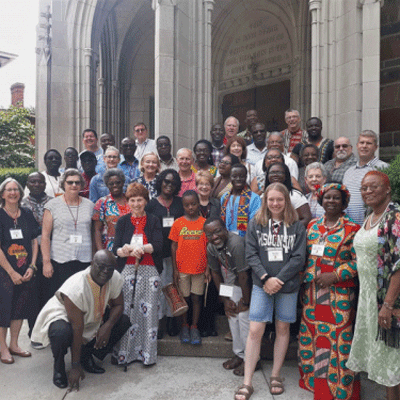
Within the Ray-Thomas facility, services of worship are now offered in three different languages — sometimes all at once — and the possibility of launching a new Hispanic/Latino ministry is currently being explored. 

To that end, Alcenir Oliveira, a native of Brazil and a recent graduate of the Interdenominational Theological Center/Johnson C. Smith Theological Seminary in Atlanta, joined the Ray-Thomas leadership team. “I think that the multicultural church is something that can become a reality,” he said.

Choir from the Anglo, Korean and Brazilian congregations singing
Singers from the Anglo, Korean and Brazilian congregations join in a “multicultural musical.” Photo courtesy of Ray-Thomas Memorial Presbyterian Church

Oliveira, who came to the U.S. in 1997, spoke of the significance of the multicultural church model to the immigrant community, especially to the second and third generations. “This model is very important for the immigrant community,” he said, “because they feel Americans are more willing to get together with them and that the church is starting to become more flexible.”

The Rev. Raafat Girgis, associate for multicultural ministries for the General Assembly Council (GAC), has provided Ray-Thomas with great encouragement throughout its discernment process, while Julia Thorne, manager for Immigration Issues in the Office of the General Assembly (OGA), has offered the congregation critical resources and support throughout its journey toward creating a new, multiethnic ministry. 

In her work to help congregations and presbyteries articulate and embody a theology of immigration, Thorne affirms Oliveira’s assessment of the immigrant experience. “The New Testament vision of community isn’t welcoming someone to your home and your land,” she said. “It is about becoming a new community together.” 

For second generation Korean-American, Jonathan Choi, a nineteen-year old student at Presbyterian College and Byeong-Ho Choi’s son, the multicultural community is the only one that accurately and powerfully reflects the reality of both his world and his faith. 

“I think it’s the greatest thing,” Choi said following his first joint worship experience at Ray-Thomas, in which hymns were sung in three different languages. “It’s a little picture of what heaven might be like, to be honest.”

Benz Scott’s own twenty-two year old daughter, Sara, who served as the student intern chaplain for the Presbyterian Student Fellowship at Vanderbilt this past year, had a similar response.  Both young adults embraced the multicultural worship as a vision of God’s Kingdom. 

After having participated in one of the newly covenanted congregation’s first joint services, Sara Scott said, “To be surrounded by three languages all singing to the glory of God is the most overwhelmingly moving worship experience I’d ever experienced.” 
 
As the PC(USA) strives to “Grow Christ’s Church Deep and Wide,” a churchwide initiative adopted by the 218th General Assembly, which calls all Presbyterians to work collaboratively to grow the church in membership, discipleship and diversity, the covenant relationship between the Ray-Thomas and Bethany Korean congregations emerges as a new and unique model toward the realization of just such growth. 

“At first, we grew a church numerically using the ‘homogeneity’ model,” Benz Scott said. “And while we aren’t growing Anglos numerically at this time in the life of the church, we are indeed all growing in discipleship and depth of faith because of what God is calling us to do. The ministry is not yet numerically and financially successful at this point, but I believe it is faithful.”

Welcome sign in Portuguese, English and Korean
A welcome sign - in three languages, Portuguese, English, and Korean. Photo by Marcia Myers.

Today, only five years after Ray-Thomas first began its discernment process, the covenanted congregations have generated and now claim a total of ten inquirers or candidates for the ordained ministry, including Koreans, Brazilians, and Caucasians. The churches are also in the process of uniting their children’s and sports ministries and enlarging their multiethnic music ministry.

“We knew we’d begun a journey that would be blessed if we let God teach us the universal language of love,” said Benz Scott.  “All kinds of amazing things are now possible.”

Choomack, who following his retirement from Cherokee Presbytery now serves as pastor of the Greene County Presbyterian Parish in Northeast Georgia Presbytery, recalled his former colleagues and their journey together with great passion and affection. 

“God will always lead the Church into new, sometimes dangerous, and almost always surprising new ways of doing ministry,” he said. “As the ministry grows, we become less and less ‘owners’ and ‘preservers,’ and more believers who are simply humble sinners saved by grace, and mindful of it every day, as we watch God at work, and as we partner ourselves with God.”

             
PC(USA) Home (Link)
     
  subnavigation divider  


  subnavigation divider  
   
  subnavigation divider  
   
  subnavigation divider  
     
  PC News - feature button  


  Link to Top of Page  
 
Contact PC(USA)