PC NEWS - Presbyterian News Service
PC (USA) Seal PC(USA) Homepage


08827
November 7, 2008

Emulate God, not Pharaoh, Covenant Network told

Acceptance of injustice breaks covenant with God, Stacy Johnson says

by Jerry L. Van Marter
Presbyterian News Service

MINNEAPOLIS — As citizens and Christians, Presbyterians have become so accustomed to injustice in the church and the world that their covenant with God is broken, renowned theologian William Stacy Johnson told the Covenant Network of Presbyterians as it kicked off its 11th annual conference here.

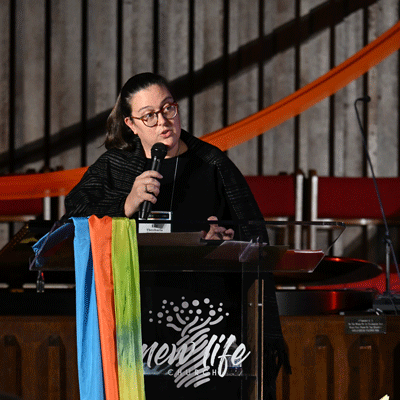
William Stacy Johnson speaking from a pulpit.
William Stacy Johnson

“We Christians, especially Presbyterians, are a covenant people and we gather here as a Covenant Network, seeking a church as welcoming as God’s grace, open to all without distinctions,” Johnson — a professor of systematic theology at Princeton Theological Seminary — told the group, which since 1997 has worked for the full inclusion of gay, lesbian, bisexual and transgendered members in the life of the Presbyterian Church (U.S.A.), including as ordained officers.

“But we have to acknowledge that our house is still broken, even in the midst of this historic week in our national life,” he said, speaking to a crowd of 400 gathered at historic Westminster Presbyterian Church here.

Johnson, who gleefully admitted to having worked on Barack Obama’s successful presidential campaign, reminded the crowd of Jesus’ “inaugural address” — bringing good news to the poor, sight to the blind, freedom to the captives, release to the captives.

Ticking off the list of political, and moral, challenges facing Obama and the nation — wars in Iraq and Afghanistan, global famine and hunger, the still devastated Gulf Coast four years after Hurricane Katrina, the global financial meltdown, to name a few — Johnson said, “The list of things that need fixing is so long, we’ve gotten used to it. We’ve become accustomed to injustice, so much so that we get along really well with those who perpetuate it, reaching compromises that give the powers of injustice what they want.”

For instance, “leaders of both political parties gave Bush authority to pursue this foolish, absurd war so they wouldn’t be perceived as soft on terrorism in future campaigns,” he said. “And how else can we explain why everyone went along with deregulation of financial markets, which  privatized profits and socialized losses.”

And perhaps most egregiously, he continued, “How do we explain that as a people we have pretty much looked the other way while our government began to torture people in our name. As congregations we go nuts over sexuality, whipping ourselves into a frenzy, while shrugging our shoulders at torture.”

Likening the situation to his daughter’s reaction at seeing the family home they were vacating packed up and ready for the moving vans — “Our house is broke!” she wailed — Johnson said, “Our house is broke, and only God can fix it.”

The key to repair is found in the Exodus story, he said. “God didn’t tell Moses to go cut a deal with Pharaoh,” Johnson said. “The people’s cry came to God and God heard it and remembered the covenant with Abraham. God took cognizance of their plight because God heard their cries and remembered the covenant God had made with Abraham.”

Of course, Pharaoh’s response was exactly the opposite. “He oppressed the Israelites even further, instructing them to make bricks without straw,” Johnson said.

The biblical mandate is clear, he added: “Emulate God, not Pharaoh.”

This is the God, Johnson continued, who said in Lev. 26:12, “I will walk among you and will be your God and you shall be my people.” “To think about God walking among us is an astonishing commitment, he said, “to think about God — not aloof, or disconnected or dispassionate — but who comes into our presence by the Spirit’s power.”

And so God’s covenant is “played out in the unfolding of a drama,” Johnson said, “a divine and human drama of God FOR us, Christ WITH us, and the Spirit AMONG us. This is not a story we’re telling about God — this is God’s own story and God has a stake in the story and how it unfolds.”

God has decided to work through us to make the covenant real, he said. “This puts a huge responsibility on us,” Johnson said. “Of course, we know salvation comes through grace, not works.

“But God then gives us a mighty work to do,” he said, “and if we don’t do it this hurts God. It is not just the voice of the poor and outcast, but the voice of God saying, ‘My house is broke.’”

All sides in church debates have misused scripture, Johnson asserted, rendering the Bible static by using it to prove their arguments “as if it’s an abstract object of investigation rather than a testimony to a dynamic God…”

The Bible story, he said, “invites us to envision a different sort of church and different sort of world than we see around us. Unless the church  has a dynamic understanding of the Bible and devotes itself to re-imagining what God FOR us, Jesus WITH us and the Spirit AMONG us means for that story today, we’re going to be stuck in a world none of us wants.”

Covenant theology makes “an audacious claim,” Johnson said: “God has determined not to be God without us. Christ is with us and we know God is with us because we know God was with Jesus. God is not just for us but with us — not just sentiment but solidarity.”

             
PC(USA) Home (Link)
     
  subnavigation divider  


  subnavigation divider  
   
  subnavigation divider  
   
  subnavigation divider  


  Deep and Wide stories  


Contact PC(USA)