|
09495
June 15, 2009
Looking for Jesus on the streets
Peacemakers take an “Urban Plunge” into the contrasts and contradictions of downtown Atlanta
by Eva Stimson
Special to Presbyterian News Service

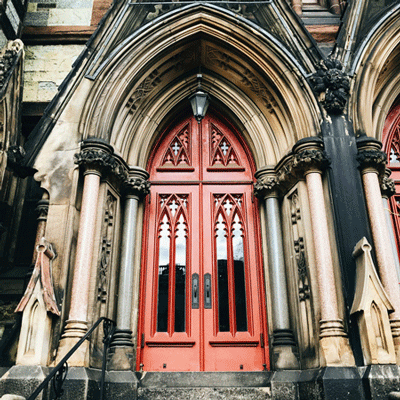
Plunge participants outside Atlanta’s Central Presbyterian Church.
ATLANTA — A homeless man sleeps in a doorway. Trash litters the sidewalk. This is just one short block from Peachtree Street, with its prosperous businesses and gleaming high-rise hotels.
Inside a dim, warehouse-like shelter run by the Metro Atlanta Task Force for the Homeless, other men sit in rows of chairs, listening to the blare of music and enjoying a few hours of respite from the hot sun.
These sights greeted 20-some participants in a Saturday-morning (June 13) “Urban Plunge,” offered as part of the 2009 Presbyterian Peacemaking Conference, which explored various ministries in downtown Atlanta.

A soup kitchen operated by Central Presbyterian Church and the Shrine of the Immaculate Conception serves a hot meal to several hundred homeless people.
The peacemaking gathering was one of 10 conferences that met jointly at the Hyatt-Regency Hotel here as part of the Presbyterian Church (U.S.A.)’s first-ever Big Tent event.
“If Jesus were walking the streets of Atlanta, where would he be hanging out?” asked one of the conference leaders, the Rev. Jeff Peterson-Davis, pastor of Pioneer Memorial Presbyterian Church in Solon, OH, as the group began its walking tour. “Would Jesus be in the boardroom in the Georgia Pacific building, or would he be a street preacher in Woodruff Park?
“We want to see what it might be like to be homeless right outside the Hyatt, to be someone who doesn’t know where their next meal is coming from,” Peterson-Davis said.
He introduced Prince Davis-Venn, tour guide for the Urban Plunge. Davis-Venn is a veteran leader of programs of outreach to the city’s homeless at Clifton Sanctuary Ministries and at North Avenue Presbyterian Church. A native of the African country of Sierra Leone, he has lived in the United States for 30 years.
Atlanta’s homeless population is estimated at between 6,000 and10,000, Davis-Venn said. With the recent economic downturn “the face of homelessness has changed,” he observed. Among the homeless people he works with are doctors, private contractors, real-estate agents — “folks from all walks of life.”

Prince Davis-Venn (right) leads 20-some people on a walking tour of urban ministries in Atlanta.
Homeless people are often told to “get a job,” said Davis-Venn. But that’s not easy to do if you have no address or phone number, no clothes for interviews and no computer skills to apply online. His Clifton ministry helps with all of these things.
Some walkers wrinkled their noses at the stench of human waste behind St. Luke’s Episcopal Church, which operates one of the city’s best-known homeless ministries.
“Think about it,” said Peterson-Davis. “If you’re homeless, where do you go to the bathroom?”
Homeless people are barred from hotels and a nearby hospital. Even the public library now requires anyone entering to show an ID card and leave their bags or parcels outside.
Atlanta has passed ordinances making it illegal to ask for money and to sleep on the streets, Peterson-Davis continued. The city has put armrests in the center of park benches to keep homeless people from lying on them. The Downtown Merchants Association hires uniformed “Goodwill Ambassadors” to assist tourists and shoo away bothersome vagrants.
“How are we called to minister in a place such as this?” Peterson-Davis asked.

The possessions of a homeless person outside St. Luke’s Episcopal Church, one of Atlanta’s oldest homeless shelters.
Photos by Eva Stimson
The final stop on the Urban Plunge was Central Presbyterian Church, across the street from the state capitol building, with its gold-plated dome visible from blocks away. Central has a joint homeless ministry with its next-door neighbor, the Shrine of the Immaculate Conception — the oldest Catholic community in Atlanta.
The two churches serve several hundred people in their soup kitchen. A night shelter open in the winter months serves about 100 people.
Central’s Outreach Center helps homeless people get photo IDs, birth certificates, food stamps and driver’s licenses. What began years ago as an emergency food give-away, operated out of the pastor’s office, has grown into a comprehensive ministry of both advocacy and response to immediate needs.
Church members “wanted to minister to their neighborhood,” explained Alicia Wilson, a student at Columbia Theological Seminary in nearby Decatur who volunteers at Central. “It’s a way to be a presence in the community.”
In addition to the Urban Plunge, several other groups from the peacemaking conference went on field trips to learn about the work of the Carter Center, and to explore nonviolence and efforts to combat racism at the Martin Luther King Jr. Center. Others stayed at the hotel to attend informational sessions about interfaith dialogue, empowerment of women and ministry with international students.
Eva Stimson is editor of Presbyterians Today magazine.
|