PC NEWS - Presbyterian News Service
PC (USA) Seal PC(USA) Homepage


Bookmark and Share

09511
June 18, 2009

Spinning the multicultural church web

Celebrating diversity and confessing stereotyping is key, Jin Kim says

by Sandy Sweep
Special to Presbyterian News Service
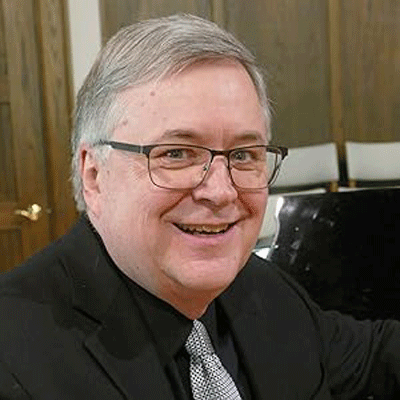
Photo of the Rev. Jin S. Kim
The Rev. Jin S. Kim, is pastor of the Church of All Nations, a multicultural congregation in Minneapolis. Photo courtesy of Church of All Nations.

ATLANTA — In his opening dialogue at the Multicultural Church Conference here June 12, the Rev. Jin S. Kim, pastor at Church of All Nations in Minneapolis, admitted he is a racist.

And he expects everyone in his congregation to do the same.

“While there has always been evil among humans, the introduction of racism has heightened oppression among mankind the last 500 years,” said Kim, in an address entitled “Becoming a Multicultural Church: Biblical Foundations for a Beloved Community,”
 .
Kim’s admission came as part of the at the denomination’s June 11-13 Big Tent event, a collection of 10 Presbyterian Church (U.S.A.) conferences meeting together with joint worship, shared meals and a plethora or workshops that were open to all.

Throughout recent history, explained Kim, groups of people have faced oppression by others seeking dominance. This oppression, said Kim, is made easier when “the targeted group is made out to be less than human.”

Kim cited historical references such as the 1758 study by Swedish botanist Carolus Linaeus, who named humans, homo sapiens, and then created four subcatergories:

  • Red Americans (americanus) — ill tempered
  • Yellow Asians (asiaticus) — severe and haughty
  • Black Africans (afer) — crafty and slow
  • White Europeans (eurapaeus) — active and very smart

This mindset, stated Kim, is in direct violation of God’s word that “God created humankind in  his image … male and female … God saw everything he had made, and indeed, it was very good.” (Genesis 1:27-31).

Kim added that it is only by admitting these false inequities among humankind that healing can occur. The members of his congregation, however, are “only going to be willing to risk as much as the pastor,” declared Kim. This, he says, is the basis for his racist admission.

So, how does Kim address the race issue where his congregation consists of 37 percent Caucasian, 3 percent Asian, 22 percent African American, and 10 percent Latino, and where more than 25 different nationalities worship each week?

“We build trust,” Kim simply stated. “A person may have faith that their brothers and sisters in Christ are sincere, but would they trust them with their children and money?” he asked.

To build this trust among church members, one sermon each month consists of several members sharing their faith stories. Following the service, there is a laying on of hands by the entire congregation. “In this way, our individual faith stories (and the racial and cultural influences) are shared and joined together in a kind of spiritual spider web,” said Kim.

Another part of this sharing is the celebration of diversity. “Getting past our racial differences doesn’t mean denying our culture or heritage,” explained Kim. “If anyone attends three or more times at our church, they will see their own heritage come through in the service.”

“We work more on character development than on (worship) techniques,” Kim said.

Sandy Sweep is a free-lance communicator and school board member in Eagan, Minn.

             
PC(USA) Home (Link)
     
  subnavigation divider  


  subnavigation divider  
   
  subnavigation divider  
   
  subnavigation divider  


  News from the Big Tent - Atlanta 2009  
     
  Deep and Wide stories  


Contact PC(USA)