
|
09541
June 26, 2009
What time is it?
Regain sense of urgency in responding to God, McNeil urges
by Erin S. Cox-Holmes
Special to the Presbyterian News Service
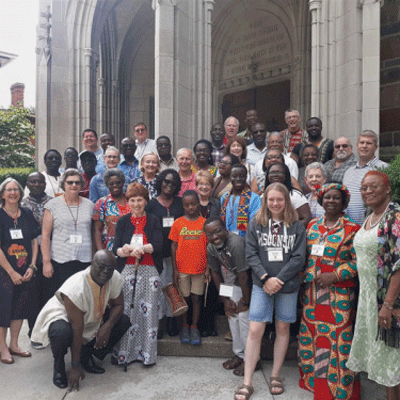
ATLANTA — “Now what? When we go home from this conference, what comes next?” asked the Rev. Brenda Salter McNeil of participants in the National Multicultural Conference, part of the first-ever Big Tent event here June 11-13.
“If I preach my guts out,” said McNeil, president and founder of Salter McNeil & Associates, a Christian company that partners with organizations to transform them into reconciling communities, “it’s for change. I’m a change agent for the Kingdom of God. But when we go home, we can’t pull it off by ourselves.”
We need the power of the Holy Spirit, McNeil said, exhorting the crowd repeatedly: “That’s a good place to say ‘Amen,’ brothers and sisters!”
Along with spiritual help, we need concrete tools, she continued.
“We have to take books, and turn them into resources for change. There shouldn’t be any books that don’t have a Leader Guide,” she said.
In addition, pastors need coaching in how to lead congregations through multicultural change —a tricky and complex task, McNeil said. “This is no longer the day of the superstar. This is the day of alliances and collaborations to advance the Kingdom of God.”
She is working with a group called VIBE Alliance — Victory in Breaking Ethnocentrism — to help congregations cross social, racial, and ethnic boundaries. “When the Holy Spirit is working,” she insisted, “Then there’s no confusion when we’re all together. We experience the reality of a Pentecost church.”
The task is urgent. Back in her college days, McNeil and her friends used to dance to a song by the rock band Chicago with the lyrics: “Does anyone know what time it is? Does anybody care?”
Jesus, said McNeil, asked just that question when he made his triumphal entry into Jerusalem.
“You would think that after that kind of ‘praise and worship party,’ that Jesus should be elated,” she said. “But instead we find a forlorn lover. We find Jesus sobbing uncontrollably over Jerusalem. What is really true about them is breaking his heart. He is weeping because his people can’t tell time.”
It would be understandable for people today to feel like this is an extreme reaction on Jesus’ part. That’s because our language has limits in talking about time. In Greek, McNeil pointed out, there are two words for time.
“Chronos is the first word that communicates time. When we ask what time it is, we are mostly asking about chronological time. But the word in the text is kairos. This word means the right time. The set time. The opportune time. Ready-or-not-here-I-come-time. A God-owned time.”
Kairos time is difficult to put into English. The best analogy, McNeil said, is that it’s like “pregnant time.”
“When it’s time, a pregnant woman doesn’t want to wake her husband only to have him say ‘It’s 3:45 a.m.’ What does she want him to say?”
The crowd enthusiastically provided the answer: “It’s time!”
“I sense that we are in a burgeoning pregnancy time,” McNeil said.
“Here in the United States, the church is stuck,” she continued, “but all over the world there’s this fire raging. It’s not happening in the way people thought. It’s happening in Africa and underground churches in Asia.”
The residents of Jerusalem missed their kairos time, and we are in danger of missing ours, McNeil warned. There are three reason people miss the time:
- Jesus may not be who we want for our Messiah. “We all still have our hoops that we want Jesus to jump through.”
- Jesus doesn’t act the way they wanted him to. “Jesus was always pushing the envelope. When you get to the place that you don’t like things changed, then Jesus is not your guy. Jesus is a change agent.”
- We’re scared. “We are scared of this crazy lover, who will change our church, our structure, shake up our lives.”
“The truth is there are great consequences for missing kairos time. We can miss chronological time and life goes on,” she said. “But if we miss kairos time, that’s consequential. kairos moments only come once in a lifetime. And missing it is generational. It’s not just about us. It’s about the generations that follow us. That’s why Jesus was weeping.”
In this pregnant multicultural moment, McNeil said, we need to know what time it is, and we all need to care.
Erin Cox-Holmes is associate general presbyter for Kiskiminetas Presbytery and a frequent contributor to Presbyterian News Service.
|