
Please give to the Native American Church Property Fund
The 223rd General Assembly (2018) directed the Presbyterian Foundation to create an ongoing fund for urgent and immediate repairs and improvements at Native American churches and chapel. We appreciate your generosity.
Make a gift to this initiative
In Racial Equity & Women’s Intercultural Ministries, we engage the Church in its mission to become more diverse and inclusive of racial, ethnic, cultural and language groups, and we equip women for leadership in all ministries of the Church. We are blessed to see a vision of Pentecost every day. There are Presbyterian Mission Agency offices supporting African American, Asian, Hispanic/Latino-a, Korean, Middle Eastern, Native American and African Intercultural ministries. The people of color and new immigrant worshiping communities that we support regularly gather together, constructing a people of color identity that stems from a common history, heritage and language. We work closely with people of color and new immigrant worshiping communities through mid councils, caucus groups, and networks, engaging in the mission to grow, transform, empower, lead and develop communities. We create an awareness of institutional racism in the church and an environment where people of color, new immigrants, and women can serve fully in ministry and leadership.
In our ministries, we work to achieve gender and racial justice and equip people of color and young adults for leadership. We assist college-age and young women of color in their faith journeys and foster networks of support for them.
As we discover how to share the gospel in an increasingly diverse culture, we have a greater chance of living out the Biblical vision of a world where the humanity of everyone is valued and where God’s love is spread to every race, class, culture and people.
Reflections for the New Year from our Intercultural Staff
“Hope in the Lord”
When you read this, the new year must be upon us. As we all enter 2023, I do so with a profound sense of hope even as I am cognizant of the struggles and burdens of 2022. For many of us, myself included, I do not have the energy to embrace 2023 with any sense of confidence. I am entering the new year exhausted and worn out but with a feeling of hopeful anticipation. Probably that is the way you all feel, too.
The ancient words from the prophet Isaiah come to us fresh for 2023. The CEB translation puts it this way, “But those who hope in the Lord shall renew their strength.” (40:31) While the NRSV translation puts it the following way, “But those who wait for the Lord shall renew their strength.” I have decided to go into 2023 with the theme of ‘Hope in the Lord’ derived from my understanding of the two translations. They will serve as the theme of the year to guide me through 2023.
May I take this opportunity to invite our congregations to embrace this as a guiding theme for our year together. May it be our guiding light and word as we enter 2023. Hope in the Lord. Wait for the Lord.
The two translations use the word hope and wait interchangeably which makes sense if you think about it. Experience teaches us that waiting for the Lord increases our ability to hope in the Lord. In his letter to the church in Rome, the apostle Paul says that “For in hope we are saved. Now hope that is seen is not hope. For who hopes for what is seen? But if we hope for what we do not see, we wait for it with patience. Romans 8: 24 – 25 (NRSV). Waiting and hoping go hand in hand. I believe that it is in our waiting that hope is born. Most of us hope in many things but I invite you to join me as we hope in the Lord more intentionally in 2023. What are your hopes? What or who do you have your hopes in? Write them down and trust God with them.
As a community, may we be known as those whose hope is in the Lord, and our strength are renewed. As the Lord leads us, we will fly up with wings like the eagle, we will run and not be tired. As the Lord re-imagines and renews us, then, we will walk and not be weary. This is our commitment. So be it.
– Rev. Princeton Abaraoha, Field Staff African Intercultural Ministries
“A Beautiful Tapestry”
I have the privilege to go around, like a free bird, to see God in action. I can see that God really is the sustainer and upholder of the world.
I could see a new worship community where the pastor and his wife, get in their cars, early on Sunday morning, and drive to the refugees’ houses to bring them to the church for worship. After worship, the pastor takes his portion of the worshipers, as well as his wife, to drop them off at their homes again. In between, I can see the smiles on the faces of those who had to start their lives and practice their faith again in a new place and new culture. During worship, I engage with them in real singing, and as the pastor shares the word of God, I can see its effect in their facial expressions. After worship, they put the food, which they brought from their homes, together and eat their meals with gladness and singleness of heart. I think, “Where did I hear that before? Is it the book of Acts?”
I could see images and colors woven together in a beautiful story, skillfully woven, in a beautiful tapestry.
These people entered God’s story with their own story, and they can see that God really is the sustainer and upholder of the world.
– Rev. Magdy Girgis, Associate for Middle Eastern Intercultural congregational support
“Embracing Kairos”
I pray for the grace and peace of the Lord as we begin another year of 2023.
During the last 3 years of COVID-19 pandemic, humanity has had unprecedented experiences. We had to adapt to a new way of life that we were not used to at all, along with the pain of having to leave our loved ones and friends unexpectedly and other various kinds of pain in life. Through this time, however, we have reaffirmed a very important wisdom: that we, particularly Christians, must live a life of Kairos, not Chronos. God’s time, not our time. The quality of life is much more valuable than the quantity of life.
I pray that the coming year 2023 will be a blessed time for us to live the life of Kairos according to the will of God.
I wish the Lord’s blessings and grace to the families of my beloved colleagues and the flocks that you serve.
– Rev. Moongil Cho, Associate for Korean Congregational Support
Native American Church Properties Inventory and Fund
The 223rd General Assembly (2018) directed the Presbyterian Mission Agency to work with mid councils to facilitate an assembly-wide inventory documenting the physical needs of Native American churches and chapels. The action taken also directed the Presbyterian Foundation to create an ongoing fund for urgent and immediate repairs and improvements.
Wonder Woman: Real or Myth?
Proverbs 31 | March 3, 2024
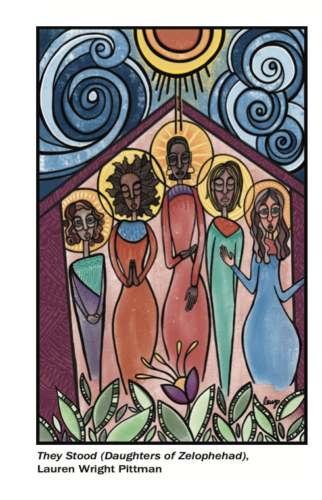
This year, Celebrate the Gifts of Women reflects on the Proverb 31 Woman. Rev.Dr. Anita Wright explores the text asking the question Wonder Woman reality or myth? We are encouraged to name the unnamed women, lift up their voices and contributions to the church and beyond. Professor Wil Gafney describes this woman as more than a housewife on steroids, but insteads lifts up her entrepreneurial spirit, her generosity and her craftswoman. The Proverbs 31 woman is a god-fearing, attentive, considerate and resourceful. We get the opportunity to explore the text in a way that lifts up attributes that not only benefit women but the entire kin-dom.
Though Celebrate the Gifts of Women Sunday is March 3, 2024, congregations or women’s groups may use the resource on any day chosen to honor women’s survival during challenging circumstances.
2024 Celebrate the Gifts of Women (Spanish)
2024 Celebrate the Gifts of Women (Korean)
2024 Women of Faith Awards
Do you know of a woman who’s doing an out-standing job of leading a movement for positive change across our denomination?
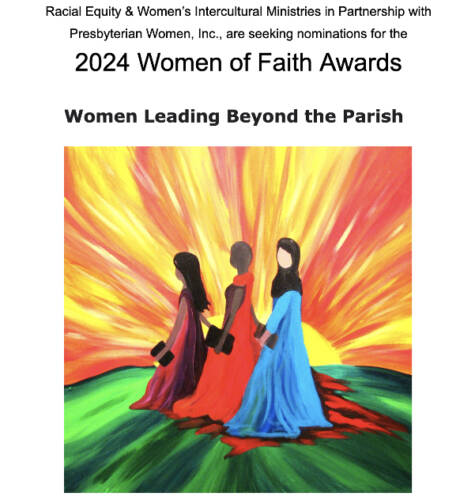
Nominate her for the Women of Faith Awards by February 14th
We are seeking women who are effective advocates for social justice in areas such as race and gender, climate change, community organizing, environmental justice and so much more.
Ways to obtain a nomination form:
Access it from here: Women Of Faith
Retrieve it from here: www.pcusa.org/women
Request it from janelle.baker@pcusa.org
Award recipients will be notified one month prior to the award ceremony. The Women of Faith Awards Committee strives for geographical, racial and cultural diversity.
Read the Racial Equity Torch
 In the current issue of the Racial Equity Torch, we lift up the work that Racial Equity & Women’s Intercultural Ministries, and the Presbyterian Church (U.S.A.) as a whole and the individual Presbyterians who have addressed social reform issues throughout time.