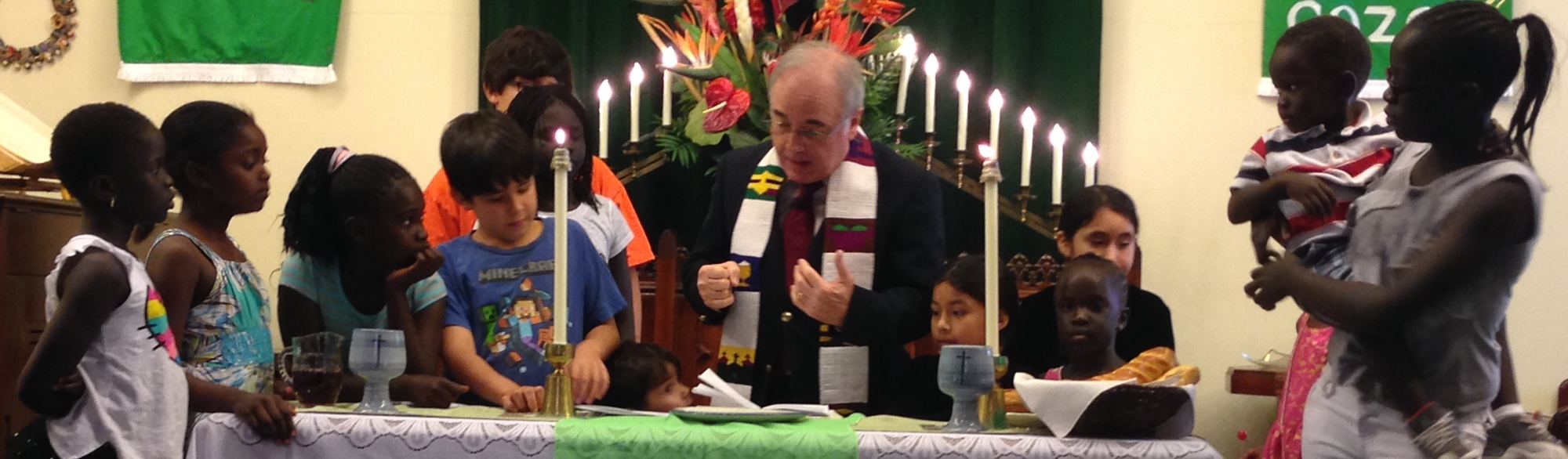
The early Church, following Jesus, took three primary material elements of life — water, bread, and wine — to become basic symbols of offering life to God as Jesus had offered his life. Being washed with the water of Baptism, Christians received new life in Christ and presented their bodies to be living sacrifices to God. Eating bread and drinking wine they received the sustaining presence of Christ, remembered God’s covenant promise, and pledged their obedience anew.
The Reformed tradition understands Baptism and the Lord’s Supper to be Sacraments, instituted by God and commended by Christ. Sacraments are signs of the real presence and power of Christ in the Church, symbols of God’s action. Through the Sacraments, God seals believers in redemption, renews their identity as the people of God, and marks them for service. (Directory for Worship, W-1.3033)
Baptism is the sign and seal of incorporation into Christ. Jesus through his own baptism identified himself with sinners in order to fulfill all righteousness. Jesus in his own baptism was attested Son by the Father and was anointed with the Holy Spirit to undertake the way of the servant manifested in his sufferings, death, and resurrection. Jesus the risen Lord assured his followers of his continuing presence and power and commissioned them “Go therefore and make disciples of all nations, baptizing them in the name of the Father and of the Son and of the Holy Spirit, and teaching them to obey everything that I have commanded you. And remember, I am with you always to the end of the age” (Matt. 28:19, NRSV).
The disciples were empowered by the outpouring of the Spirit to undertake a life of service and to be an inclusive worshiping community, sharing life in which love, justice, and mercy abounded. (Directory for Worship, W-2.3001)
Baptism is rich with multiple meanings which overlap like beautiful water lilies on a pond.
Help people make the connection with baptism in all of life and ministry.
Explore These Living Waters, the Reformed / Catholic agreement on baptism and resources for its study
Find liturgical ideas from the French baptismal liturgy.
Baptism in the Directory for Worship | (W-2.3001 – 2.3010)
Baptism is the sign and seal of incorporation into Christ. Jesus through his own baptism identified himself with sinners in order to fulfill all righteousness. Jesus in his own baptism was attested Son by the Father and was anointed with the Holy Spirit to undertake the way of the servant manifested in his sufferings, death, and resurrection. Jesus the risen Lord assured his followers of his continuing presence and power and commissioned them “Go therefore and make disciples of all nations, baptizing them in the name of the Father and of the Son and of the Holy Spirit, and teaching them to obey everything that I have commanded you. And remember, I am with you always to the end of the age” (Matt. 28:19, NRSV). The disciples were empowered by the outpouring of the Spirit to undertake a life of service and to be an inclusive worshiping community, sharing life in which love, justice, and mercy abounded.
In Baptism, we participate in Jesus’ death and resurrection. In Baptism, we die to what separates us from God and are raised to newness of life in Christ. Baptism points us back to the grace of God expressed in Jesus Christ, who died for us and who was raised for us. Baptism points us forward to that same Christ who will fulfill God’s purpose in God’s promised future.
In Baptism, the Holy Spirit binds the Church in covenant to its Creator and Lord. The water of Baptism symbolizes the waters of Creation, of the Flood, and of the Exodus from Egypt. Thus, the water of Baptism links us to the goodness of God’s creation and to the grace of God’s covenants with Noah and Israel. Prophets of Israel, amidst the failure of their own generation to honor God’s covenant, called for justice to roll down like waters and righteousness like an everflowing stream. (Amos 5:24) They envisioned a fresh expression of God’s grace and of creation’s goodness—a new covenant accompanied by the sprinkling of cleansing water. In his ministry, Jesus offered the gift of living water. So, Baptism is the sign and seal of God’s grace and covenant in Christ.
As circumcision was the sign and symbol of inclusion in God’s grace and covenant with Israel, so Baptism is the sign and symbol of inclusion in God’s grace and covenant with the Church. As an identifying mark, Baptism signifies
- the faithfulness of God,
- the washing away of sin,
- rebirth,
- putting on the fresh garment of Christ,
- being sealed by God’s Spirit,
- adoption into the covenant family of the Church,
- resurrection and illumination in Christ.
The body of Christ is one, and Baptism is the bond of unity in Christ. As they are united with Christ through faith, Baptism unites the people of God with each other and with the church of every time and place. Barriers of race, gender, status, and age are to be transcended. Barriers of nationality, history, and practice are to be overcome.
Baptism enacts and seals what the Word proclaims: God’s redeeming grace offered to all people. Baptism is God’s gift of grace and also God’s summons to respond to that grace. Baptism calls to repentance, to faithfulness, and to discipleship. Baptism gives the church its identity and commissions the church for ministry to the world.
God’s faithfulness signified in Baptism is constant and sure, even when human faithfulness to God is not. Baptism is received only once. The efficacy of Baptism is not tied to the moment when it is administered, for Baptism signifies the beginning of life in Christ, not its completion. God’s grace works steadily, calling to repentance and newness of life. God’s faithfulness needs no renewal. Human faithfulness to God needs repeated renewal. Baptism calls for decision at every subsequent stage of life’s way, both for those whose Baptism attends their profession of faith and for those who are nurtured from childhood within the family of faith.
- Both believers and their children are included in God’s covenant love. Children of believers are to be baptized without undue delay, but without undue haste. Baptism, whether administered to those who profess their faith or to those presented for Baptism as children, is one and the same Sacrament.
- The Baptism of children witnesses to the truth that God’s love claims people before they are able to respond in faith.
- The Baptism of those who enter the covenant upon their own profession of faith witnesses to the truth that God’s gift of grace calls for fulfillment in a response of faithfulness.
Baptism is received only once. There are many times in worship, however, when believers acknowledge the grace of God continually at work. As they participate in the celebration of another’s Baptism, as they experience the sustaining nurture of the Lord’s Supper, and as they reaffirm the commitments made at Baptism, they confess their ongoing need of God’s grace and pledge anew their obedience to God’s covenant in Christ. (Directory for Worship, W-2.3009)
As there is one body, there is one Baptism. (Eph. 4:4-6) The Presbyterian Church (U.S.A.) recognizes all Baptisms with water in the name of the Father, of the Son, and of the Holy Spirit administered by other Christian churches. (Directory for Worship, W-2.3001 – 2.3010)

The Rev. Theresa Cho presides at the Lord’s Supper. Photo courtesy of St. John’s Presbyterian Church.
The Lord’s Supper is the sign and seal of eating and drinking in communion with the crucified and risen Lord. During his earthly ministry Jesus shared meals with his followers as a sign of community and acceptance and as an occasion for his own ministry. He celebrated Israel’s feasts of covenant commemoration.
In his last meal before his death, Jesus took and shared with his disciples the bread and wine, speaking of them as his body and blood, signs of the new covenant. He commended breaking bread and sharing a cup to remember and proclaim his death.
On the day of his resurrection, the risen Jesus made himself known to his followers in the breaking of bread. He continued to show himself to believers, by blessing and breaking bread, by preparing, serving, and sharing common meals. (Directory for Worship, W-2.4001)
Find resources for exploring and celebrating weekly Eucharist.
Download new eucharistic prayers (Great Thanksgivings) for general use, lectionary dates, and other occasions.
Celebrate the Lord’s Supper each week in the Season of Easter.
Learn about the Extended Serving of Communion, a way to expand the eucharistic ministry of your congregation, engage homebound members in the worship of the church, and cultivate the spiritual gifts of elders and deacons.
Allergies or food restrictions mean we who share the one loaf need to consider serving gluten-free vegan communion bread.
Read “This Bread of Life,” the Catholic / Reformed dialogue on the Eucharist or Lord’s Supper.
Discover the fourfold pattern of eucharistic action in the New Testament—taking, blessing, breaking, and giving—through this study guide.
Download
Memorize the basic shape of the communion liturgy so that you can eucharisté any time in conversation with the Word preached.
Download
The Lord’s Supper in the Directory for Worship | (W-2.4001 – 2.4007)
The Lord’s Supper is the sign and seal of eating and drinking in communion with the crucified and risen Lord. During his earthly ministry Jesus shared meals with his followers as a sign of community and acceptance and as an occasion for his own ministry. He celebrated Israel’s feasts of covenant commemoration.
In his last meal before his death, Jesus took and shared with his disciples the bread and wine, speaking of them as his body and blood, signs of the new covenant. He commended breaking bread and sharing a cup to remember and proclaim his death.
On the day of his resurrection, the risen Jesus made himself known to his followers in the breaking of bread. He continued to show himself to believers, by blessing and breaking bread, by preparing, serving, and sharing common meals.
The Church in the New Testament devoted itself to the apostles’ teaching, to fellowship, to prayers, and to the common meal. The apostle Paul delivered to the Church the tradition he had received from the risen Lord, who commanded that his followers share the bread and cup as a remembrance and a showing forth of his death until he comes. The New Testament describes the meal as a participation in Christ and with one another in the expectation of the Kingdom and as a foretaste of the messianic banquet.
In the Lord’s Supper the Church, gathered for worship,
- blesses God for all that God has done through creation, redemption, and sanctification;
- gives thanks that God is working in the world and in the Church in spite of human sin;
- gratefully anticipates the fulfillment of the Kingdom Christ proclaimed, and offers itself in obedient service to God’s reign.
At the Lord’s Table, the Church is
- renewed and empowered by the memory of Christ’s life, death, resurrection, and promise to return;
- sustained by Christ’s pledge of undying love and continuing presence with God’s people;
- sealed in God’s covenant of grace through partaking of Christ’s self-offering.
In remembering, believers receive and trust the love of Christ present to them and to the world; they manifest the reality of the covenant of grace in reconciling and being reconciled; and they proclaim the power of Christ’s reign for the renewal of the world in justice and in peace.
As the people of God bless and thank God the Father and remember Jesus Christ the Son, they call upon the Holy Spirit
- to lift them into Christ’s presence;
- to accept their offering of bread and wine;
- to make breaking bread and sharing the cup a participation in the body and blood of Christ;
- to bind them with Christ and with one another;
- to unite them in communion with all the faithful in heaven and on earth;
- to nourish them with Christ’s body and blood that they may mature into the fullness of Christ;
- to keep them faithful as Christ’s body, representing Christ and doing God’s work in the world.
Around the Table of the Lord, God’s people are in communion with Christ and with all who belong to Christ. Reconciliation with Christ compels reconciliation with one another. All the baptized faithful are to be welcomed to the Table, and none shall be excluded because of race, sex, age, economic status, social class, handicapping condition, difference of culture or language, or any barrier created by human injustice. Coming to the Lord’s Table the faithful are actively to seek reconciliation in every instance of conflict or division between them and their neighbors. Each time they gather at the Table the believing community
- are united with the Church in every place, and the whole Church is present;
- join with all the faithful in heaven and on earth in offering thanksgiving to the triune God;
- renew the vows taken at Baptism; and they commit themselves afresh to love and serve God, one another, and their neighbors in the world.
In this meal the Church celebrates the joyful feast of the people of God, and anticipates the great banquet and marriage supper of the Lamb. Brought by the Holy Spirit into Christ’s presence, the Church eagerly expects and prays for the day when Christ shall come in glory and God be all in all. Nourished by this hope, the Church rises from the Table and is sent by the power of the Holy Spirit to participate in God’s mission to the world, to proclaim the gospel, to exercise compassion, to work for justice and peace until Christ’s Kingdom shall come at last. (Directory for Worship, W-2.4001 – 2.4007)
“It is appropriate to celebrate the Lord’s Supper as often as each Lord’s Day. It is to be celebrated regularly and frequently enough to be recognized as integral to the Service for the Lord’s Day.” – Presbyterian Church (U.S.A.) Book of Order, W-2.4009

The recovery of the fullness of the Service for the Lord’s Day – including Word and Sacrament – is one of the most important and exciting liturgical projects of our time. This website provides resources for congregations committed to celebrating – or interested in exploring – weekly Eucharist. Whether your congregation already celebrates weekly Eucharist or is just beginning to consider the idea, check out these materials to support and enliven Sunday worship.
Teaching resources
Learn about Invitation to Christ: Font and Table, the 2006 sacrament study of the Presbyterian Church (U.S.A.), which encourages congregations to explore more frequent celebrations of the Lord’s Supper.
Study “This Bread of Life,” the Catholic / Reformed dialogue on the Eucharist or Lord’s Supper.
Read “The Feast of Easter,” Jonathan Carroll’s article in Call to Worship about celebrating weekly Eucharst in the Season of Easter.
Read about John Calvin’s attempt to establish the Lord’s Supper each Lord’s Day in Geneva.
Discover the fourfold pattern of eucharistic action in the New Testament—taking, blessing, breaking, and giving—through this study guide.
Won’t weekly Eucharist make our worship services longer? Not necessarily.
Liturgical resources
Download new eucharistic prayers for general use, lectionary dates, and other occasions.
Season of Advent
Year A
Year B
Year C
Lent
Year A
Year B
Year C
Easter
Year A
Year B
Year C
Celebrate the Lord’s Supper each week in the Season of Easter 2015 (Year B). Learn more and find resources.
Learn about the Extended Serving of Communion, a way to expand the eucharistic ministry of your congregation, engage homebound members in the worship of the church, and cultivate the spiritual gifts of elders and deacons.
Explore Common Ministry, Shared Celebration, an initiative to encourage more frequent communion at the Presbytery level.
Musical resources
Download musical responses for the Great Thanksgiving (Sanctus and Benedictus, Memorial Acclamation, and Great Amen) set to familiar hymn tunes for Advent (Picardy, Veni Emmanuel), Christmas (Mendelssohn), Lent (Redhead 76), Easter (Easter Hymn), and Ordinary Time or general use (Dix).
Share your story
“I am very fortunate to belong to a congregation that has celebrated weekly and monthly communion for ten years. The first service, a contemporary service of worship, celebrates weekly communion in a unique style around the table. The second service, a traditional service, celebrates communion monthly. My church loves both, expects both and cherishes both. To each service we extend Christ’s invitation for all people to join at his table. It is a joy.” Marty Shelton-Jenck, pastor, Community of Grace Presbyterian Church in Sandy, Utah
“We are easing people into the idea of weekly communion. We began this process by celebrating communion through all of Eastertide of last year. We will celebrate communion all of Advent this year.” Dave Lewis, pastor, United Presbyterian Church of Shawnee, Oklahoma
“We are celebrating Eucharist more often, and I hope within a couple of years or maybe three that we will be at the weekly stage — ideas on how to make that happen would be most helpful.” Pat Berger, pastor, Covenant Presbyterian Church, Gresham, Oregon
Share your congregation’s story