People Investing in People
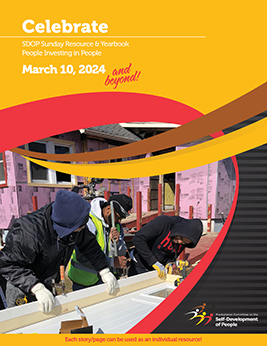 SDOP Sunday resource 2024:
Download
SDOP Sunday Resource & Yearbook Survey
Survey
Click Here
“Self-Development of People (SDOP) enters into partnerships with community groups of low-income people that want to change their lives and communities. We receive and review grant applications year round. Apply now!
Presbyterian Committee on the Self-Development of People is a ministry that affirms God’s concern for humankind. We are Presbyterians and ecumenical partners dissatisfied with poverty and oppression, united in faith and action through sharing, confronting, and enabling by participating in the empowerment of economically poor, oppressed, and disadvantaged people, seeking to change the structures that perpetuate poverty, oppression and injustice.
SDOP Core Strategies:
- Promote Justice
- Build stronger communities
- Seek economic equity
Past grants funded by SDOP
If you’d like to see the types of projects we fund, you can find descriptions here.
Coordinator’s Message from the 2024 SDOP Focus newsletter
Read stories about our work and our partners
Farmers “Hatching-Out” from “Incubator”
 By George O’Neill, Chair, Self-Development Of People Committee for the Presbytery of the Northern Plains
The Presbytery of the Northern Plains has awarded a Self-Development of

Moveable Greenhouse New Roots Incubator
People (SDOP) grant in our region for the first time since 2016. The recipient is the New Roots Farm Incubator Cooperative which provides training in farming techniques to immigrant and other disadvantaged farmers. After graduating from the incubator (a process called “Hatching-
Out”) farmers have the opportunity to lease or buy a plot of land on which to farm. The land is owned by PRAIRIE (Prairie Rose Agricultural Institute for Research, Innovation, & Education), a non-profit organization located in Felton, Minnesota. The SDOP-funded program, which we have called the “Hatching-out Fund,” will provide graduating farmers with funds to lease a plot of land as well as cover the cost of other needs in order to begin farming. The total fund is $5,000, which will support at least six farmers who are currently nearing graduation from the incubator.
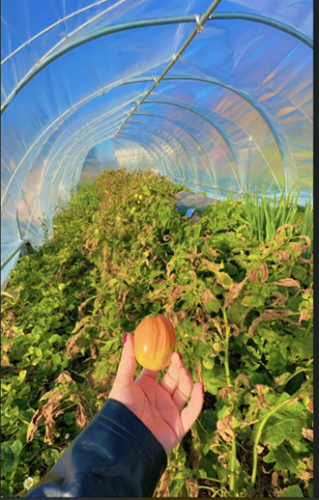
African Eggplant New Roots Incubator
Your Presbytery SDOP committee is delighted to have formed this partnership with the New Roots Farm Incubator Cooperative. As a reminder, the mission of SDOP is to provide grants to low income or marginalized groups to improve their self-sufficiency.
Members of SDOP for the Presbytery of the Northern Plains: George O’Neill (Chair), Jihan Brifki, Paul Zondo, Nichole Boyer, Anne Roberts, JoAnn Zuts, Pastor Robert Drake.
For more information on becoming a certified committee and the certification process email Margaret Mwale or visit https://www.presbyterianmission.org/ministries/sdop/for-synods-and-presbyteries/
Read more stories

Alonzo Johnson
Coordinator for Self-Development of People
Phone: (502) 569-5780
Fax: (502) 569-8001
Email
Alonzo provides direction, coordination, strategic and theological vision to the Presbyterian Committee on the Self-Development of People ministry and its commitments to social, racial, and economic justice. He serves as the key liaison between the National Committee on Self-Development of People and the Presbyterian Mission Agency. He promotes and interprets the ministry of SDOP to congregations, mid councils, ecumenical and community partners.

Margaret Mwale
Associate for Community Development and Constituent Relations
Phone: (502) 569-5792
Fax: (502) 569-8001
Email Margaret
Margaret coordinates and interprets the SDOP ministry to Mid-Council Committees, congregations and potential community partners to facilitate partnership development. She reviews and authorizes payments of funding decisions from Mid-Council Committees. She advises Mid-Councils on certification applications and process. She develops, coordinates and facilitates educational and training workshops for National, Synod and Presbytery SDOP Committees and community groups of economically poor and disadvantaged people. She provides staff support to Community Relations and Church-wide Relations Standing Committees. Lead continuing education events/training for National Committee.
Clara Nunez
Associate for Program
Phone: (502) 569-5781
Fax: (502) 569-8001
Email Clara
Clara manages and coordinates the day to day work of SDOP and the National Committee. She implements the program policies, and facilitates the grant process of establishing domestic partnerships. She interprets the ministry of the Self-Development of People to potential partners, congregations, committee members and community partners. She develops direction and content for the SDOP website and other social media.
Teresa Bidart
Bilingual/Meeting planner
 Phone: (502) 569-5790
Fax: (502) 569-8001
Email Teresa
Teresa facilitates the work of the International Task Force (e.g. maintains database of all applicant groups received outside of the United States and processes and distributes minutes from Task Force meetings); translates correspondence from Spanish to English and vice versa; sets up arrangements for task force, steering committee and other called meetings and informs members of such.
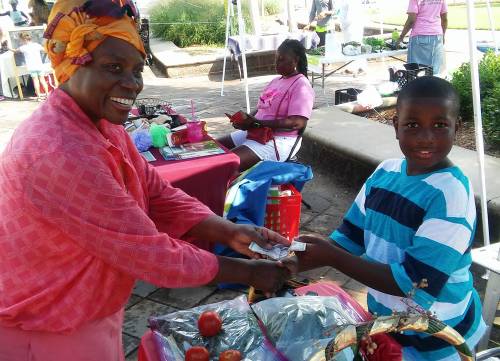 Free community workshops year-round
- Workshops held in different cities.
- SDOP partners with other organizations to host events/community workshops. Interested in partnering with us? Contact us!
Check back at this website for community workshops and other event updates.
Community Workshops – Grants
- Oppressed by poverty and social systems
- Working on projects to address community issues
- Looking for long-term improvements to lives and communities
- Group members must initiate, directly benefit from and control the project
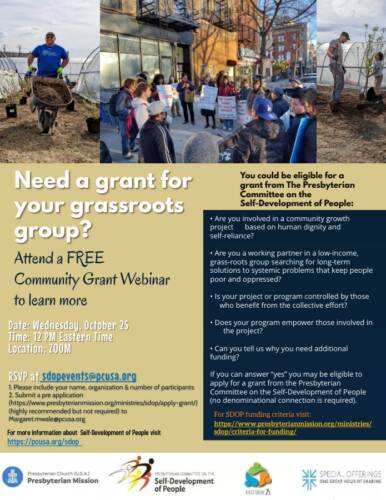 Grants for Grassroots Groups are available!
Presbyterian Committee on the Self-Development of People Attend a FREE Community Grant Webinar to learn more.
Date: Wednesday, October 25
Time: 12 PM Eastern Time
Register: Please indicate your name, organization & number of people in your party – send information to sdopevents@pcusa.org.
The Struggle is Real: Part of a webinar series featuring a dialogue & listening forum with church and community leaders on the intersection of urban poverty and lack of affordable housing/homelessness.
- Urban poverty and how it intersects with varied social and economic justice issues including a lack of affordable housing/homelessness and how churches can take intentional action to step outside their walls to form relationships and live out loving their neighbors.
- Best practices about relationship building and developing partnerships with those that are unhoused/homeless.
- Presence and activism, exploring & learning ways to take concrete actions to eradicate urban poverty and the issues of lack of affordable housing/homelessness.
Description: The workshop will feature a discussion by church and community leaders on the intersection of urban poverty and lack of affordable housing/homelessness and how the church can understand ways to listen, engage and form relationships with these communities.
Date of Event: 11/9/2023, 2-3:30 PM Eastern Time
For more information email sdop@pcusa.org. Registration details and additional information will be available on the Self-Development of People website in the fall.
Journey to Justice SDOP 50th Anniversary Webinar Series
The second webinar in the series remind us of how SDOP was founded. The webinars will challenge us to go beyond charity and take a more holistic view of poverty, equipping teams to create real and lasting change.
Hear from leaders in the PC (USA) and in community development as you or your team are guided through core principles that go beyond charity and build relationships.
How Far We Have Come: Conversations Around the Black Manifesto!
Postponed to later date to be announced.
In 1969, James Forman an American Civil Rights leader active in the Student Nonviolent Coordinating Committee and representing the National Black Economic Development Conference presented the Black Manifesto, a document that caused controversy for a variety of churches. Forman’s call for economic equity, access and reparations although despised by many created substantive conversations about economic equity and its intersections with race and class in the United States. Invited to the General Assembly of the Presbyterian Church (then United Presbyterian Church) in 1969, Forman’s reading of the Black Manifesto made many uncomfortable, but for some of its Presbyterian hearers, these concerns about racism, lack of economic access and poverty would influence the creation of the Presbyterian Committee on the Self Development of People.
To register email sdopevents@pcusa.org.
SDOP glossary of terms
SDOP Glossary of Terms (Spanish)
What is the theological basis for the Self-Development of People ministry?
We believe all people have been created in God’s image. This biblical truth leads to the theological conclusion that God has endowed people with the freedom to become who they were created to be. The human condition may subvert that intent, but Christ liberates us to fulfill God’s intent. The Self-Development ministry helps people to move toward self-determination and God’s intention of creation, redemption, and abundant life.
What are some of the biblical references that compel the Church to engage in the Self-Development of People ministry?
Psalm 35:10
Psalm 140:12–13
Proverbs 19:17
Isaiah 58:6–9
Isaiah 61:1–4
Amos 5:21–24
Micah 6:8
Matthew 25:31–46
Philippians 2:1-8
Philippians 4:8–9
What is the source of funding for the Self-Development of People ministry?
Approximately one-third of the undesignated monies from the One Great Hour of Sharing Offering is the primary source of financial support. The secondary source is the interest income from the short-term investment of the funds used by Self-Development.
Does the National Committee fund groups more than once?
The National Committee generally funds a group only once. The group can submit a second application, which the National Committee will consider on its merit. Multi-year funding may be appropriate for some groups and may be proposed when a group first applies.
Are regional groups fundable by Self-Development?
Generally, the National Committee does not fund regional, statewide or national groups.
How do Presbytery and Synod Self-Development Committees get certified?
Every two years, presbyteries and synods submit certification applications for Self- Development of People Committees to the National Committee. The applications include names, addresses, race, vocations, previous connection with self-development programs and denominational affiliations of their Self-Development Committee members. The applications also include written evaluations of projects funded by the committees. Self-Development Committees must be composed of a majority of persons who are representatives of racial/ethnic minority groups and the majority must be members of the Presbyterian Church (U.S.A.). Staff members of the presbyteries or synods may serve the Self-Development Committees as staff and are ex-officio and without a vote. Chairpersons must be Presbyterian, and must be a clergy unless the Presbytery has assigned a staff person to the SDOP committee.
The presbytery and synod certified Self-Development Committees will have final authority to validate and fund projects within their bounds, and to deal directly with the National Committee and community groups.
The presbytery and synod Self-Development Committees must agree to evaluate proposals based on the Self-Development criteria, which are the funding standards for all Self-Development Committees.
The completed certification application must be signed by the chairperson of the Self-Development Committee.
What is the life of certified committees?
A Presbytery or Synod Committee is certified for a two-year certification cycle. The National Committee is required to review annually the work, make up and operations of every Presbytery and Synod Self-Development of People Committee. The National Committee is expected to certify these committees, or withdraw certifications in the event Committees do not conform to the mandate and standards for Self-Development Committees. Committees are requested to inform the National Committee of any and all changes in the composition of their committees’ membership.
Does a certified Presbytery or Synod Self-Development Committee have final authority to validate and fund projects within the bounds of its governing body?
The Presbytery or Synod Committee’s action is final on projects it validates. Neither the National Committee nor any other entity re-validates its projects. No other entity can set aside an action to fund a given project. Each Self-Development Committee is the final authority on the projects it funds. The only exception exists when a Presbytery or Synod Committee request monies from the National Committee’s Extended Funding Program, where the National Committee has the final authority.
How does a Presbytery or Synod Committee get money for validated projects?
A Presbytery or Synod Committee submits a “Request for Payment” form and a “Project Evaluation” form, which has been completed by the Committee, to the national office for each program it funds. The request is processed and a check is sent to the appropriate governing body. The forms should be requested from the national office.
Why is a Project Evaluation form requested by the National Committee?
Copies of the “Project Evaluation” forms are used for the Presbytery and Synod Committee’s evaluation process, the records and the certification procedures. They serve as part of the basis for certification. They reveal the quality of projects funded by Presbytery or Synod Committees. They also furnish examples of work done that lead to the accomplishment of the goal of Self-Development and the alleviation of the plight of poor people. Further, they are sources of suggestions and inspiration, when shared with other Self-Development Committees and in interpretation material.
Can Presbytery or Synod Committees send projects applications on to the National Committee for funding consideration?
Yes, Presbytery and Synod Committees can send project applications to the National Committee for funding consideration. However, this does not ensure the funding of the projects. Such project applications are received and put into the National Committee’s evaluation process with all other applications. It may be a better process to suggest or recommend that the applying groups show their own self-reliance and submit their applications to the National Committee themselves.
How does a Presbytery or Synod Committee meet its Self- Development Committee administrative costs?
Committee’s Self-Development administrative expenses may be taken out of the presbytery’s or synod’s share of the Self-Development funds (maximum is 10 percent of the Committee’s annual allocation). However, many governing bodies absorb this expense as a part of their general mission costs.
Can individuals, congregations and governing bodies make designations?
Yes, designations can be made to the Self-Development of People ministry. The Presbyterian Church (U.S.A.), through the Mission Support Services (MSS), is required to honor designations. If designations are made, it is best to work the designation through the One Great Hour of Sharing offering.
Is there a Presbytery and Synod Committee deadline for use of funds?
Yes, the deadline for the use of Self-Development funds is December 31 for both Presbytery and Synod Committees. Funds are not carried over to the next year.
Do Presbytery and Synod Committees follow the same procedures as the National Committee?
Every Self-Development Committee must use the Self-Development of People criteria as the standard to determine whether or not a group’s project is valid for funding. However, each committee is responsible for establishing its own operational procedures. For example, each committee must determine how often and where to meet, when to accept applications, when and if the committee will do site visits, how the committee will do interpretation and help educate its congregations and how to involve the middle governing bodies.
What is SDOP’s Philosophy?
Self-Development is not charity. Rather, it is a ministry in which people join together to share and use the human and material resources God has provided. Self-Development is the freeing of a person to be the kind of person God intended, because all humanity was created in God’s image. It is human dignity and worth; it is justice; it is spiritual, social, political and cultural freedom. It partners with those oppressed by poverty, who have decided what they will do to change their situation. It is the Church in action made possible by the One Great Hour of Sharing offering.
What makes projects funded by SDOP different?
Self-Development of People participates in the empowerment of economically poor, oppressed and disadvantaged people seeking to change the structures that perpetuate poverty, oppression and injustice. In SDOP projects, low-income people determine the problem, organize themselves to do something about their condition and are the direct beneficiaries of the project.
Does the Self-Development of People Program help only Presbyterians?
No, Self-Development of People enters into partnerships with groups of economically poor, oppressed and disadvantaged people who: 1) are oppressed by poverty; 2) want to take charge of their own lives; 3) have organized or are organizing to do something about their own condition; and 4) have decided that what they are going to do will produce direct, long-term changes for their lives or communities and will directly benefit them.
Can you tell me about other funding sources?
Self-Development of People cannot write or apply for grants for others. If you contact us we can provide a list of other funding sources that may be helpful.
Can I use the Self-Development of People logo?
You are welcome to use the SDOP logofor interpretation and promotion purposes.
NOTE: We are not currently accepting applications from individual groups outside the United States.
After World War II, European nations, Japan, the Union of Soviet Socialist Republics and the United States mushroomed into technologically sophisticated societies. At the same time, however, a new spirit of nationalism was growing within the colonies of Britain, Spain, the Netherlands and France. Many new nations were born, some taking their zeal for independence from the very nations that had controlled them. But these new countries had minimal financial and technical resources at their disposal. No matter how hard they tried to catch up, advanced nations surged ahead at an accelerating rate. By 1961, the gap between what was called developed nations and underdeveloped nations had grown wider than before the war. Recognizing that polarization between the rich and poor countries was growing more intense, the United Nations issued a declaration:
“On December 19, 1961, the United Nations designated the period of the 1960s as the Development Decade, an era of unprecedented activity designed to reverse the process which widened the gap between the rich and poor nations. The need was recognized, plans were made and activities started …”
Between 1961 and 1970, rich and poor nations across the globe still grew further apart, and as the world witnessed political, social and economic upheaval, the Church heard the voices of underprivileged people cry out for justice. How should the Church respond?
It seemed that massive foreign aid programs administered by governmental or ecumenical agencies could lower the rising incidence of death and disease but could not reverse the process of degeneration in underdeveloped countries. In addition, the kinds of ministries in which the United Presbyterian Church was then engaged were not capable of totally responding to that cry.
Nevertheless, the Church’s history of mission showed that for the past 150 years, various governing bodies and their agencies had often interpreted Christ’s commands to teach, to preach and to heal through developmental ministries, which emphasized an individual’s moral right to fulfill his or her own potential. The concept of self-development was as old as the Church itself. It simply needed to be brought to the forefront and applied to the modern dilemma.
The Church interpreted “power” as the ability to control one’s destiny. But the forces which alienated rich nations from poor ones worked within advanced countries as well. The concept of a self-made person, choosing his or her own path, was vital to the Church, but as a social reality seemed little more than a dream.
Why? In technologically sophisticated societies, the ability to take the reins of one’s life into one’s own hands was too often inhibited by a tyranny of poverty and discrimination, a tyranny which was theologically no more acceptable to the Church than that of despotic governments. It was morally demeaning for Christians to stand by and watch millions travel down the road to despair.
In a period of great insight and inspiration, the 1970 General Assembly launched a project that strongly recognized this fact of ecclesiastical reality. In order to get the program started, the Board of National Missions provided $1,250,000 to implement the work of the National Committee on the Self-Development of People, until monies would be coming in from the One Great Hour of Sharing offering.
SDOP historical roots

James Forman
James Forman (1928-2005) was the great civil rights leader who served as the executive secretary of the Student Nonviolent Coordinating Committee in the 1960s. In 1969, Forman was one of the organizers of the Black Economic Development Conference in Detroit. At this conference, he played a major role in the writing of the Black Manifesto, which called for reparations from white churches for past injustices to people of color.
After the conference, Forman first presented the Black Manifesto at Riverside Church in New York City, and then at the annual conferences of various denominations.
During the same time period, questions about justice issues relating to Hispanic people in the United States were being raised. Eliezer Risco, representing an organization called La Raza, expressed many of these concerns to the 1969 General Assembly of the former United Presbyterian Church (U.S.A.), which was meeting in San Antonio. As part of their presentation, La Raza indicated that they supported the Black Manifesto.
Forman, too, was at the General Assembly that year, where he shared the Black Manifesto.
Presbyterians responded to Risco and Forman by appointing a committee to study the matters that had been raised by them. When that Committee reported back to the General Assembly in 1970, the Assembly adopted the Committee’s recommendation, thus starting the Self-Development of People ministry.
The 1970 General Assembly gave Self-Development of People this mandate:
The Presbyterian Committee on the Self-Development of People shall assist the Presbyterian Church (U.S.A.) in carrying out its global commitment to work toward the self-development of economically poor, oppressed, and disadvantaged people who own, control, and benefit directly from projects that promote long-term change in their lives and communities. The mandate was established by the 182nd General Assembly (1970) of the former United Presbyterian Church (U.S.A.) and reaffirmed and approved by the 199th General Assembly (1987) of the Presbyterian Church (U.S.A.)
Presbyterians have traditionally valued self-determination. It is a concept deeply rooted in the Christian Church’s philosophy and in the pioneering spirit of the United States. The Presbyterian Church (U.S.A.), through the Self-Development of People ministry, considers the application of this concept a crucial element in turning the tables on despair here and abroad. It affirms the concept demonstrated by Christ and His mission. By His actions, Jesus demonstrated His belief in people as children of a loving God. The Presbyterian Church (U.S.A.) continues that mission by exercising the same belief in the practical terms of our own day and age.
Christians recognize their own need for independence and self-respect. Through the work of the Self-Development of People ministry, Presbyterians have the opportunity to be partners in development so that others may grow with dignity.
That some of our sisters and brothers are forced to beg for human dignity is absolutely scandalous to the Kingdom to which we have been called to witness. May God provoke us to give our money, our time and our talents to programs of self-development as an evangelical witness to the good news of salvation revealed in Jesus Christ.