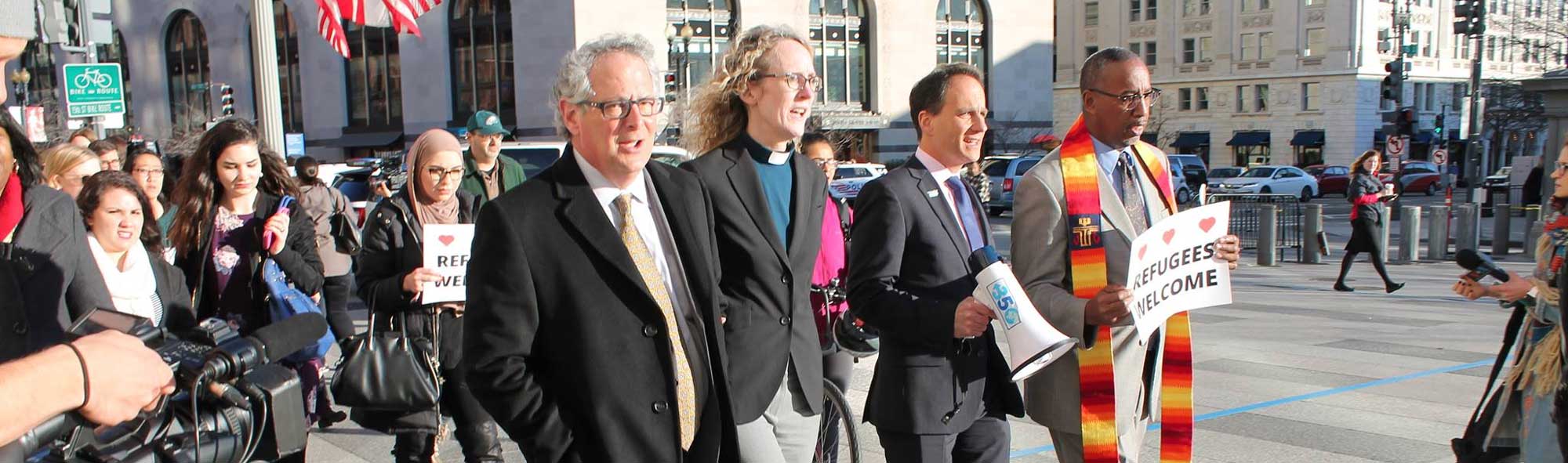
The Presbyterian Office of Public Witness is the public policy information and advocacy office of the General Assembly of the Presbyterian Church (U.S.A.). Its task is to advocate, and help the church to advocate, the social witness perspectives and policies of the Presbyterian General Assembly. The church has a long history of applying these biblically and theologically-based insights to issues that affect the public — maintaining a public policy ministry in the nation’s capital since 1946.
Reformed theology teaches that because a sovereign God is at work in all the world, the church and Christian citizens should be concerned about public policy. In addition, Presbyterian forefather John Calvin wrote, “Civil magistery is a calling not only holy and legitimate, but by far the most sacred and honorable in human life.”
A presence in Washington, D.C.
Ministry in Washington offers a chance to translate the church’s deep convictions about justice, peace and freedom from words into reality. The political process is where decisions are made that help or harm people; decisions that help to make the kind of world God intends.
Office of Public Witness staff members visit national policy-makers and their staff, write letters, make phone calls and occasionally testify before Congress or facilitate the testimony of church leaders. This involvement helps to clarify the moral and ethical issues at stake in public policy. The goal is to make clear to people in government what the General Assembly is concerned about, why, and what can be done to respond to those concerns.
By adopting a study entitled, “Why and How the Church Makes a Social Policy Witness”, the 205th General Assembly (1993) emphasized the importance of the church’s social witness policies and programs. Along with affirming that God alone is Lord of the conscience, the study affirms “the responsibility and authority of the church to make a social witness policy which guides that witness. The church, if it is to remain true to its biblical roots, theological heritage, and contemporary practice, must not fall silent. It must speak faithfully, truthfully, persuasively, humbly, boldly and urgently.”
Over 60 Years …
In 1936, the former United Presbyterian Church in the USA developed the Department of Social Education and Action. Presbyterians have always been known as political advocates; however this new Department created the first organized national effort. Knowing the value of Washington representation, the Department hired Fern Colborn in 1946 to maintain an office and a secretary on Eleventh St. NW in Washington, DC. This became the first Presbyterian Washington Office. Since then, the Washington Office has been led by several directors and many dedicated issue staff.
What Does Scripture Say About Justice?
Throughout the Bible, scripture reveals God’s will to do justice. The Hebrew prophets continually remind God’s people “…What does the Lord require of you but to do justice, and to love kindness, and to walk humbly with your God?” (Micah 6:8). The prophets give specific warning to those who seek only their own well-being and ignore the well-being of the marginalized and oppressed. Israel’s failure to be just and righteous is clearly seen as disobedient to God and the reason for national decay and destruction.
Jesus frequently witnessed to the priority of the poor in the reign of God. He challenged the rich young ruler, he sharply criticized the hard-heartedness of religious leaders, and he taught that those who reached out to marginalized persons were serving him (Luke 18:18-25, Matthew 19:16-24 and Luke 10:25-37). In addition, Christ speaks of the accountability of nations to do justice in Matthew 25 and states, “Truly I tell you, just as you did it to one of the least of these who are members of my family, you did it to me.”
The Washington Office has compiled travel resources for individuals or groups planning a visit to Washington, D.C. Visitors may use the resources below to find accommodation, transportation and other information related to their stay.
Note: the Presbyterian Washington Office is in the Methodist Building, which is in the white triangle area at the corner of First St. and Maryland Ave. between the United States Supreme Court and Dirksen.
Transit/transportation to and around Washington, D.C.
Woodley Park Guest House
2647 Woodley Road, NW, Washington, D.C. 20008
Phone: (202) 667-0218 Send an email.
Kalorama Guest House at Woodley Park
2700 Cathedral Avenue, NW, Washington, D.C. 20008
Phone: (202) 588-8188
Fax: (202) 588-8858
Cell: (202) 297-4999
Toll Free: (800) 974-9101 Send an email.
Adam’s Inn Guest House
1746 Lanier Place, NW, Washington, D.C. 20009
Phone: (202) 745-3600 Send an email.
Andrews House (Guest House of the Church of the Savior)
2708 Ontario Road, NW, Washington, D.C. 20009
Phone: (202) 483-0799 Send an email.
International Guest House (an outreach of the Mennonite Church USA)
1441 Kennedy Street, NW, Washington, D.C. 20011
Phone: (202) 726-5808 Send an email.
Stuart Center art the Center for Educational Design and Communication (minimum group of 6)
821 Varnum Street, NE, Washington, D.C. 20017
Phone: (202) 635-7987 Send an email.
Hilltop Hostel Washington, D.C. (formerly India House Hostel)
300 Carrol Street, NW, Washington, D.C. 20012
Phone: (202) 291-9591 Send an email.
The Pilgrimage (part of Church of the Pilgrims, a PC(USA) congregation)
2201 P Street, NW, Washington, D.C. 20037
Phone: (202) 387-6615
Fax: (202) 387-6614 Send an email.
Smithsonian Institution The Web site for America’s national educational facility provides information about 17 museums and the National Zoo in the Washington, D.C., metropolitan area.
The Washington Office has compiled travel resources for individuals or groups planning a visit to Washington, D.C. Visitors may use the resources below to find accommodation, transportation and other information related to their stay.
Note: the Presbyterian Washington Office is in the Methodist Building, which is in the white triangle area at the corner of First St. and Maryland Ave. between the United States Supreme Court and Dirksen.
Transit/transportation to and around Washington, D.C.
Andrews House (Guest House of the Church of the Savior)
2708 Ontario Road, NW, Washington, D.C. 20009
Phone: (202) 483-0799 Send an email.
International Guest House (an outreach of the Mennonite Church USA)
1441 Kennedy Street, NW, Washington, D.C. 20011
Phone: (202) 726-5808 Send an email.
The Pilgrimage (part of Church of the Pilgrims, a PC(USA) congregation)
2201 P Street, NW, Washington, D.C. 20037
Phone: (202) 387-6615
Fax: (202) 387-6614 Send an email.
Smithsonian Institution The Web site for America’s national educational facility provides information about 17 museums and the National Zoo in the Washington, D.C., metropolitan area.
Is your presbytery focusing on justice issues through public policy? The Presbyterian Office of Public Witness can help you understand proposed legislation affecting how we live together in God’s world and how to bring the heart of the gospel to the heart of the nation’s capital. In addition, Office of Public Witness staff can assist your congregation in its public policy ministry in other ways, including:
Internship and Summer Fellowship Programs: The Office of Public Witness believes that formation of servant leaders and advocates is vital to the public policy ministry and witness of the Presbyterian Church (U.S.A.). Find more information about our program and for application information.
Visiting Associate Program: The Office of Public Witness started its Visiting Associate Program in 1986, under which a qualified applicant (who may wish to do sabbatical or study leave) has the opportunity to negotiate working with the permanent staff in addressing public policy issues.
Special Briefings: Office of Public witness associates offer tailored briefings to youth groups and campus ministry groups who wish to call on their Members of Congress in Washington. Please contact the Office of Public Witness for more information.
Coming to Washington?
The Office of Public Witness has compiled travel resources for individuals or groups planning a visit to Washington, D.C. Visitors may use these resources to find accommodation, transportation and other information related to their stay.
Is your presbytery focusing on justice issues through public policy? The Presbyterian Office of Public Witness can help you understand proposed legislation affecting how we live together in God’s world and how to bring the heart of the gospel to the heart of the nation’s capital. In addition, Office of Public Witness staff can assist your congregation in its public policy ministry in other ways, including:
Internship and Summer Fellowship Programs: The Office of Public Witness believes that formation of servant leaders and advocates is vital to the public policy ministry and witness of the Presbyterian Church (U.S.A.). Find more information about our program and for application information.
Visiting Associate Program: The Office of Public Witness started its Visiting Associate Program in 1986, under which a qualified applicant (who may wish to do sabbatical or study leave) has the opportunity to negotiate working with the permanent staff in addressing public policy issues.
Special Briefings: Office of Public witness associates offer tailored briefings to youth groups and campus ministry groups who wish to call on their Members of Congress in Washington. Please contact the Office of Public Witness for more information.
Coming to Washington?
The Office of Public Witness has compiled travel resources for individuals or groups planning a visit to Washington, D.C. Visitors may use these resources to find accommodation, transportation and other information related to their stay.
Responding to a shortfall in revenue during the Covid-19 pandemic featuring The Rev. Jon Moore Presbyterian Mission Agency Mission Engagement Advisor and The Rev. Princeton Abaraoha, field staff for African… Read more »
The interview reports are based on individual interviews with NWC leaders and participants. They help track the impact the 1001 initiative is having on lives and communities. This report, part… Read more »
The Presbytery Survey provides information about how mid councils support, encourage and hold accountable the new worshiping communities within their bounds. This report, part of a 10-year longitudinal research project,… Read more »
The Leader Survey Report is based on an annual survey of new worshiping community leaders. It provides the most in-depth research on demographics of new worshiping communities. This report, part… Read more »