
Reformation Sunday
Presbyterians celebrate the tradition that grounds their faith on Reformation Sunday. It is always the last Sunday in October, marking the occasion in 1517 when Martin Luther posted his 95 theses on the church door in Wittenberg, Germany.

October 25: Reformation Sunday 2026
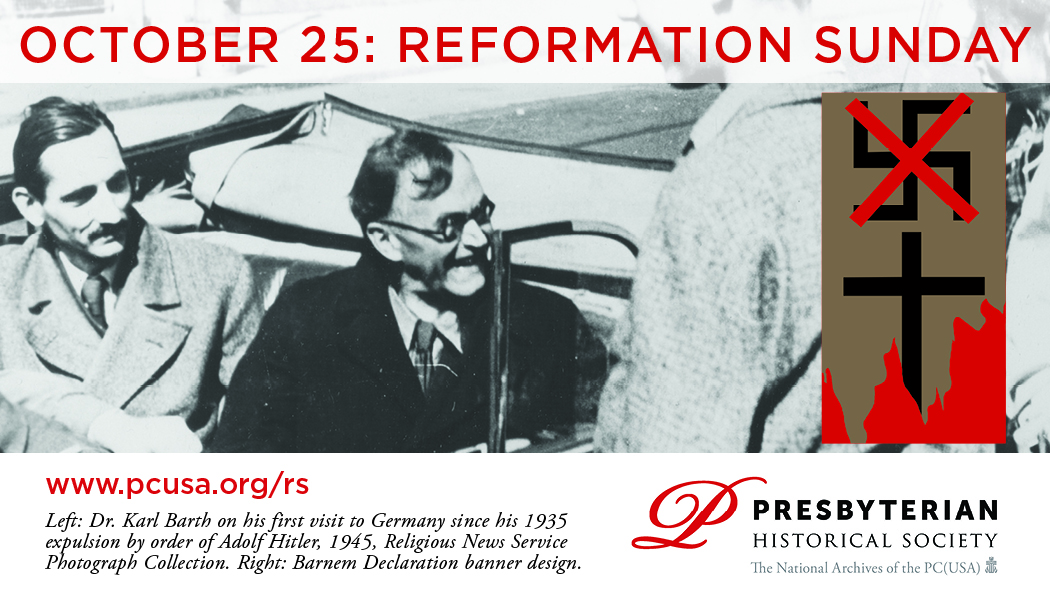
The Theological Declaration of Barmen, drafted by theologians Karl Barth and Hans Asmussen, is in the Book of Confessions, one of only three additions to the book made in the 20th century.
In 1934 representatives of Germany’s Protestant churches gathered in Wupperthal, Barmen, and wrote a letter to the German people on the unity of the church and its freedom in Jesus Christ. We remember this modest text because of its situation—it accused the official church of Nazi Germany, the Reichskirche, of error.
Antisemitic and nationalistic sentiments inside German Christendom had been stoked during the period of celebration of the 400th anniversary of Luther’s Theses in 1917— taking as their basis Luther’s overtly antisemitic writings—and by 1933 a movement of Protestants called Deutsche Christen, which sought to further align the churches with Nazi ideology, had taken control of Germany’s pan-church assembly.
The Theological Declaration Concerning the Present Situation of the German Church, without naming the Nazis, holds that the Fuhrerprinzip is incompatible with Christianity (Book of Confessions, 8.12). it avers that the Church does not orient itself based on "prevailing ideologies and political convictions" (8.18). At its most forceful it says:
"We reject the false doctrine, as though the State, over and beyond its special commission, should and could become the single and totalitarian order of human life, thus fulfilling the Church's vocation as well." (8.23)
In preparing a new Book of Confessions for the United Presbyterian Church in the U.S.A. in 1965 and 1966, the General Assembly's Committee of Fifteen selected Barmen to represent modern Christendom. One member of the committee* preached in his own congregation that in Barmen’s vision of life "the church may not willingly become the victim of state power"—its duty was opposition.
Few German Protestants opposed the Nazis. Only about 10 percent of German ministers were members of the Confessing Church. And the drafters made clear that Barmen was a theological document, not a political one. Wilhelm Niemöller—brother of Martin, a Barmen drafter known for his text First They Came—wrote in 1956: “The confessing Church has never, neither during Hitler’s reign nor afterwards, made a point of being understood as a ’resistance movement,’ or as an ‘opposition,’ or as a ‘front.’ It wanted to witness the one Word in our world and time.”
The banner representing Barmen was designed by the duo Avery and Marsh, better known for their musical theater and hymns. It shows the swastika struck through and the cross rising.
Related resources and further reading
- RG 75, United Presbyterian Church in the U.S.A. General Assembly Special Committee of Fifteen to Examine the Proposal to Revise the Confessional Position of the Church Records, 1965-1969, https://pcusa.org/historical-society/collections/research-tools/guides-archival-collections/rg-75, Presbyterian Historical Society
- SCM 369. William Sherman Skinner papers, https://princetonseminaryarchives.libraryhost.com/repositories/2/resources/767, Princeton Theological Seminary, Princeton NJ
- The continuing relevance of the Barmen Declaration, https://www.fpcphila.org/the-barmen-declaration
- Tobias Cremer (2019), “The Resistance of the Protestant Church in Nazi Germany and its Relevance for Contemporary Politics” The Review of Faith & International Affairs, 17(4), 36–47, https://doi.org/10.1080/15570274.2019.1681728

2025: John Knox, the Reformer of Scotland
2024: Writings of Argula von Grumbach
2023: 1963, A Year of Reform
2022: 40 Years of Belhar
2021: The Edict of Worms
2020: Zwingli's Plague Song
2019: Reformed Theology
2018: Sanctuary Geneva
2017: Luther's Bible
2016: Erasmus and the New Testament
2015: Remembering Jan Hus
2013: The Heidelberg Catechism