PC NEWS - Presbyterian News Service
PC (USA) Seal PC(USA) Homepage


08110
February 13, 2008

Train up a child

For nearly 100 years the Presbyterian Pan American School has focused on preparing racial-ethnic students for success

by Toya Richards Hill
Presbyterian News Service

Editor’s note: The following story is part of a package of stories and photos compiled about the Presbyterian Pan American School. The package is part of a series that will run over the next several weeks focusing on Presbyterian Church (U.S.A.)-supported racial-ethnic schools and colleges.
Photo of a student studing
Students like this young teen are the essence of the Presbyterian Pan American School, where 96 percent of seniors go on to colleges or universities. Photo by Toya Richards Hill

KINGSVILLE, TX – There’s a nondescript compound situated just off a main highway here where mostly brown-skinned kids with dreams of vibrant futures intersect with an institution that for nearly 100 years has existed solely to ensure their success.

It’s where 17-year-old Guatemalan Christa Gomez is laying the groundwork for what she ultimately will become in life. And it’s the same place her father and three older brothers outlined their plans too.

As a kid growing up, “I knew I was going here,” she said. “I was quite excited.”

Gomez had heard stories about learning English at the Presbyterian Pan American School in the United States and meeting kids from other countries.  She had also heard “you grow in your spiritual life.”

Now in her second year at the college preparatory boarding school first founded by Presbyterians in 1911, Gomez said she intends to go to college and study nutrition once she graduates, with her ultimate goal being to become a missionary.

Walk the grounds of Pan American, first known as the Texas-Mexican Institute, and you’ll hear similar stories. Some 150 high-school-age boys and girls like Gomez have opted, with their families’ blessings, to leave the comforts and freedom of home to live and study on student visas full-time at Pan American.

One of the racial-ethnic schools and colleges of the Presbyterian Church (U.S.A.), Pan American traditionally has educated students from countries south of the U.S. border, including Mexico, Guatemala and Costa Rica.

Yet in recent years with stepped-up recruitment efforts, the diversity of the student population has been broadened with kids hailing from countries including South Korea, Taiwan and Equatorial Guinea.

Some of them are there because the type of education they’re getting at Pan American is hard to find back home, while others come seeking skills like enhanced English that will give them a competitive edge.

“We’ve got a good reputation. Kids come here and they succeed,” said James H. Matthews, the school’s president.

A teacher in front of a class room
Teacher Diane Garcia presses her students for only the best, insisting that they “practice self-discipline.” Photo by Toya Richards Hill

A fully accredited high school, Pan American offers a comprehensive academic curriculum via classes promising a 15-to-1 student-teacher ratio. Offerings also include advanced placement classes, which enable students to earn college credits, and even study at the nearby college for more advanced students.

All Pan American students as well spend time weekly in the school’s campus work program, everything from helping out in the cafeteria to assisting in the library.

One of the biggest draws is the school’s English as a Second Language (ESL) program, and the school boasts that “all of our students graduate fluent in English (as well as their native language).

“If you are not stepping up to the plate in my class … you are not going to make it,” English teacher Diane Garcia preached to students on a recent school day. Wherever you go when you leave Pan American, “it’s still the quality of academic scholarship” that matters most, she said.

“You’ve got to know what you’re doing,” Garcia stressed. “So get it together. … You have to begin to practice self-discipline.”

A stern message, but one faculty and staff say is essential in order to effectively prepare Pan American students, the majority of whom return to their native countries to live and work.

School officials note that 96 percent of Pan American seniors go on to colleges or universities in the U.S. or their home countries.

“I want to maximize student potential,” said Barbara G. Stottlemyer, dean at Pan American. “As educators, we help them find their gifts,” both spiritual and academic, she said.

“We cannot educate fully if we don’t take the holistic approach,” Stottlemyer added.

That means intertwined with reading, writing and arithmetic is a hearty dose of spiritual growth and development.

Among other things, Pan American students have daily devotions in the on-campus chapel and the school’s chaplain provides regular support and guidance for the religiously diverse population.

The combination has made a difference in the life of 18-year-old Benjamin Manzano from Mexico City, who said he’s learned to look to God for comfort and support since coming to Pan American.

“In the beginning I didn’t have any friends,” he said. “I felt loneliness.”

Yet things began to change for Manzano after hearing a sermon on campus that stressed “Jesus was the best company.”

“The next morning I felt different,” he said. Manzano joined a number of on-campus activities and “really started feeling the fire.”

In addition, he said, “I really saw a miracle in my grades.” Last semester, Manzano earned 95 or higher in his total academic average, earning him a spot on the president’s list.

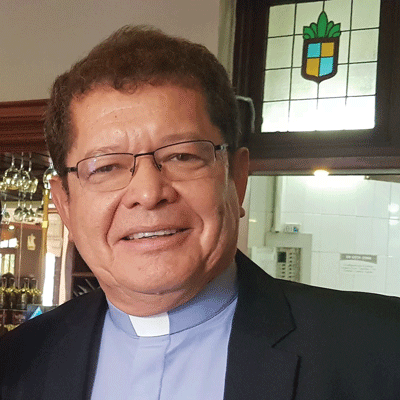
Photo of James H. Matthews
James Matthews

His current priorities: to be in the top 10 percent of his class, graduate, go on to college and eventually become a dentist.

“Failure is not an option,” said Manzano, who wants his 12-year-old brother also to come to Pan American.
 
Failure wasn’t an option either for Rita Gonzalez, a student in the first coed class at Pan American in 1956.

Today, as the school’s director of admissions and registrar, she makes certain the message about Pan American’s mission gets disseminated as far as possible.

Manzano said it was through a visit by Gonzalez to his school in Mexico City that he learned of Pan American. And other students tell a similar story.

Gonzalez said she often travels into Latin America on recruiting trips, meeting especially at Presbyterian churches and schools she has a relationship with.

But at the same time, she admits the best recruiting technique the school has had through the years is “word of mouth.”

Word of mouth also has aided in bringing in students from outside the region. “They find us,” Gonzalez said.

Although about 90 percent of the student body receives financial aid, Matthews said “every family pays something.”

That results in 45 percent of the school’s $2.4 million-a-year operating budget coming from tuition and fees, Pan American’s largest revenue source. The school’s next largest source of revenue – 20 percent of its budget – is governing bodies and churches.

Like most of the PC(USA)’s racial-ethnic schools and colleges, Pan American also receives funds from the denomination’s Christmas Joy Offering, one of four special offerings designated by the General Assembly to provide direct support for specific causes.

The challenge for Pan American is not money, it’s letting people know exactly what’s going on here and helping them understand that it’s mission, not simply an institution, Matthews said.

“People have got to focus on the mission,” he said. “And for this particular mission, it’s about the kids.”

To contact the Presbyterian Pan American School, email or call (361) 592-4307.


PC(USA) Home (Link)
     
  subnavigation divider  


  subnavigation divider  
   
  subnavigation divider  
   
  subnavigation divider  


  Deep and Wide stories  


Contact PC(USA)