08138
February 21, 2008
Giving us the ministry of reconciliation
Stated clerk Reflects on 2 Cor. 5:19 in context of Kenya mission
by the Rev. Clifton Kirkpatrick
PC(USA) General Assembly stated clerk
LOUISVILLE — It was an unforgettable experience.
I had the great privilege of leading a World Council of Churches ‘Living Letters’ delegation to Kenya at the beginning of this month. We went at the request of the National Council of Churches in Kenya to support the churches there in seeking reconciliation, to lend the voice of the world church for efforts toward peace, and to share the prayers and concerns of Christians around the world with our brothers and sisters in Christ in Kenya.
We met with the leaders of the churches and the leadership of the Interreligious Council of Kenya. We spent several hours with Vice President Kolonzo and members of the Kenyan Cabinet, and with Raila Odinga, the presidential candidate of the Orange Democratic Movement, and the key leadership of that party. We shared with all of them our concerns for a peaceful resolution to the conflict.
One of the most helpful gatherings was with the leadership of women’s organizations, who were united and passionate for a better way to be found to achieve reconciliation.
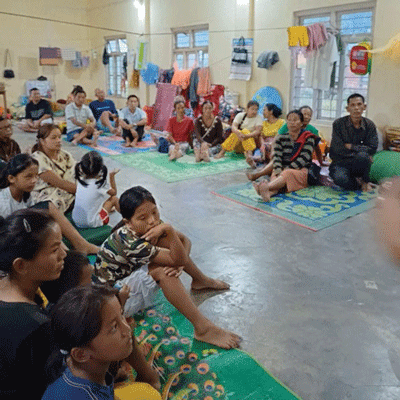
Our most heartbreaking visits were with families whose loved ones had been killed, whose homes had been burned to the ground, and who found themselves stranded in refugee camps.
We even spent time with some very angry young men that saw no hope for change short of violence.
What we learned was that there are no “quick fixes” to the problems in Kenya. After listening to various explanations of the crisis, a member of our delegation from the United Kingdom stated, “This is as complicated as Northern Ireland.” And he was right!
On the surface, the conflict is over a flawed election. Underneath are years of festering conflicts between the different ethnic groups that make up that nation. Beneath that are deep injustices left over from the colonial period and a society with one of the widest gaps between the rich and the poor anywhere in the world.
What was clear to all is that peace, reconciliation, and justice must go hand-in-hand in any solution. What was also clear to almost everyone with whom we spoke was a profound sense that this situation must not be allowed to deteriorate into another Rwanda.
Like my colleagues in the delegation, I was devastated by the suffering of so many people. Yet, I also left with a sense of hope that Christians and others might still be a force for justice and reconciliation in that land.
What left me with hope is that the churches, who themselves have at times been compromised, are now committed to being a force for peace and reconciliation. They have invited all of us to join them in praying and working for peace in Kenya. I do hope and pray that we will heed their call and that Kenya will know peace.
You will find more information on the visit and the situation in Kenya at http://www.oikoumene.org/en/news/news-management/eng/a/article/1722/ecumenical-solidarity-vis-1.html.
You will also find a PBS interview with me for “Religion and Ethics Newsweekly” at http://www.pbs.org/wnet/religionandethics/week1123/newsfeature.html. |