
08179
March 6, 2008
Reason to believe
Small Russian congregation demonstrates big heart for ministry

The sanctuary of First Baptist Church in Smolensk. Photo by Jerry L. Van Marter
SMOLENSK, Russia — Wedged into a cramped little cubbyhole on the second floor above the sanctuary of First Baptist Church here, three young men pore over a bank of monitors and control panels, looking for just the right video footage.
They are preparing First Church’s weekly 30-minute television program — a compendium of sermon and music from worship, instructional segments on Christian family life and interpersonal relationships, reports on mission trips or activities, and features on the myriad social ministries of this 230-member congregation.
And they have tons of material to choose from.
This is a little congregation with a big, big heart for mission. Recently the Russian government of Vladimir Putin presented a medal to Pastor Viktor Vladomirovich Ignatenkov in recognition of the social ministries of First Baptist Church.
In addition to the standard congregational fare of worship, Christian education, youth ministry and Bible study, First Church is also engaged in outreach to 16 orphanages in the Smolensk area; Christian education and youth ministry training for leaders of other congregations; a summer camp that draws hundreds of orphans and other children to the nearby countryside; the television ministry; camps for the elderly; a prison ministry; a variety of organized sports activities; and annual wilderness treks for young adults.
How does a church of 230 members accomplish so much? “We don’t count that we do a lot,” Ignatenkov says. “In many areas we’d like to do more — a deaf ministry, rehabilitation for drug addicts and alcoholics.”
Ignatenkov says the theology of the church is that “every member has an individual ministry that is a gift to the whole congregation. All of us should be our ministry team …but not all are involved in the work.”

Olga Ignatenkov talks about the Christian education program of First Baptist Church while sitting in the Sunday school classroom where she teaches. Photo by Jerry L. Van Marter
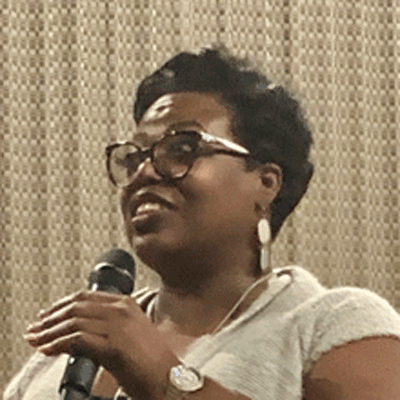
“They all pray! That’s work!” says his daughter Olga, a university student who is a leader in First Church’s Christian education ministry. The church’s Sunday School has an enrollment of 50 children in four different age groups, she says.
During Christmas vacation, First Church sponsored a day camp program that drew 58 children, only five of them from the church’s membership, and a Christmas Eve celebration attracted 95 kids, only 15 of them from the congregation.
Such outreach is typical of First Baptist Church. “We serve in a very difficult neighborhood with lots of very poor children,” Olga says. “We were afraid of trouble, but it went very well (at Christmas). Neighborhood children are not afraid of the church any more.”
Now Olga has turned her attention to the upcoming summer camping program. In 2001, First Baptist bought a camp, primarily in response to a need church members observed while conducting their orphanage ministry.
“During the summer, the orphanages just kind of dump kids out in the country, with no program or equipment,” Viktor says. “That’s why we go out there, that’s why we bought the camp.”
As with most of its ministries, First Baptist has assiduously recruited partners. The government cooperates in the prison ministry. The sports program is done in partnership with Athletes in Action. First Church’s partner in the orphanage and camping ministries is White Memorial Presbyterian Church of Raleigh, NC, which is part of the Presbyterian Twinning Project coordinated by PC(USA) missionary Ellen Smith.
In addition to donating cash for the upgrading of many of the orphanages, White Memorial helped with the purchase of the summer camp and donates supplies, equipment and even volunteers for the summer program.
“We are always glad when White Memorial comes to help,” Olga says. “And they give us their prayers and materials — the children know the arts and crafts and games, which are not available in Russia, come from our U.S. partners and they are very excited and thankful.”
Two youth teams from White Memorial have come to Smolensk to help with the summer camping program, says Ellen Smith. “They (the young people) are particularly effective because young people, Russian and American, get ‘it’ better and faster.”

Pastor Viktor Ignatenkov (right) shows PC(USA) mission worker Gary Payton a historic Bible that survived decades of communist rule in Russia. Photo by Jerry L. Van Marter
“When we talk about twinning, we are talking about a spiritual journey together,” says Gary Payton, the PC(USA)’s regional liaison for Russia, Ukraine, Belarus and Poland. “This relationship between White Memorial and First Baptist is an example of how the church can and ought to be.”
Payton says that telling the story of the Smolensk congregation helps U.S. Presbyterians understand “what it is to be a faithful Christian — the hands and feet of Christ. Our church has grown up in peace and has no understanding of what it means to survive through unimaginable repression.”
Viktor Ignatenkov understands. His grandfather, a lay pastor in Smolensk, was killed by Stalin’s regime in 1937.
Viktor says the Bolsheviks left the Baptist church alone for the first 10 years after the 1917 revolution that ushered in 75 years of communist rule. “The Bolsheviks and the Baptists had been in prison together under the czar,” he says, “so they understood each other as persecuted.”
But by the mid-1920s under Stalin, he continues, “all religious freedom was gone and they began to arrest people and churches started to close.” The worst of the repression was in 1937, Viktor says, the year his grandfather was murdered in the killing fields of nearby Katyn forest.
Churches began to reopen in 1941, when the German army occupied Smolensk. “Of course, there were only women, children and old men, because all the able-bodied men were at the front,” Viktor says.
For the remainder of the communist period, which ended with the collapse of the Soviet Union in 1991, the churches continued to minister quietly, restricted to worship and Bible study but no social outreach.

The crew of First Baptist Church’s television “studio,” readying this week’s 30-minute show on the church’s mission and ministry. Photo by Jerry L. Van Marter
In a sense, churches like First Baptist are now making up for the decades of ministry that were lost to communist rule. “We have started one or two new churches around here every year since 1991,” says Viktor, who is also the senior presbyter for his region. “We are fortunate in this congregation, so work very hard to train other pastors and leaders — for Sunday school in March, for pastors and missionaries in April, for youth ministry workers in May and through the summer.”
“Presbyterians need to hear this story,” Payton says, “so that we can learn to separate the things that are important from the things that are not important and thereby become more faithful to Jesus Christ.”
Viktor Ignatenkov says, simply: “If our history and ministry can be a blessing to anyone, then praise the Lord.”
To contribute to the Presbyterian Twinning Project, coordinated by Ellen Smith, click here. To contribute to the ministry of Gary Payton, regional liaison for Russia, Ukraine, Belarus and Poland, click here.
For information about and letters from PC(USA) missionaries in Russia and around the world, go to the Mission Connections Web site. |