08215
March 18, 2008
Transforming the understanding of stewardship
Emphasis on giving must include the worshiper, not only the house of worship, Travis says

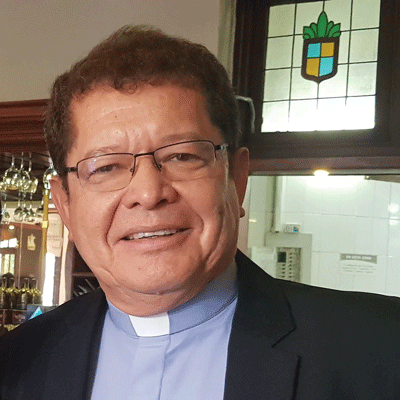
The Rev. Karl Travis
FORT WORTH, TX — Historically the primary spiritual pitch of Presbyterian Church (U.S.A.) congregations regarding stewardship has centered on how the church’s ministries can directly benefit from the financial contributions of their members.
Now the time has come for the emphasis to shift from preserving and promoting the institution to furthering the well-being of its parishioners, especially when it comes to worshipers growing personally and spiritually through disciplined financial giving to their church.
In other words stewardship is not about the church’s need to receive. Stewardship is first about the individual’s need to give.
That’s the message the Rev. Karl Travis, pastor of First Presbyterian Church in Fort Worth, TX, delivered to the 2008 Presbyterian Stewardship Conference here March 10-12.
“I have grown tired of the stewardship pitch beginning with the church hat-in-hand,” he told the 190 people attending. “People want now to speak first of joy, grace, the individual benefits of disciplined generosity.”
In his address, titled “The Disciplined Art of Choice Management,” Travis said stewardship is more than merely putting cash or a check into the church offering plate. It is a decision made beforehand to commit to a goal — a goal of giving a portion of one’s resources and sticking to it. Stewardship is a promise and a plan. It is a commitment with a purpose. That’s what disciplined giving is all about, he said.
Travis, a fourth-generation Presbyterian minister, described stewardship as an act of “personal spiritual devotion” that, while it might happen to benefit the church, must start by benefiting the believer.
“If you’ve come to this conference because your church is in rough financial waters and you’re wondering how to increase its budget to pay the light bill, fair enough,” he said. “But take note: If that’s your initial theological pitch, you’re going to remain in the dark.”
Travis said disciplined giving is the source and substance of Christian stewardship. It causes members to become invested in their giving in an entirely different sense than simply giving money. It raises critical questions about lifestyle, accumulation, financial management, values, faith and sharing.
“Stewardship is about the joyous discipline of thanking God with the way we live our lives and spend our money and share our money,” said Travis, a frequent conference speaker on the subject of stewardship.
By learning to control our money through disciplined generosity rather than letting money control us, contributors move closer to the kind of persons God wants them to be, he said.
The 44-year-old native Texan and self-professed irreverent Generation Xer insisted that stewardship is the foremost theological issue in the church today, the concept that leads to mature faith. “Our culture is awash in gold,” he said, “yet spiritually adrift.”
But it’s not an easy subject for pastors to discuss with parishioners because “we are institutional authority figures in an age which is anti-institutional and anti-authoritarian,” said Travis, who also has served churches in Michigan and New Mexico.
At many Presbyterian churches stewardship is at best a once-a-year subject that only comes around during a congregation’s annual stewardship campaign: An event that “seems somewhat like getting a flu shot” that parishioners hope will protect them against the topic for the rest of the year, he said.
“Didn’t anyone ever teach you never ever in polite company to mention money, religion or politics, and never ever in the church to mention stewardship?” Travis asked rhetorically.
He said annual stewardship campaigns are talked about as though financial giving was the definition of stewardship itself. But such talk does the word a great injustice, he said.
Stewardship, understood properly, is larger than money and more frequent than an annual campaign aimed at meeting a church’s budget. It’s about even more than teaching the dignity and spiritual rewards of practiced generosity, he said.
“Our annual campaigns are actually intentional efforts at offering a theological antidote to the spiritual cancers of our age,” Travis said, “namely materialism, consumerism and acquisition.”
Stewardship is a conversation that must be “overt, regular, disciplined, and committed,” held in the open. Pastors must gather the courage to stand up and talk about money from the pulpit. Those who cannot are committing “professional malpractice,” Travis said.
“If it’s true that the gospel of Jesus Christ provides the antidote to the cancer of the age and we have the cure and don’t mention it, surely we’re withholding life-giving miracle,” Travis said.
Building upon an idea from Barry Schwartz’s book, “The Paradox of Choice: Why More is Less,” Travis spoke about the confusing level of choice we face today.
“God reduces choices,” he said, referring to “The Liturgy of Abundance, The Myth of Scarcity,” an article written by Walter Brueggemann, author and retired professor of Old Testament at Columbia Theological Seminary in Decatur, GA.
Brueggemann argues that the Israelites’ flight from Egyptian slavery to a 40-year trek through the desert in the Book of Exodus had to do with God’s people being reminded that they can trust God to give them enough.
“And how is it that we learn trust? God reduces their options,” Travis said. “God simplifies the menu. God reminds them that God can be trusted.”
This theme — that choosing God eliminates other choices — is seen throughout the Bible. “When Adam and Eve eat of the fruit, they step beyond God’s preferred choices. Where God has brought order humanity steps back toward chaos. In the temptation story, Jesus does not so much choose between good and evil,” Travis said, “as he willingly reduces his options.”
In the United States today, Travis said, the chief spiritual dilemma is materialism. Not just economically but philosophically. He said society has taught succeeding generations that the real things, the most valuable things, the things that people should want and trust most, are those things which are material, those things which can be measured, touched, tasted, smelled, bought, owned, sold and acquired.
Thus over time materialism has given rise to an “alternative myth” about what human beings are for, he said, that the value of people is based on the resources they command, the clothes they wear, the car they drive, the house they inhabit and the bank accounts they accumulate.
This alternative myth is complete “poppycock,” Travis said, because “Christians know that we are not what we own. Christians know that human beings are infinitely valuable because we breathe. We’re children of God, made in the image of God.”
The pastor said there is nothing more singularly liberating in this culture than to give something up, to sacrifice it, and then to feel good about it. In this cultural climate that teaches people to cling, Travis said it is truly a subversive act to give something up. It is countercultural.
“Stewardship is an exuberant conversation within which we step toe-to-toe with the idolatries of this age and declare with a loud and clear and resonant voice, ‘I am not your slave! I am a child of God, sealed by the Holy Spirit, marked as Christ’s forever, and nothing you can ever say or do can ever make that not true’” he said.
If that perspective is taught in the pews then each year at the annual stewardship campaign there will be a “joyous declaration of independence” as people engage in the simple act of completing their pledge cards,” Travis said.
Travis, a graduate of Presbyterian-related Trinity University in San Antonio, TX, and the University of Edinburgh in Scotland, was joined at the stewardship conference, with its “Kaleidoscope” theme, by pastors, elders, presbytery and synod leaders and other stewardship proponents interested in learning more about doing stewardship and teaching it to others.
Participants exchanged ideas, shared experiences, attended workshops and plenary sessions, networked with colleagues and came together for worship at the three-day event.
The conference was co-sponsored by Giddings-Lovejoy Presbytery; Heartland Presbytery; Northern Kansas Presbytery; the Synod of the Covenant; the Synod of Lincoln Trails; the Synod of Living Waters; the Synod of the Southwest; the Synod of the Sun; the PC(USA)’s General Assembly Council; the Texas Presbyterian Foundation; and the Presbyterian Endowment Education and Resource Network.
|