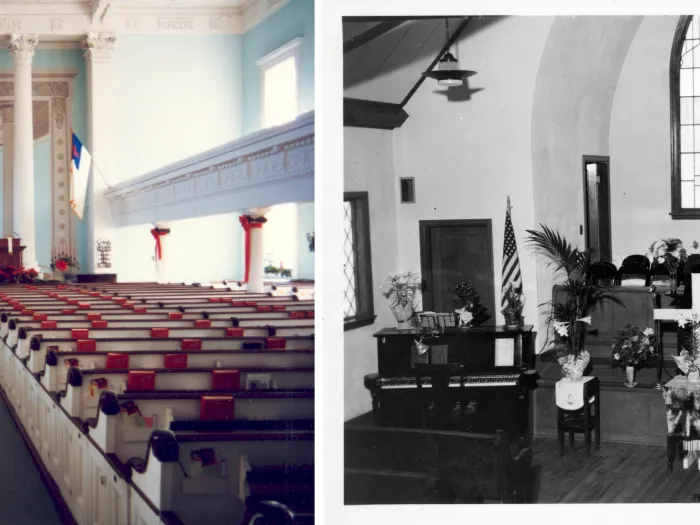
The Presbyterian Historical Society continues its series contextualizing items of business before the 227th General Assembly. Here we turn to the item on Christian nationalism by looking at the history of displaying flags in church.
OVT-002 calls on the PC(USA) to reject Christian nationalism, including by amending the Form of Government. While American Presbyterians have a tradition of defending religious freedom and confronting the state going back at least to Francis Makemie’s 1707 arrest in New York for preaching, periods of patriotic and messianic fervor tend to converge in history.
Presbyterians are among those who fly the so-called “Christian flag” – a white field, a blue union, with a red cross upon it. Originating during Rally Day events on Coney Island in 1897, the flag had a hymn written for it in 1903, and received its own pledge of allegiance in 1908. Use of the Christian flag around Rally Day was in places transposed anachronistically – a 1915 publication by the PCUSA Board of Publication and Sabbath-School Work shows the Christian flag at the head of an army dressed in a combination of medieval Crusader and Roman garb, with a motto from Psalms: “Thou hast given a banner to them that fear thee.”

Presbyterian faith and nationalist sentiment often operated in tandem during the First World War. While Presbyterians like Norman Mattoon Thomas became more fervent pacifists during the war, the main thrust of the denomination was to provide for the moral welfare of the troops. This is visible in a 1918 poster by the National Service Commission of the PCUSA which called for a Sacrificial Week of donations for the men at the front, urging congregants to “Follow The Boys Who Follow The Flag.”

The 1920s brought church growth, the development of fundamentalist Christianity, the First Red Scare, and a boom in the modern Ku Klux Klan – which occasionally used a red cross on a blue background like the Christian flag in its imagery. And as a pervading sense of the Christianity of American nationhood developed between the World Wars, the Christian flag became a totem of American Presbyterian influence. A 1941 pamphlet on the history of the Christian flag, published by Westminster Press, “Twice Blest,” avers that the flag served to mark off Sundays for people in “Zululand:” “The people here do not know one day from another, so each Sunday the Christian Flag floats from a high pole on a hilltop where it can be seen for miles around and acts to the natives like a call to prayer.”

By the mid-20th century, the habit of placing the American flag at one side of the altar and the Christian flag at the other was so common as to be taken for granted – both standards flew in sanctuaries from Sag Harbor, New York, to Juneau, Alaska. The presence of both flags at the head of the church was so prevalent that the origins of the practice in the evangelical fervor of the early century had been largely forgotten by the time that people started writing to the National Council of Churches for guidance.
The practice had been normalized through decades of political action outside the Church. From the 1920s through the early 1940s, groups like the Daughters of the American Revolution, the Ku Klux Klan, and the American Legion all agitated for mandatory flag salutes, the presence of the flag in public schools, and mandatory recitation of the pledge of allegiance. The original flag salute promoted by the Legion was indistinguishable from the Hitlerite salute used in Nazi rallies, and would eventually be replaced with placing one's hand on one's heart.

A 1942 law on proper display of the American flag dictated how churches should display it. Believing that inside a house of worship the banner of the state can’t take precedence, Christians wrote to the National Council of Churches for guidance. The NCC General Secretary Edwin Espy, in contemplating how to respond to one church, notes that the US Supreme Court declined to hear a 1942 lawsuit by the American Legion, which had sought to dictate to a church how to fly the United States flag. Espy adopted a similar caution. To actually write an effective NCC policy would mean potentially litigating the issue. While intending to deal with a matter of etiquette, Congress on its face violated the First Amendment in telling churches to give the US flag preeminence.

And so the NCC issued a staff memorandum in 1953 on church use of the American and Christian flags. Among its points were that the cross alone is “a good and sufficient symbol for the house of God in the Christian tradition.” The staff note indicates that no “ecclesiastical action’ ever made the “so-called Christian flag” official. And it went on to contradict the law saying, “when symbols are defined as representing loyalty to God or loyalty to the nation they should be so displayed as to indicate the recognition of loyalty to God as preeminent.”

Requests for guidance continued to come in to Marvin Halverson, of the NCC Department of Worship and the Arts. Most in the NCC archives held at PHS are from Presbyterian congregations, demonstrating a desire for a rules-based order. Many are from churches that recently built new spaces for worship. First Presbyterian Church, Cedar Rapids, Iowa mentions their “reconstructed sanctuary” in 1963. First Christian Church of Pasadena, California wrote in 1961, “On the conviction that the church invites loyalty to God in its hour of worship, we have used no flags in the sanctuary for several years,” but upon building a new building, the flag issue is raised again.
Also in 1961 the pastor of Community Presbyterian Church, South Gate, California writes for flag guidance saying, “I have noticed a growing sensitivity concerning all things patriotic.” And well he might, because at the same time mainline Protestant Southern California churches were enduring a right-wing pamphleteering campaign accusing them of being infiltrated by communists. Eugene Carson Blake denounced the pamphleteers in several public forums as using Hitler’s “big lie” technique, including at a meeting of Los Angeles Presbytery.
Forty years later Presbyterians would again rally around the flag during the patriotic fervor and outpouring of national grief immediately following the terrorist attacks of September 11. A survey taken from PC(USA) members in November 2001 reported 78% of elders “displayed the U.S. flag more often than usual after the attacks.” 75% of respondents said their worship services on September 16, 2001 included “patriotic hymns” and 24% had “special recognition of the United States flag.”
Vernon Broyles helped the PC(USA) moderate this sentiment when he wrote about faith and patriotism in 2002. In his account, love of country is a fine sentiment, and the Reformers of the 16th century maintained respect for the “civil magistrate” – but the calling to belong to Christ supersedes citizens’ allegiance to terrestrial powers. “As Christian patriots we fulfill our proper responsibility in both roles when we are rooted in the knowledge that the Cross of Jesus Christ stands high above the flag of every nation, including our own.”
Learn more:
NCC RG 4. National Council of the Churches of Christ in the United States of America General Secretary Records, 1950-1973.
NCC RG 6. National Council of the Churches of Christ in the United States of America Division of Christian Life and Mission Records, 1945-1973.
Fanny Crosby and R. Huntington Woodman, “The Christian Flag,” in The Abridged Academy Song-Book : for Use in Schools and Colleges (1918) https://archive.org/details/abridgedacademys00leve/page/292/mode/2up
PC(USA). General Assembly Committee on Ecumenical and Interfaith Relations. (2025) Confronting White Christian Nationalism. https://pcusa.org/resource/confronting-white-christian-nationalism
You may freely reuse and distribute this article in its entirety for non-commercial purposes in any medium. Please include author attribution, photography credits, and a link to the original article. This work is licensed under a Creative Commons Attribution-NonCommercial-NoDeratives 4.0 International License.