
Rounding out the moderator’s spiritual life
The Co-Moderators of the 226th General Assembly share with their mid council colleagues some of what’s worked for them

LOUISVILLE — “Moderating isn’t separate from your spiritual life,” the Rev. CeCe Armstrong told mid council moderators and moderators-elect last week during their gathering online and at the Presbyterian Center in Louisville, Kentucky. “Moderating is your spiritual life during this season.”
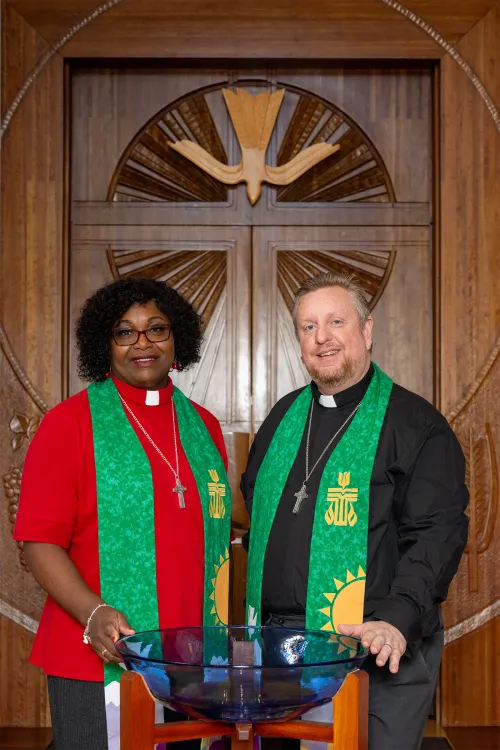
Armstrong and her fellow Co-Moderator of the 226th General Assembly, the Rev. Tony Larson, led an engaging talk on Saturday on spirituality and the moderator. The Co-Moderators used their “C.A.R.” framework, for “Communication,” “Alignment with God’s Will” and “Relationship,” to share some of what they’ve learned with those already moderating or about to moderate presbyteries and synods across the country.
As Armstrong did during the Friday worship service, the Co-Moderators invited moderators to consider who at their most recent mid council meeting was like Peter, “faithful one minute and denying the next?” Or Thomas, demanding proof. Or Martha, serving but resentful. “Most important,” said Larson, “which disciple were you that day?”
“On any given day,” one moderator said, “I am all of those together.”
“We will call you Legion,” Larson joked, “because you are many.”
Another moderator said the Peter types “only come out when there is a hot-button issue. They either go away happy or mad, and then they don’t come back.”
Armstrong asked moderators, “Can you listen to people as Jesus listened, even when you’re sure they ain’t great?”
The Co-Moderators then presented a “Sacred Listening” process they’ve used when conversations become difficult. Pause and take three breaths before responding, they recommended. Tell the person “what I hear you saying is …” even if you disagree with them. Ask: “Help me understand what’s beneath that concern.” Then silently pray, “God, is there truth here I’m missing?”
Larson said he was leading worship at the church he serves, Trinity Presbyterian Church in Surfside Beach, South Carolina, when a visitor told him how much he hated Larson’s sermon that Sunday. “He and I would locate ourselves in a different place in the theological landscape of the church,” Larson said. “I try to be mindful of being a unifying aspect, but when I’m at home and the Spirit says ‘here’s what you need to say,’ I say it, and that’s not what he needed to hear.”
During the coffee fellowship following worship, the voices of the two men began to rise. “People looked at me like, what are you doing with this visitor?” Larson said. “My C.A.R. was headed toward a collision.”
The two refilled their coffee cups and sat down with one another for more than two additional hours. “I leaned what we weren’t in alignment about and what I had assumed incorrectly. I am grateful we were able to turn that conversation around,” Larson said. The two Presbyterians still exchange emails. “I think there is wisdom in this practice of sacred listening,” Larson said.
The Co-Moderators next presented a practice they called “A Moderator’s Examen.”
Before the meeting, they suggested thinking about “What outcome am I hoping for? Am I willing to be surprised by the Spirit? Who might God want to speak through that I’d rather not hear? Can I make Jesus’ chair visible in this meeting?”
During the meeting, ask, “Am I listening for the Spirit or managing toward my preference? Where is anxiety in the room? What’s the question beneath the question being asked? Whose voice haven’t I heard from yet?”
After the meeting, reflect on “Where did I sense the Spirit moving? Where did I block the Spirit? What am I carrying from this meeting that I need to release? What surprised me?”
After the 2024 presidential election and the nation’s increasing ideological division, one of Larson’s pastor friends determined she needed to try to understand another political viewpoint. She reached out to a woman who checked all the opposite boxes and asked her, “Can we have coffee together once a month for the next six months?” “She was nervous, but they have kept the practice,” Larson reported. “In that practice, they have developed a relationship that transcends their differences, which are still there.”
The Co-Moderators left their mid council counterparts with questions that fit into their C.A.R. framework, questions they can use with others in their mid council. For communications, they asked: “What brought you to this mid council? What keeps you engaged? Tell me about a time you felt invisible, or felt heard for the first time in our meetings?”
On alignment: “Where have you seen God moving in our mid council? What do you think God is calling our mid council to do?”
On relationship: “What do you love about the church? Who taught you to care about the church? What’s one faithful step or commitment we can make together to serve Jesus through the church?”
“Sometimes, it’s just agreeing to talk again,” Larson said. “If we don’t hold relationships in the church, we’re losing the most important part.”
You may freely reuse and distribute this article in its entirety for non-commercial purposes in any medium. Please include author attribution, photography credits, and a link to the original article. This work is licensed under a Creative Commons Attribution-NonCommercial-NoDeratives 4.0 International License.


