
Lake Institute trains new worshiping community leaders
Partnership helps 21 leaders develop sustainable fundraising strategies

For new worshiping communities across the Presbyterian Church (U.S.A.), securing sustainable funding while staying true to their mission presents unique challenges. Traditional fundraising models often don't fit the realities of small, emerging communities led by bi-vocational leaders serving diverse populations.
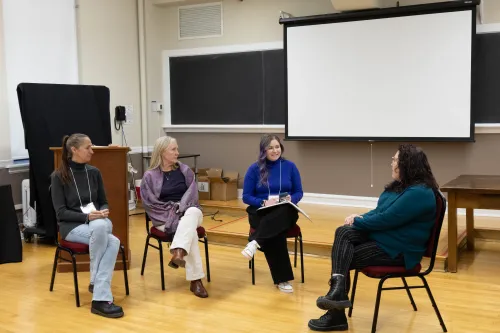
The Lake Institute on Faith & Giving recently partnered with the 1001 New Worshiping Communities movement to address these challenges, offering specialized training to 21 leaders and three staff members. The workshop, held at a discounted rate for the network, provided tools for integrating financial stewardship with theological vision.
"We are grateful to the Lake Institute for offering this training to our network at a significant discount," said the Rev. Nikki Collins, manager of the 1001 New Worshiping Communities movement. "Beyond that, in the planning for this event, the Lake Institute staff worked with Jeya So, associate for training, 1001 NWC, to tailor some of their materials for the unique context of starting new worshiping communities and for working across cultural contexts."
Collins emphasized the quality of the program, noting that facilitators brought both expert knowledge and deep personal experience in congregational giving while creating space for participants to explore their own relationship to money.
Looking ahead, Collins said 1001 NWC will continue listening to the needs of new worshiping community leaders and their supporting presbyteries to identify additional training that will lead to sustainability and flourishing.
Reframing stewardship as spiritual formation
The training offered a crucial shift in perspective: viewing stewardship not merely as fundraising but as spiritual formation. This reframing resonated deeply with Peter Okyere, Ph.D. candidate and digital ministry strategist, who leads A Light to the Nations, a new worshiping community that began in Worthington, Ohio, in 2023.

As coordinator for immigrants and refugees in Scioto Valley Presbytery, Okyere launched the Matthew 25 initiative with connections to Delaware, Ohio, and ministry partnerships in Ghana and Nigeria. The multicultural, justice-oriented community aims to embody hospitality and provide a spiritual home for people seeking authentic connection across cultures.
Okyere said he hoped to gain practical tools for aligning fundraising and resource development with the mission of multicultural ministry while ensuring sustainability and remaining faithful to core values. The training delivered on that hope, emphasizing entrepreneurial thinking and adaptive leadership for communities building from the ground up.
"The training reminded me that generosity grows when people see how their gifts advance God's mission," Okyere said. "I plan to integrate narrative storytelling into our ministry — sharing testimonies of transformation that inspire giving and deepen engagement. This will help our community connect financial practices with discipleship and justice."
Communicating mission with integrity in immigrant contexts
Learning to communicate mission and invite others into generosity while building sustainability without losing the heart of ministry drove one leader's participation in the training. Katia Regina DaCunha, founder and executive director of Latinx In Action, leads its emerging new worshiping community serving immigrant families on Cape Cod in the Presbytery of Southern New England.
The community began informally in 2017 in Hyannis, Massachusetts, responding to spiritual hunger among newly arrived immigrant families experiencing trauma and isolation. Prayer gatherings and pastoral care naturally grew into a worshiping community rooted in dignity, hope and hospitality, creating space where people encounter God's presence in their own language, culture and story.
An elder currently pursuing ordination through Gordon-Conwell Theological Seminary, DaCunha said she hoped to gain tools for sustainable leadership, fundraising with integrity and the building of generous cultures that fit multicultural and immigrant contexts. The training offered practical and accessible frameworks that spoke directly to the realities of small, emerging and often under-resourced communities.
During a practical exercise, DaCunha shared the community's Emergency Safe Planning Program for immigrant families who may face encounters with Immigration and Customs Enforcement. The feedback she received proved invaluable.
"Their insights helped me see even more clearly how essential this program is for the safety, stability and dignity of our families," DaCunha said. "I left with concrete ideas on how to communicate its impact and invite partners to support it." She identified strengthening and funding this program as a priority moving forward.
Finding a pastoral approach to fundraising
The need for a more pastoral perspective on finances brought another leader to the training. The Rev. Laura Beth Buchleiter, founder and co-creator of spiritual development at The Center for Peace & Restoration, acknowledged that administration and finances are not her strong suit, and she had been seeking ways to shift her perspective on inviting others into the community through financial support.

Buchleiter's new worshiping community officially launched in August in Indianapolis, with its office and meeting space in the We Bloom Center for Growth on the city's old South Side. The launch fulfilled a vision to create space where queer people can reclaim peace and joy that has too often been withheld by the church.
The training's focus on building generous community proved especially valuable. While much of the curriculum was geared toward larger, more established institutions, gathering with other 1001 New Worshiping Community leaders allowed participants to collectively adapt material to their individual environments.
"We didn't just talk about generous community, we built one right there in the classroom and the dining hall," Buchleiter said.
She identified novelty as a particular challenge for new worshiping communities, noting that the "new" creates barriers to traditional funding resources. The project she is proposing as part of completing the certificate will help her and others in similar ministry contexts better understand where their base lies on a spectrum from hurting to healing to generosity. This understanding will help craft messages about identity and growth that speak to intended audiences.
Collins praised the dedication of new worshiping community leaders across the denomination: "The group of people leading NWCs in the PC(USA) never ceases to amaze and inspire me. They are fueled by love for God and love for their neighbors and they bring the very best of themselves to the work they do. Every time I am with them I realize that the future of the PC(USA) is in amazing hands, and our collective investment in this movement is yielding abundant fruit."
You may freely reuse and distribute this article in its entirety for non-commercial purposes in any medium. Please include author attribution, photography credits, and a link to the original article. This work is licensed under a Creative Commons Attribution-NonCommercial-NoDeratives 4.0 International License.


