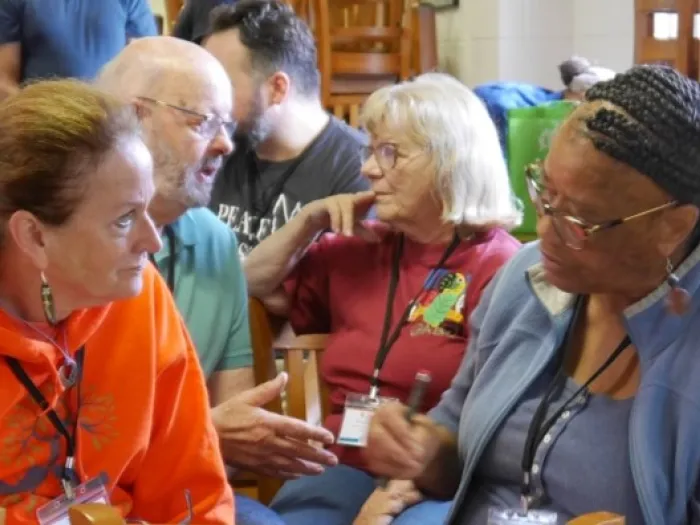
The Rt. Rev. Mariann Edgar Budde addresses a full house at Westminster Presbyterian Church in Minneapolis
Hundreds turn out to hear from the spiritual leader of the Episcopal Diocese of Washington as part of the Westminster Town Hall Forum

LOUISVILLE — The Rt. Rev. Mariann Edgar Budde packed them in Thursday at Westminster Presbyterian Church in Minneapolis for the Westminster Town Hall Forum, delivering an engaging and insightful talk she called “Courage is Contagious.”
Bishop Budde is the first woman elected as spiritual leader of the Episcopal Diocese of Washington. She exploded into the nation’s consciousness with a sermon she preached in January to President Donald Trump and others at the Washington National Cathedral.
Watch the 92-minute recording of Budde’s Westminster Town Hall Forum talk here. She is introduced at the 40:45 mark.
Budde served 18 years as a priest in Minneapolis. For her, a favorite Westminster talk was in 2003 by the late Rev. Peter Gomes, a Harvard ethics professor and the minister at the university’s Memorial Church. During that talk, Gomes described the sermon he delivered every year to incoming Harvard students called “How Are You Going to Live After the Fall.”
“Innocent pagans that most of them are, they assume that I am asking them what their plans are after September,” Budde said, quoting Gomes. “But I’m not. I’m asking them what they’re going to do after their first dreams fall from the sky. What are you going to do when you don’t get that job? When you don’t get the girl or boy? When you are brushed aside and hurt? When your children rise up to treat you as poorly as you are treating your parents?”
“The good life that you rightly seek must serve you in your most difficult, desperately hard times,” Gomes said that day. “If what you live by does not serve you then, it is no good for you, even in the good times.”
Budde got around to talking about courage, but first she spent some time on hope. “Our understanding of hope is critically important in the times we’re in,” she said. “We’re understandably disappointed when our hopes don’t come to pass. … When what we long for really matters to us, to the people we love, to the fate of our communities,” the disappointment is “devastating” when our hopes are dashed.
“That’s precisely why we need to tap deeper wells in search of a more resilient hope that enables us to persevere in the face of disappointment and prolonged adversity,” she said. The late anthropologist Jane Goodall described this hope as “humanity’s survival trait,” Budde noted. “Without it, we perish, for those who lose hope grow apathetic and do nothing,” she said, quoting Goodall. “Those who live and act from this deeper hope in the hardest times are the very ones who help create the conditions in which the things we all long for and as yet cannot see indeed come to pass.”
This practice of hope “has become increasingly important to me as I get older, because Lord knows the last thing the generations coming up behind us who are elders now need is our cynicism and our despair,” Budde said. “They don’t need our finely tuned rage. They don’t need our snarky comments. They really don’t.”
“What they need is wind in their sails. They need us to hold fast to all that is good. They need us to provide places of respite and encouragement,” she said. “They need us to write checks, to give sacrificially of our time and resources, and to keep the light of faith burning, just as our spiritual forebears did for us.”
Most of us can’t keep this deeper hope alive on our own, “and thankfully we don’t have to,” Budde said. “It comes to us as the question itself — what gives you hope? — suggests: it comes to us as a gift.” In fact, “you don’t need to be a person of faith to experience the gift, which in my mind is a mark of the giver’s generosity.”
“Most consistently and powerfully,” Budde said, the gift of hope “comes through the example of people who refuse — simply refuse — to succumb to cynicism and despair.”
That brought Budde to the topic of courage “and the simple observation that courage is contagious. It’s like hope: it’s mysterious and communal. It passes through and among us like electricity, helping us to accomplish, as the Apostle Paul once wrote, ‘far more than we could ask for or imagine.’”
Like hope, courage is also innate. “It’s in us. It’s a God-given attribute to our species. It allows us to take small, brave steps throughout life, and sometimes even to take an enormous leap,” Budde said. “As with all attributes and skills that grow stronger with practice, we draw strength and inspiration from one another.”
What is it about someone else’s courage that inspires us to be brave? “I think it touches something deep within us, because in that moment, they embody what we know to be true or what we hope for,” she said, “and they show us by their example that it’s possible to live by that truth.”
As Budde was preparing her January sermon for Trump and others, she read an account of Roman Catholic bishops in California who had taken a strong stand of support for migrants in their communities. “Their courage to say what I knew, what we all knew to be true, that the vast majority of immigrants and migrants and refugees are not dangerous criminals but are active, contributing members of our society — their courage inspired me,” she said.
A sermon or a speech “is not consequential on its own,” Budde said. “It’s only decisive to the extent it is linked to lives of integrity, faithfulness and sacrificial love, and part of communities and movements that are dedicated to a higher purpose. That’s why you’re here,” she told those in the packed church. “The primary reason I accepted this invitation to speak was to say thank you to the people and the communities that taught me so much about courage.”
She said she’ll never forget the day she and the leaders of the church she served in Minneapolis called for an all-parish meeting “to share the difficult news that we had fallen significantly short of our financial goals for what was an ambitious and controversial renovation of our building,” Budde said. “This particular project had been difficult. As a congregation we were not of one mind.”
Even though she was their spiritual leader, Budde didn’t know what to say, even though the proposal “was how we envisioned that future ministry in the neighborhood.”
Then a woman who along with her wife was raising two children in the church “spoke about how much the church meant to her and her family and how important our witness was to the wider community,” Budde said. “Then she said, ‘I don’t have a lot of money, but I’m doubling my pledge right now, and I challenge everyone here to do the same.’ Miraculously, one of the largest critics of the whole process stood up and clapped and said he was prepared to do the same.”
“I watched in absolute awe as the mood in the sanctuary changed as more people raised their voices in similar expressions of support. It was like electricity,” Budde said. “The project was completed as originally planned, in no small measure due to how her courage spread among us all.”
She recalled the words of another Town Hall Forum speaker, Parker Palmer, who said in 2002, “You can learn a lot about people by figuring out what they mean when they say the word ‘we.’”
This was in the aftermath of the 9/11 attacks and the subsequent rise in anti-Muslim sentiment. “He was encouraging us to keep company with strangers, to welcome strangers and to celebrate their presence in our community,” Budde said. “I simply want to say what you all know: that we are capable as a people to be the most expansive country in the world, and the most closed-in and narrow. We have both those strains in our history and our culture.”
“Looking back, we are never proud of the moments we draw the circle tight. We’re never proud of the people we become, the behaviors that we justify and the things we say when the circle is drawn tight so that we become small and protected,” she said. “We’re always a better people and a better nation with an expansiveness that embraces the diversity and the beauty of all humankind.”
When we lose hope, look around for someone who, by the grace of God, is still standing, Budde recommended. “Look for your beacons of hope and then pray for the grace to be among them,” she said. Budde was given a rousing ovation by the large crowd, and another one at the end of a question-and-answer session following her talk.
Learn more about the Westminster Town Hall Forum here.
You may freely reuse and distribute this article in its entirety for non-commercial purposes in any medium. Please include author attribution, photography credits, and a link to the original article. This work is licensed under a Creative Commons Attribution-NonCommercial-NoDeratives 4.0 International License.