
Hunger as a weapon of war
Presbyterian Hunger Program webinar features four panelists working for food justice in war-torn places

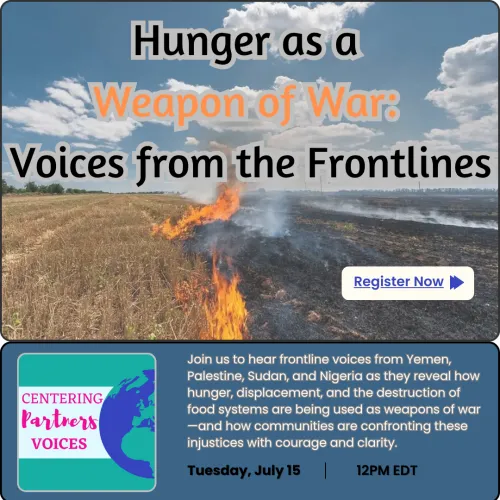
LOUISVILLE — A Tuesday webinar put on by the Presbyterian Hunger Program looked at ways hunger is being used as a weapon of war in four places across the globe — in Gaza and the West Bank, Yemen, Sudan, and Nigeria.
Four panelists spoke as part of “Hunger as a Weapon of War: Voices from the Frontlines”:
- Zoughbi Zoughbi, founder and director of Wi’am, the Palestinian Conflict Transformation Center
- Nadher Ghaleb, programs director of Generations Without Qat in Yemen
- Dr. Rose Muraguri, coordinator of food security and livelihood support in South Kordofan, Sudan, with Social Metrics Organisation
- Seeni Olaide Olarinde, program staff with Civil Society for the Eradication of Poverty, known as CISCOPE in Nigeria.
The Presbyterian Hunger Program’s Eileen Schuhmann welcomed four dozen or so viewers to the 90-minute webinar, part of the PHP’s Centering Partners’ Voices series, which is hosted by the Global Solidarity Collective. She noted that last month, Pope Leo XIV told the United Nations’ Food and Agriculture Organization that “we are now witnessing, with deep sorrow, the inhumane use of hunger as a weapon of war.”
“Starving civilian populations is a very cheap way to wage war,” the pontiff said.
“Our role,” said Schuhmann told those on the call before introducing the panelists, “is to listen with open hearts, to hold space for hard truths and to ask what solidarity looks like beyond headlines and borders.”
Nigeria is currently facing a severe hunger crisis, with millions at risk of starvation due to conflict, climate change and economic stability. Olarinde said that insurgency has driven food producers off their land, affecting food production and transportation “and causing a lot of malnutrition. It’s a traumatizing situation, with barricades everywhere.”
Zoughbi thanked PHP for convening Tuesday’s webinar. “People feel like they are not alone, that there are people who care,” he said. He noted Gaza “has been turned into what human rights experts call an open-air prison.” Farmlands have been bombed, livestock has been killed and fishing boats have been destroyed. “Infrastructure like food warehouses have been flattened,” he said. The World Food Programme says 4 in 5 Gazans are food insecure, Zoughbi said.
Muraguri thanked PHP for “what you are doing for us in Sudan,” which has also seen widespread displacement of farmers. One region has seen a 500% increase in food prices. As of last month, 25.6 million people in Sudan were experiencing acute food shortages, with 3 in 4 of those suffering “extreme hunger,” Muraguri said. “There is a lot of military and militia interference over the transportation of aid to communities,” she said.
In Yemen, 17.6 million people don’t have enough food to eat, “because war has blocked our economy,” Ghaleb said. People “risk their lives” to cross lines in search of food, he said, adding, “malnutrition among children and pregnant women grows.”
In Nigeria, combatants collect a tithe of crops before allowing farmers back on their own land, Olarinde said. Stores are looted of food for sale, and farmers are prohibited from growing crops that exceed certain height requirements.
“Food and hunger are weaponized in Palestine. It is a tragic deprivation,” Zoughbi said. While the human tragedy in Gaza has received the most attention, in the West Bank, settlers have burned olive trees, poisoned livestock and attacked shepherds, he said. “Parents go hungry so their children can eat,” he said.
Muraguri said that when aid is restricted or blocked and Sudanese people go hungry, “it weakens any resistance they might have.”
“People flee their homes, their farms and their food stalls, making them even more susceptible to hunger, malnutrition and even death. It becomes a weapon,” she said. “It pushes communities into survival mode: they eat whatever it is they can access.”
In Yemen, “human starvation has become a means of control,” according to Ghaleb. “Women and children and people with disabilities are the most affected.”
In Palestine, “survival is resistance, and hope is a form of nonviolent resistance,” Zoughbi said. “Growing food is an act of defiance.” Palestinians who can are growing something akin to victory gardens, he said. “They understand that staying rooted is the best form of resistance,” Zoughbi said.

Nigerian women are coming together to farm, Olarinde said. “It is easier to attack one person than a group of people,” he said. Women have learned to farm together and share their produce.
During the webinar, viewers commented on what they learned.
“The testimonies you share make us realize that the world must turn its attention and actions toward [these] countries,” one participant wrote. “What’s happening is incredibly sad, but it’s even worse to recognize that nothing concrete is being done by the international community to resolve the situation.”
“It’s very hard that across the globe, the challenges seem to be the same,” another person wrote.
Schuhmann concluded the webinar by asking how Presbyterians and others can be in solidarity.
“Churches and civil society groups must move from support to action, and here I salute the Presbyterian Church,” Zoughbi said. “It begins with listening.” People who journey from places including the United States to Israel-Palestine “listen to us and they become the representative of people with no voice.”
“Come and see,” he said, “not as tourists, but as learners, partners — a voice for the voiceless. When you return home, speak boldly and stay committed.”
“It’s not enough to get into the shoes of others,” he said. “You have to walk a few miles.”
You may freely reuse and distribute this article in its entirety for non-commercial purposes in any medium. Please include author attribution, photography credits, and a link to the original article. This work is licensed under a Creative Commons Attribution-NonCommercial-NoDeratives 4.0 International License.


