‘Hill Country Strong’
Within a month of the Guadalupe River flooding, a Presbyterian pastor wrote and self-published a book of essays and devotions

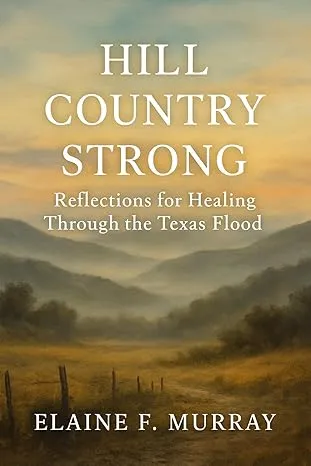
LOUISVILLE — Less than a month after the devastating floods in the Texas Hill Country, the Rev. Elaine Murray — who lives in Kerrville and serves as co-pastor, along with her husband, the Rev. Dr. Rob Lohmeyer, of nearby Pipe Creek Presbyterian Church — wrote and self-published a theological book of essays and devotions called “Hill Country Strong: Reflections for Healing Through the Texas Flood.” All proceeds from the book are going toward supporting local rebuilding efforts.
“As a pastor, you’re not a first responder,” Murray said. “But you want to encourage people and find a way to make sense of what’s happening.”
“I thought there was a need to tell a deeper story of this incredible community and that God is at work even in this storm,” she told Presbyterian News Service. “This is the way God’s power, God’s love and God’s presence in a tragedy are being known.”
Murray introduces that theme with an essay, “Where is God When Waters Rage?”
“What this book aims to bring you close to is the reality of God’s intimacy and deep involvement in times of crisis and disaster,” she wrote. “God cannot bear to be apart from us — even in our terror. There is no depth of human emotion or experience in which God is not deeply close to and intertwined with.”
That’s “a far more powerful story to me than the idea of God with some sorcerer’s hat, conjuring up a whirlpool of rising river tide in the middle of the night,” she wrote. “This storm was not punishment. This storm was not God’s design. This storm was an intersection of lots of things, which we will parse out and research in weeks and months to come. But where was God as the waters raged? With us, heart broken open and muddied up. God was with us in the terror, in the relief, in the sadness and in the mourning. God is with us in the suffering.”
Murray envisions the book as a devotional or “for particular aspects of the healing process where you or others feel stuck,” she wrote. “God’s big enough to handle your mad and sad and all the other big feelings. The writer is big enough to handle your pushback too. This book is my gift to a community I love as we are in pain together.”
On the morning of July 4, Murray and others checked on people who’d been camping along the Guadalupe River, who survived. One person who didn’t survive, Jane Ragsdale of First Presbyterian Church of Kerrville, was Murray’s Sunday school teacher in sixth grade.
While all the members of Pipe Creek Presbyterian Church’s Rockin’ RVers group got out in time, the restaurant where they’d eaten the night before was completely washed out, Murray noted.
“The losses have been one after another,” she said. Part of her task putting the book out as quickly as she could was that “I thought I could do spiritual cleanup” that complements all the cleanup and restoration work going on in the affected area.
“It was the shock energy” that propelled her across the finish line, she said. “I thought, ‘This is what I can do.’”
Her husband is “an uncredited partner” in her project. “As we were weeping over all this, he helped me see that Creation started with a flood. ‘That’s an essay,’” he told her. “I thought it was better to give an imperfect timely offering,” she said, “than to hold off.”
Murray said she was taken with Walter Brueggemann’s “Virus as a Summons to Faith: Biblical Reflections in a Time of Loss, Grief and Uncertainty.”
“My husband and I read it,” she said. “I thought, ‘Walter is gone. I am not him, but I can interpret [the Hill Country flooding] through a theological lens.”

In her book, Murray touches on “the disaster within the disaster,” when people just show up to help without plugging into one of the response teams, or send clothing and other goods that people in the area must sort and store instead of working in direct response to the disaster.
In a devotional on John 11:35 and the death of Lazarus that led to Jesus weeping, Murray writes that “sometimes the best thing we can do is wait and weep. Hold the space, get curious about what heals in times like these.” In the week that followed the July 4 floodwaters, “2,000 people showed up to sniff, wade, swim, search and retrieve the lost,” she wrote. There’s “value in weeping with and for them. In doing so, we show solidarity and gratitude. We remind these folks that they are not alone, like Jesus did with those grieving Lazarus’ death. The time would come for miracles, but it is miracle enough to be, to share in the heartache, to create and nurture safe places for rest and renewal.”
In a devotional on Psalm 66, Murray writes that “God has indeed brought us out to freedom beneath a clear sky. The rains do stop. The healing does get to begin … To offer gratitude is to set a stake in the earth again for the kind of society we want to live in, the kind of world we are seeking to build, even from the wreckage of what once was.”
James 5:16 inspired Murray to write a prayer people can try when words fail: “Source of all life, we hold in our hearts every person washed away by these floodwaters. May their terror be over. May their loved ones be comforted. May a shroud of peace hover over us while our community heals. May every helper and volunteer be shown a way to be put to good use. May the stories we tell in ages to come be testimonies of your grace and your strength that have carried us through to a new day and a new dawn. Amen.”
Murray called her writing effort “a testament of love for God and love for people. I think that is what gets us through hard times,” she said. “Even if we don’t have the expertise or what we believe is enough, this is an offering. I believe God works healing through that.”
You may freely reuse and distribute this article in its entirety for non-commercial purposes in any medium. Please include author attribution, photography credits, and a link to the original article. This work is licensed under a Creative Commons Attribution-NonCommercial-NoDeratives 4.0 International License.