Is dying more than a medical event?
POAMN workshop features a dialogue on end-of-life care, both physical and spiritual

BOULDER, Colorado — Two women with decades of experience in helping people who are near death — one as a physician, the other as a pastor and palliative care chaplain — led a helpful and from-the-heart dialogue Wednesday as part of the Presbyterian Older Adult Ministries Network’s annual conference, “Bridging Generations.” About 100 people from 24 states are in attendance.

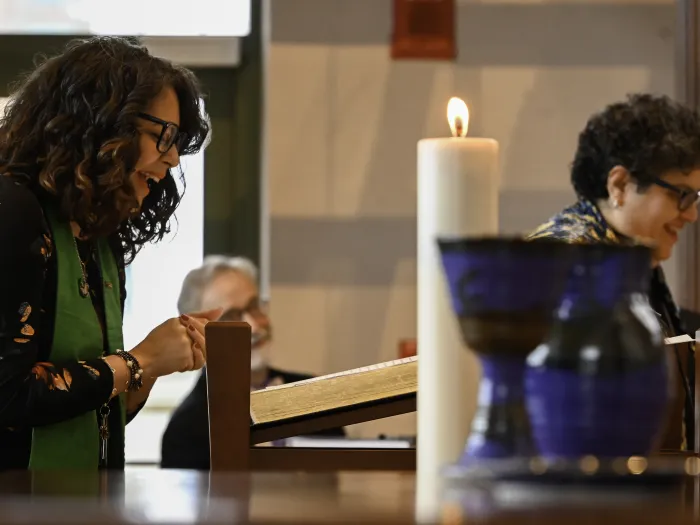
Dr. Jean Abbott, a retired physician and educator in Boulder, and the Rev. Dr. Lorraine Leist, associate pastor for congregational care and older adults at Montview Boulevard Presbyterian Church in Denver, called their dialogue presentation “Is Dying More Than a Medical Event?”
We have different trajectories of dying, as a handout explained. About 10% die abruptly, with the rest falling into three roughly even categories: a terminal illness, organ failure or a frailty trajectory.
One survey asked respondents what constitutes for them an “acceptable life.” More than half said that bowel and bladder incontinence and relying on a breathing machine to live were worse than death, with not being able to get out of bed almost as bad. On the other end, being in a wheelchair, in moderate pain all the time or at home all the time were rated much better than death by 60% or more of the respondents.
The two presenters made their talk personal by going over three case studies. Abbott started by discussing a friend, a 79-year-old man who’d always been a vigorous traveler and distance runner who found out he had a leaky aortic valve. He underwent surgery and rehab, but his path going forward is unclear. “His great joys have always been travel and being outdoors,” Abbott said. Now he relies on his wife to keep track of his medications and to go to the hospital with him.
“This is clearly a medical situation, but it’s spiritual and existential as well,” Leist said. Questions including “why me?” and “why now?” often come up. “Someone of faith may ask, ‘where is God now? I started by getting tired and now I have this condition that could kill me.’”
Another aspect, Leist said, is the search for meaning. “What is the meaning of my life now? My life had been defined by things of my own choosing. Now [this man is] facing fear, grief and reconfiguration of family life. As a chaplain, I have been present with people struggling to adapt.”
The second case study was on Leist’s father, “and his clarity about end-of-life wishes,” Leist said. Her father got sick and died two weeks later at age 82. “What was significant is he was very clear his entire life that he wanted nothing to do with the medical system, which is a challenge for many who have medical conditions,” she said.
“When he got sick, we were clear we didn’t want him to have to go to the hospital. We involved hospice,” she said. “We were able to honor his wishes and allow him to die peacefully at home.”
“It’s interesting he avoided the rabbit hole of going down the medical pathway,” Abbott said. “Medicine always has something to treat, but there’s rarely a discussion of the big picture.”
“My father was fortunate enough to have a chaplain for a daughter,” Leist said. Family members “talked about the importance of making his wishes known” early in his disease process, about seven years before he died.
Abbott noted that some people “change their mind near the end” about the kind of care they’re receiving. “Wait a minute! I have some unfinished business,” they might say. But Leist’s father “was very clear and had a strong family who could push back at the medical system.”
“It was a push,” Leist said. “His doctors were saying, ‘bring him to the hospital,’ but we knew it was time. We were able to afford him the dignity we knew that he wanted.”
“We are sharing stories with you because you travel with people on this journey,” Abbott told those in attendance. “It’s important to support them and understand when their choices might change.”
The third case involved an 86-year-old woman with progressive dementia. Family members were concerned for her husband’s caregiving capacity.
“We listen and make space for the grief,” Leist said. “The promises made to care for someone for a lifetime — those are serious promises we make. Giving space and time allows people to grieve the loss of the capability to fulfill those promises.”
What, then, makes dying more than a medical event?
“We need to make space for lament,” Leist said. “We have this process of being able to cry out to God in anger and grief to create an avenue or opening to reconnect with our faith.”
We can also, of course, “provide pragmatic support — meals, driving, respite. It’s our call to love our neighbors, and it’s all over scripture,” Leist said, “asking us to take care of each other in practical and pragmatic ways.”
For those in the church, “you’re traveling with whole families” when a family member is reaching the end of their life, Leist said. “Being able to provide care in a meaningful way — not just to the person with the illness, but to the whole system including the congregation who cares for these folks — is super important.”
“Values drive what your choices are,” Abbott said. “You have to decide what’s worth living for. You can’t get rid of all the risk.”
You may freely reuse and distribute this article in its entirety for non-commercial purposes in any medium. Please include author attribution, photography credits, and a link to the original article. This work is licensed under a Creative Commons Attribution-NonCommercial-NoDeratives 4.0 International License.