
Presbyterian Hunger Program approves over $1 million in grants
Funding will support projects in nearly 30 countries, including the US

LOUISVILLE — The Advisory Committee of the Presbyterian Hunger Program has approved more than $1 million in grants to further the work of organizations across the United States and nearly 30 other countries.
The funds will be used to address hunger and poverty and their root causes, while also supporting advocacy efforts, including community organizing.

“We remain grateful for the generosity of Presbyterians in giving to One Great Hour of Sharing, hunger appeals and other accounts so that we can support these grants that are making a difference in places like Palestine, Haiti, Sudan and multiple states all across the United States,” said the Rev. Rebecca Barnes, who manages PHP.
The grants also include funds from the Presbyterian Tree Fund, which comes from contributions that Interim Unified Agency offices make to compensate for Presbyterian Church (U.S.A.) work-related travel, Barnes said. The fund is used for tree planting and carbon-sequestration projects.
The Advocacy Committee met over the course of multiple days to discuss grant proposals largely for work that will be taking place in 2026.
“PHP grants support grassroots communities, nonprofit organizations, coalitions building people power, community organizing groups, and presbytery-based Hunger Action Advocates,” Barnes said. “Recipients range from long-term partners such as the Coalition of Immokalee Workers to Joining Hands networks in Peru and Cameroon to new groups like the Detroit Black Community Food Sovereignty Network or Juneli Nepal — all of whom are working persistently and creatively to address hunger in their own ways and in their own contexts.”
Additional recipients will include Alaska Community Action on Toxics, an Indigenous-led group concerned about contaminants in their region. Among other things, the group will be teaching residents how to grow food organically and providing health-related advocacy and leadership training.

“I just love what they do,” said committee member Eileen Best during the recent grant discussions. “They have an emphasis on gardening and local sustainability for their food, rather than importing everything.”
Best also highlighted the group’s “emphasis on transitioning away from fossil fuels and eliminating plastics,” adding, “They do really, really good work.”
International grant recipients will include the Good Shepherd Collective, which is planning to produce a podcast series tying current events in Palestine to broader systems of economic exploitation, imperialism, settler-colonialism, and indigenous resistance globally, according to PHP.
“This is an excellent way to tell truth when more and more mainstream media is blocking facts,” said the Rev. Ann Elyse Hicks, another committee member. “This podcast and the stories that they are trying to lift up are so crucial to hear right now.”
PHP staff members set the stage for discussion of the grants last week by describing some of the challenges facing ministry partners in the U.S. and other parts of the world.
National Hunger Associate Andrew Kang Bartlett noted that groups are operating during a time when poverty and income inequality are deepening, and “we see all around us the dismantling of government and public funding for the public good.” He also decried exploitation that comes with the extractive economic system and noted the country’s “ongoing legacy of dispossession and racial oppression.”
Valery Nodem, PHP Associate for International Hunger Concerns, was part of a staff overview of challenges on the international scene.
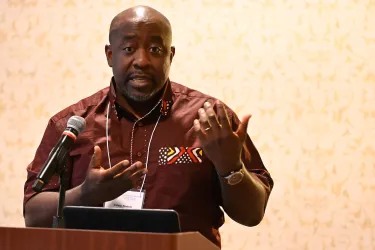
“There is a huge wave of authoritarianism coming back,” Nodem said. “Before Covid, it had started ... going down, but it's coming back — very, very strongly — and I feel like a lot of us in this country are probably feeling that as well.”
Other challenges abroad include stagnant development and lack of opportunity, rampant inflation, and “lots of civil conflicts and wars are shaking the world right now," he said.
Because of those issues and more, it is important for Presbyterians to be a part of finding solutions, according to PHP.
“With recent drastic cuts to international food aid and to federal support that undergirds state SNAP (Supplemental Nutrition Assistance Program) benefits, it is more critical than ever that Presbyterians demonstrate our commitment, our values, and our financial support for addressing hunger in our communities and around the world,” Barnes said. “While the grants that the Presbyterian Hunger Program makes are vital, churches and charities will not be able to fully make up for the lack of structured, funded, governmental support for those who are hungry.”
Barnes is thankful for the Advisory Committee, which receives nearly 100 grant applications each fall, and for the PHP staff, which invests in grant partner relationships and solidarity throughout the year, bringing expertise and vigor to visioning and planning.
“We are living through a time that is particularly challenging as we see new situations of severe hunger and famine emerging, as we anticipate domestic hunger rising in light of governmental cuts, and as many of our partners live in places where advocating for the hungry and poor can be risky,” Barnes said. “This makes me all the more thankful for the work we are blessed to be able to do, and we pray for God’s continual presence and help, especially in these difficult times and places.”
The Presbyterian Hunger Program is one of the Compassion, Peace and Justice ministries of the Interim Unified Agency of the Presbyterian Church (U.S.A.).
You may freely reuse and distribute this article in its entirety for non-commercial purposes in any medium. Please include author attribution, photography credits, and a link to the original article. This work is licensed under a Creative Commons Attribution-NonCommercial-NoDeratives 4.0 International License.


