The life and times of John R. Fry
John Richard Fry (1923-2010) was a pastor, writer, publisher and activist


John Richard Fry (December 7, 1923– December 9, 2010) was a modern polymath. In his 87 years of life, he played the violin and Sousaphone, enlisted in the Marine Corps, became an ordained Presbyterian minister, involved himself heavily in civil rights activism in Chicago, was called to trial by the U.S. Senate, traveled the U.S. as a reporter, discovered passion for typesetting and publishing, crafted a magazine that shared his name, and more.
Born in the final month of 1923 to a copper mill foreman father and a devoted Baptist mother, Fry was believed to be destined for the pulpit. As his youth progressed, he learned how to play the violin and the Sousaphone and was a member of his high school football team. He graduated and set off for the West Coast, which is where he spent his 18th birthday — Dec. 7, 1941, the day of the Pearl Harbor attack.

He enlisted in the Marine Corps the next day and was shipped to the South Pacific, where he served for two years before being hospitalized for ill health. After his release, he studied at Colgate University, graduating with a degree in philosophy and a burgeoning family. He continued his academic career at Union Theological Seminary in New York City; after his culmination, he served for four years in an Ohio pulpit before going to work for the Presbyterian Board of Christian Education in the 1950s.
This new position necessitated the hauling of his family — a wife and two sons, and the memory of a little girl who died in infancy — from Ohio to Pennsylvania, as the Board’s offices were in Philadelphia, housed within the historic Witherspoon Building. During his tenure with the Board, Fry published several books and articles, and his family grew by two more.
By 1960, he had become a rover. More technically, he took a position as a “roving reporter” for Presbyterian Life magazine. He was sent to the heart of the civil rights action in Mississippi and Alabama, and penned articles recounting the violence he witnessed over voting rights. Perhaps it was the experiences gained during this on-the-ground reporting that influenced his next move in 1965, when the Fry family packed up and left Philadelphia for Chicago.

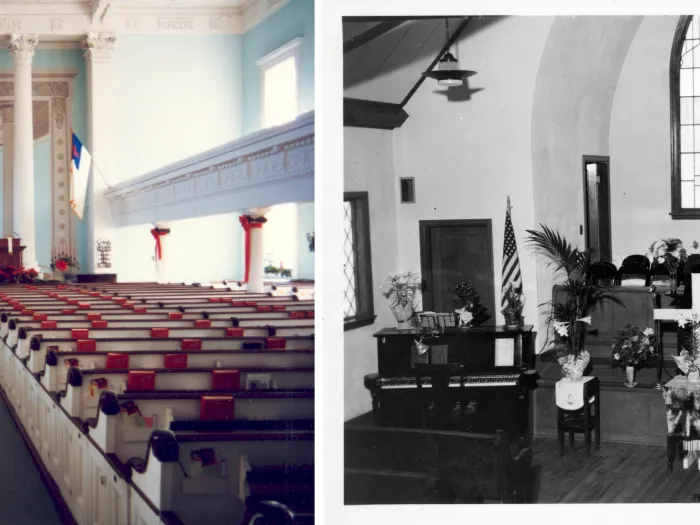
Fry had been called to minister at First Presbyterian Church in Chicago, the city’s oldest congregation. For six years he worked doggedly within his community to minimize gang violence, encourage his congregants to fight for equality, and combat local poverty through various church programs. The church’s relationship with the local youth gang, the Rangers, is what drew First Church into the limelight during Fry’s service from 1965 until 1971.
Members of the major youth gang in Woodlawn at the time, Blackstone Nation, were called “Rangers.” The Rangers had, up to this point, refused to involve themselves in the civil rights movement — something that the Rev. Dr. Martin Luther King Jr. and his newly founded Southern Christian Leadership Conference (SCLC) was hoping to change.
In May 1966, Fry allowed the SCLC to host a meeting with the Blackstone Rangers in First Church’s John Knox Hall. A month earlier, the session of First Church employed Charles LaPaglia and Robert Keeley to begin a relationship with the Rangers, fueled by the same hopes as MLK. “No one else was doing a thing,” Fry writes in the introduction to his book, “Fire and Blackstone: Non-sermons by Chicago’s white activist minister,” published in 1969. “Something had to be done.”
After that first meeting of the Rangers and the SCLC, “more and more Rangers began using the church building on a regular daily basis,” Fry shares. The church’s involvement with the Rangers began to draw controversy, while simultaneously having positive effects on the immediate community. One instance, for example, was when the Rangers surrendered more than 100 weapons to the church in the presence of police and Treasury Department agents —they were stored in the church’s walk-in safe. Years later, upon the assassination of Martin Luther King in 1968, when riots sparked all around the city, the Rangers patrolled Woodlawn and kept violence at bay. They even maintained a truce with their rivals, the Disciples.
Still, apprehension amongst church members and the church at large grew unwieldy—the media representation of the partnership did not help to calm any nerves, as the local police force was very much against Fry’s work. In a raid that made national news, the police destroyed furniture and “discovered” the cache of weapons they had helped store in the safe. Fry was called to testify at the Senate Investigation that followed, where outrageous allegations were thrown against the pastor and his flock. The Presbytery of Chicago conducted their own investigation into these claims and vindicated Fry and his congregation in a 2,500-page report.

At the end of his time at First Church, Fry was frustrated and tired. “The point is that the relevant theological issues were seldom discussed,” he wrote of the affair, continuing to explain that “First Church people are unanimous in their desire for full self-determination by Black people of Black people," and that this is what scared folks, this commitment to the fight for racial equality. "The common denominator seen in [the activities of the church] was a kind of sinister Black independence. The police initially saw our association with the Blackstone Rangers as a deterrence to their ability to wipe the Rangers out," Fry concludes in the Background section of "Fire and Blackstone."
Fry's time at First Church Chicago, and his efforts with the Blackstone Rangers, was the most publicized part of his long life. But there was more to come after six years of service in Chicago. 1971 saw Fry get divorced, return to the west coast, and accept a four-year teaching position at the Graduate Theological Union in Berkeley.
And then, in 1975, John Fry met and fell in love with Carol Alice (March 2, 1938-October 9, 2022). In 1976 he moved to Eugene, Oregon, to be with her, and “frying pan” was born.
Each month, the couple printed and published a magazine that focused on social justice issues from a theological perspective. They titled it “frying pan." The cover designs changed each month, except for one shared characteristic: the presence of a cast-iron pan somewhere in the image. They made a game of it, offering a free subscription to the reader who could accurately guess the location of the frying pan on the previous month's cover. Whether it was cradled in a statue's arms or filled with food on someone's kitchen table, the frying pan had to be there.

The article topics varied and submissions were open to all, and included eye-catching titles like "How do you spell Presbyterian?" and "Cheese and Auld Lang Syne," as well as more serious ones like "URGENT: Juana Marie Juarez, Mexican, Was Kidnapped by the Salvadorean Army," which came with a call to action that encouraged readers to ring their representatives. The magazine's "statement of purpose" read as follows:
“The purpose of frying pan is to stimulate consideration of a broad range of religious, moral, social and theological issues facing the church and the nation; to promote the idea that there is an authentic Christian existence outside the authority and the jurisdiction of the Christian church; to present analysis and descriptions of contemporary events and other materials which are fully candid and absolutely accurate; to create a broadly based national readership which will be alert to the perils and possibilities of our present age. We undertake the publication of frying pan in part because we do not believe that the religious or the secular press is altogether candid or accurate in its description and analyses of contemporary events, materials and issues. The secular press does not intimately understand the issues; the religious press is obliged to obscure crucial factors because it is within the jurisdiction and authority of the churches. We believe it is important to publish an independent and reader-supported, reader-owned magazine which is obliged only to truth and public decision, to truth’s God and to public discussion’s and our God. We believe God is more interested in the peace, happiness, and equity of the peoples of the Earth than in the prosperity of a series of American Christian churches.”
John Fry had worked for years with the Presbyterian Board of Publications and was intimately familiar with the process and bureaucracy of the media, thanks to his career experience and time in the pulpit. The "frying pan" magazine was the result of Fry's sensing a gap in the literature, and hoping to fill it. His time within the world of Presbyterian publishing and his service on the battlefront against poverty influenced the creation of his own channel of communication, one in which he was truly unrestrained.
John and Carol authored three books together and established a typesetting business before retiring in 1984, though they would continue to publish "frying pan" into 1986. John died in December 2010, five years after he and Carol moved to Vancouver, Washington. Carol died in October 2022. Bound volumes of the "frying pan" publication are housed at the Presbyterian Historical Society in Philadelphia.
Browse the civil rights, protests, and social reformers digital collection in Pearl. In case you missed it: the Rev. David Black, the current pastor at First Presbyterian Church of Chicago, was featured on the news service in December.
You may freely reuse and distribute this article in its entirety for non-commercial purposes in any medium. Please include author attribution, photography credits, and a link to the original article. This work is licensed under a Creative Commons Attribution-NonCommercial-NoDeratives 4.0 International License.