
Art in the archives: Duke Ellington's sacred concerts
Some background on Duke Ellington, Billy Strayhorn and the music they made together

In honor of Black History Month, Presbyterian Historical Society staff member Olivia Cacchione shares some background on Duke Ellington, his orchestra, and his series of "Sacred Concerts".
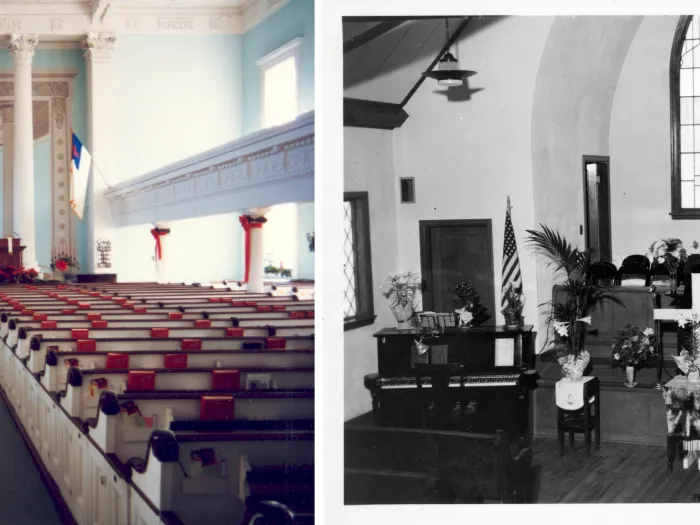
It was standing room only at Fifth Avenue Presbyterian Church in New York the night of December 26, 1965. Over the course of two performances, 3,600 people flooded into the sanctuary to hear a performance of Duke Ellington’s Sacred Concert. The program did not lack for grandiosity. Duke Ellington and his band took the stage (or chancel, as it were) alongside three church choirs. The legendary Lena Horne made a surprise appearance. Tap dance hall-of-famer Bunny Briggs contributed his own beats. The group put on no less than 16 songs and medleys for what Ellington called “the performance of all performances — God willing.”

The concert at Fifth Avenue was the second performance in what would become a whole series. When Ellington was first invited to put together a show at Grace Cathedral, San Francisco earlier in the year, he declared: “Now I can say openly what I have been saying to myself on my knees.” For the next eight years, he and his group would travel far and wide “from Cambridge, Massachusetts to Cambridge, England,” in the words of Ellington, performing variations of the Sacred Concert.
Born Edward Kennedy Ellington in 1899, the Duke developed a deep faith from a young age through his mother’s influence. As a child, he attended both a Baptist and an A.M.E. Church every Sunday. His religious conviction brought him great joy and stability throughout his life. As an adult he was reported to have read the Bible in the bathtub nightly.
His love for music developed right alongside his faith and in 1923 he decided to try his luck in New York as a jazz pianist and bandleader. Luck was on his side. In 1927, the group that would become known as Duke Ellington and His Famous Orchestra headlined at the renowned Cotton Club in Harlem. The reach of the Cotton Club, which included national radio broadcasts, put him on the map as an artist. But as a segregated venue where Black artists performed for white audiences, it could hardly live up to his standards as a self-described “race man,” and throughout his career he used music to shift jazz away from the racial stereotypes of what was known as “jungle music.” By the end of three years at the Cotton Club, he was the foremost big band leader in the nation — a role he would maintain throughout the 1930s, represented in iconic numbers like “It Don’t Mean a Thing (if It Ain’t Got that Swing).”

Living up to his childhood nickname of Duke, Ellington was known for his sharp presentation and regal bearing. His kingly manner extended to his musical technique. As a pianist, composer and bandleader, Ellington adhered to meticulous and exacting standards. His precision offered a contrast to the raw style of the brass players in the Orchestra. These musical innovators birthed an entire style of “vocalizations,” using mutes to create growling, whining, and “singing,” as they developed an influential wa-wa sound. Some of the clearest examples appear in early numbers like “Black and Tan Fantasy,” but the horns kept growling, singing, and swinging through later iconic works like “Cottontail.” Just one listen will reveal the humor, wit and storytelling that so defined the Orchestra’s style.
One can’t talk about Ellington without talking about these collaborators, as so many of his works relied on their creative techniques, ideas and improvisations. This led to no small amount of conflict, as the Duke took credit and compensation even in instances where instrumentalists shaped an entire composition. Despite these tensions, some of them were nearly lifelong members. The longest-running included trumpeter Cootie Wilson, trombonists Lawrence Brown and Joe “Tricky Sam” Nanton, clarinetist Barney Biggard, and sax players Harry Carney and Johnny Hodges. Of these, Wilson, Brown, Carney, and Hodges performed alongside Ellington in the Sacred Concerts. Each of these versatile artists played an indispensable role in the style we now associate with Ellington.

Of all of Duke’s collaborators, none was closer to Ellington than his co-composer Billy Strayhorn, whose “Take the ‘A’ Train” became one of the Orchestra’s defining numbers. Strayhorn and Ellington began working together in 1938 and from then on the two artists were nearly inseparable. Ellington called him “my right arm, my left arm, all the eyes in the back of my head, my brainwaves in his head, and his in mine.” Strayhorn was intellectual, unassuming, openly gay, and completely beloved by all who knew him.
When the Sacred Concerts began in 1965, Ellington and the Orchestra had been touring and performing for well over 30 years. Be-bop replaced swing in the 1940s, followed by free jazz and the experimental stylings of Miles Davis and John Coltrane in the late ‘50s and early ‘60s. But no artist was better suited to take on a project like the Concerts, which took the “big” in Big Band to a whole new level. Ellington said that one of his greatest blessings was the combination of right time, right place, right people. And for him, the Sacred Concerts provided a prime example.
The Concerts were not a series of jazzed up hymns. They were original Ellington works that brought together a whole collection of styles, from swing to be-bop to gospel and beyond. The version performed and recorded at Fifth Avenue was partially built around an earlier major work – the suite “Black, Brown, and Beige” and especially the track “Come Sunday,” which made two appearances in the program. Written two decades before the Concerts, “Come Sunday” offers an early example of Ellington expressing his religious devotion at a time when much of his music remained secular.
Around the time of the Sacred Concerts, Billy Strayhorn developed esophageal cancer. While Strayhorn was in the hospital, Ellington sent him the words “In the Beginning God” and asked Strayhorn to help set them to music. What Strayhorn sent back was nearly identical to the theme Ellington himself had been toying with. Ellington said of the concert that every musical phrase of six notes represented these first six syllables in the Bible. The program from the Fifth Avenue performance notes Strayhorn’s contribution and asks for continued prayers for his health. In addition to contributing to the composition, he accompanied Lena Horne at the piano for a one-off tune called “Christmas Surprise.”
The Sacred Concert at Fifth Avenue was Strayhorn’s last performance. He passed away in 1967 at the age of 51. His final work, titled “Blood Count,” documents his decline through musical language and is likely the most haunting piece the man ever wrote, made all the more so by the Orchestra’s profound recording led by Johnny Hodges on the sax.
It is often observed that by the time of the Third Sacred Concert in the early 1970s, Ellington was grappling with his own mortality. One can’t help but think also of Strayhorn’s death, the profound grief Ellington felt, and the refuge he took in his religious conviction. He immortalized Strayhorn in the Second Concert through the upbeat number “It’s Freedom,” which also not so subtly brought Ellington’s lifelong civil rights activism to the fore both musically and lyrically. Partway through the number, Ellington recites what he calls Billy Strayhorn’s four major moral freedoms: “Freedom from hate, unconditionally; freedom from self-pity; freedom from fear of possibly doing something that might benefit someone else more than it would him; and freedom from the kind of pride that could make a man feel that he was better than his brother.”
The Sacred Concerts rarely make it into the textbooks as one of Ellington’s major contributions, likely in part because the jazz world had gone in a different direction by the time of their inception. But Ellington himself called the Sacred Concerts “the most important thing I have ever done.” What could be more fitting for a man who identified himself as God’s messenger? Through the Sacred Concerts, Duke Ellington was finally able to musically state his conviction that God is “a three-letter-word for love.”
Olivia Cacchione is the Outreach Specialist at the Presbyterian Historical Society as of August 2025. She holds a doctorate in Musicology from Northwestern University and a Master in Music History from the University of Washington.
You may freely reuse and distribute this article in its entirety for non-commercial purposes in any medium. Please include author attribution, photography credits, and a link to the original article. This work is licensed under a Creative Commons Attribution-NonCommercial-NoDeratives 4.0 International License.



.jpg)