
This month in Presbyterian history
Medical missions in New Mexico, a letter from the president, sports day at Baghdad High, and more

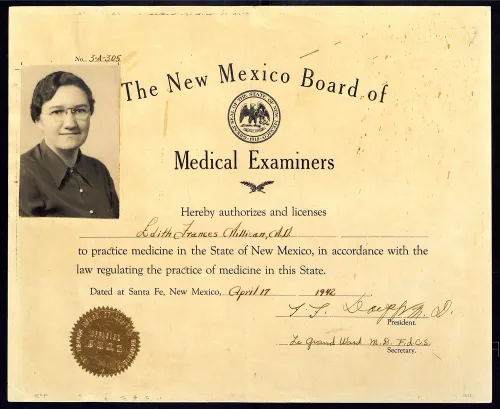
In April 1942, Edith Frances Millican found herself not in China — her home country and where she'd been assigned as a missionary after graduating from the Women's Medical College of Philadelphia the year before— but in Embudo, New Mexico, where she'd been authorized for medical work by the New Mexico Board of Medical Examiners.
Born in 1914 in China, where her missionary parents were stationed, Edith devoted her life to the same work as her mother and father. Aimee and Frank Millican had arrived in China in 1907, seven years before welcoming their daughter into the world. They served primarily in the Hunan province until September 1917, when they transferred to the PCUSA's China Mission at Ningpo. In 1930, they followed their assignment from Ningpo to Shanghai, where they worked with the Christian Literature Society. Frank translated, edited, and published pamphlets and books; Aimee helped start a broadcasting station. After a decade in Shanghai, 1940 saw the Millicans return to the United States on furlough.
In 1941, Edith graduated from the Women's Medical College of Philadelphia and was appointed to the PCUSA's China Council. She would not make it to China — instead, she found herself in the dry atmosphere of the western United States, at the Embudo Presbyterian Hospital in New Mexico, where she worked while she waited. That same year, her father returned to China, alone, where he was interned by the Japanese until the end of the war in 1945.

Edith returned to China in 1943, and spent nearly a year working as physician to the 14th Air Force Fighter Squadron stationed there. After 11 months with the squadron, she worked with war victims and refugees before being put in charge of the Chenhsien Hospital in Hunan province in 1946. She'd come full circle, returning to the place where she'd entered the world almost thirty years earlier.
But Edith would find herself in New Mexico again — it's where she died, in her sleep, on February 14, 1985, at the age of 71. After two years at Chenhsien Hospital, Edith returned to the U.S. on furlough in 1948. She'd planned to return to China the following year, but instead found herself in a residency at her alma mater, where she spent two-and-a-half-years studying before returning once more to Embudo in 1951. She remained there for five years. In 1956 she accepted another residency, this time at St. Luke's Hospital in Spokane, Washington. And then, in 1957, Edith Millican assumed the duties of resident physician at the Board of National Missions' Mora Valley Medical Unit in Cleveland, New Mexico. Before she could take this position, she had to submit her medical license to the New Mexico Board of Medical Examiners — thankfully, she'd received the necessary authorization when she'd first arrived all those years before.
The Millican Family Papers digital collection provides access to correspondence, biographical materials, and photographs documenting the Millican family's missionary experiences in China, and to a lesser extent in the Philippines, emphasizing the difficulties of their work during the Sino-Japanese War of the late 1930s and during the post-World War II years. Edith Millican's correspondence documents medical work in China during and after World War II, giving insight into the training and experiences of, and opportunities for, American women doctors. Also included are photographs documenting Edith Millican's time serving the Board of National Missions as a physician in New Mexico.

In the archives at PHS lives a letter signed by the 35th president of the United States. "Dear Reverend Blake," President John F. Kennedy wrote on April 12, 1960, "Many thanks for your very thoughtful letter of March 28. I regret that the pressures of campaigning have prevented my answering it earlier. I would like very much to talk with you whenever it can be arranged. ..."
The Rev. Dr. Eugene Carson Blake was serving as the Stated Clerk of the United Presbyterian Church in the U.S.A. (UPCUSA) when he wrote President Kennedy a letter of congratulations. Serving as Stated Clerk from 1951 through 1966 — at the height of the civil rights era — Blake was an extremely active ecumenical leader, participating in sit-ins and marches and encouraging church engagement in social activism.
In April 1960, Blake and Kennedy began planning for their first meeting. In the off chance that an in-person appointment could not be arranged, President Kennedy suggested that Blake “discuss some of these issues with my assistant — for I think you know how very interested we are in making certain that the best communication and understanding be maintained.”

What did Blake write in his letter of congratulations to the newly inaugurated 35th President? At the time, he was heading a delegation from the UPCUSA regarding the end of racial segregation within churches — the United Presbyterian Commission on Religion and Race. It was most likely that Blake was hoping to sit down with Kennedy for a discussion on the crossroads of civil rights and religion and what might be done in the upcoming years of their terms in office.
In 1963, Blake participated in the March on Washington alongside the Rev. Dr. Martin Luther King Jr. Blake, MLK, and the other organizers met with Kennedy at the White House before the event, where Blake invited Kennedy to speak at the upcoming triennial General Assembly of the National Council of Churches of Christ, scheduled for December in Philadelphia.
When, 10 days before the NCC meeting, President Kennedy was assassinated, the scheduled keynote address became a eulogy, delivered by Blake to a crowd of 10,000, which can be listened to in full in Pearl. "The ecumenical movement has come to have a new shape and a new promise since we met in San Francisco three years ago," Blake said. "President Kennedy's coming to address this assembly on this night, if an assassin's hand had not prevented it, would have clearly symbolized the beginning of a new era of hope." The collection of Blake's personal papers lives in the archives at PHS; the archival guide to RG95 provides more background into Blake's legacy as Stated Clerk.

April 1961 saw the students of Baghdad High School participating in Sports Day. The photos featured here are taken from the Margaret Purchase Papers at PHS, RG501. Margaret Purchase was a UPCUSA missionary, Christian educator, and social activist who served as a teacher and administrator at Baghdad High School from 1956 to 1969. When she worked there, it was called the American School for Girls in Baghdad, though it was later renamed Baghdad High School in Mansour. Purchase taught English classes, Bible studies, and Physical Education before serving as principal of the school — perhaps Sport Day was her idea!
When Americans were forced out of Iraq in 1969, Purchase transferred to Beirut, Lebanon, where she served as the executive secretary of the Christian Education Division of the Near East Council of Churches. Her collection at PHS documents her missionary service in Iraq and Lebanon and includes correspondence, journals, and numerous photographs and slides. View other digitized images of Baghdad High School, including interior shots of the school taken by Purchase, in Pearl.

In April of 2018, the Center for Womanist Leadership —an organization spearheaded by the Rev. Dr. Katie Geneva Cannon, the first African American woman to be ordained in the Presbyterian Church — celebrated its opening by welcoming 1,500 guests to its Inaugural Gathering. The conference, titled “Bearing Witness to Womanism,” opened with a free event — an appearance and address given by author Alice Walker. In the following days, a crowd of 250 participants convened to discuss womanist theory, thought and theology.
Four months after the gathering, Cannon passed. In 2019, Union Presbyterian Seminary Trustees named the Center in her memory — it is now known as the Katie Geneva Cannon Center for Womanist Leadership. Dr. Cannon’s legacy lives on in the work of the Center that she helped establish, and in her words. In fact, Cannon's enormous influence as an educator and theologian can be experienced through her digitized sermons and writings, which have been made accessible through the Katie Geneva Cannon Digital Collection.
In 2021 the Presbyterian Historical Society, The Center for Womanist Leadership at Union Presbyterian Seminary, and The Burke Library at Union Theological Seminary (Columbia University Libraries) partnered to unite the records that Cannon distributed across the institutions. Over a two-year period, PHS staff scanned Cannon's records and made them available through Pearl Digital Collections, the Society's online archive. Happy browsing, and happy April!
You may freely reuse and distribute this article in its entirety for non-commercial purposes in any medium. Please include author attribution, photography credits, and a link to the original article. This work is licensed under a Creative Commons Attribution-NonCommercial-NoDeratives 4.0 International License.


