What’s in your go-bag?
Austin Seminary invites one of its alums, Pastor Hierald Osorto of Minneapolis, to share how ministry flourished during Operation Metro Surge

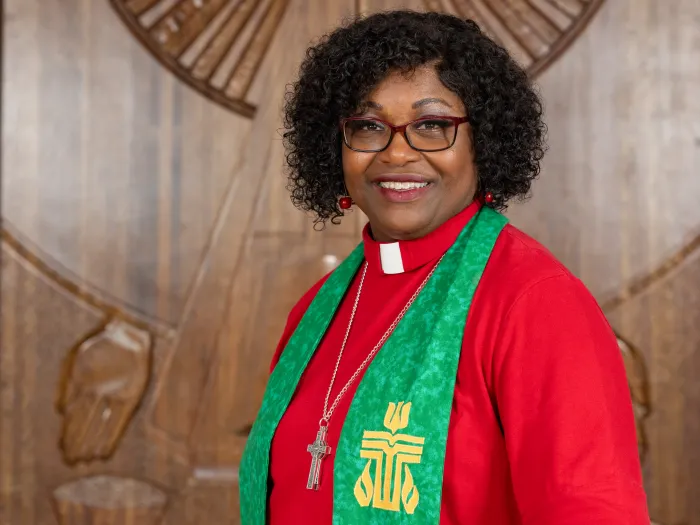
LOUISVILLE — Speaking last week during the final installment of Austin Presbyterian Theological Seminary’s “Cultivating Ideas” series, Pastor Hierald Osorto, an Austin Seminary graduate and the pastor of San Pablo-St. Paul’s Lutheran Church in Minneapolis, shared stories of serving the South Minneapolis community during the most difficult times of Operation Metro Surge.

Osorto was the guest of the Rev. Dr. Jennifer Lord, who teaches homiletics and liturgical studies at Austin Seminary. The title of Osorto’s talk was “What’s in Your Go-Bag? Preparing Ahead of Time for Worship and Preaching in Times of Crisis.”
Lord asked Osorto, “What do we already have in place for worship that can be a container for times of crisis? Can we add practices ahead of time?”
His go-bag has three elements, Osorto said: context, courage and yes.
San Pablo-St. Paul’s Lutheran Church is in one of the most diverse ZIP codes in Minneapolis, said Osorto, himself the child of Salvadoran immigrants. Nearly 140 years ago, Swedish immigrants founded the church. Now the neighborhood is home to some 20 languages. “Our stories include two homelands: the one we left behind, and the one we’re invited to embrace in Minneapolis,” he said.
As the immigration enforcement initiative ramped up late last year, “We were clear we would remain committed to sanctuary,” Osorto said. “Anyone who comes to our building feels a sense of safety and belonging.”
Wellness sessions at the church followed grocery deliveries for those unable to shop for themselves, and legal assistance was provided. “It was how we participated in God’s vision for wholeness,” he explained.
Even at the height of the enforcement measures, “the community insisted on worshiping together,” he said. That required coordinated transportation efforts, “but people said it was worth the risk. Gathering together was our resistance.”
If faith leaders in the neighborhood, including a nearby rabbi, had not done the work of coordination ahead of time, “it would have been much more difficult to navigate worship and sit through the grief and the crises people were living,” Osorto said. “They want communion every Sunday. They say if we don’t have communion, it’s not church.”
People who worship at San Pablo-St. Paul’s “want to hear the good news that speaks to their daily lives as a neighbor and sibling and co-worker,” Osorto said. “I preach about laments and grief and also try to find the joyful moments. This is a community that has been joyful.”
Courage is the second item in Osorto’s go-bag.
On the Sunday after Renee Macklin Good was killed by an ICE agent, Osorto invited a friend in to help lead worship. “I wanted us to feel anchored in our neighborhood,” Osorto said. “He said, ‘I am brave because we are brave.’ That became our mantra. It helped me pay attention to ways we as a community incite hope in one another, and how our hope showed people our hearts.”
“It helped me feel courageous on Sundays,” he said, “and throughout the week.”
The month before, the congregation was determined to continue its tradition of the Posadas procession even as enforcement activities were making that observance dangerous. “We could have chosen not to re-enact the holy family’s search in Bethlehem,” Osorto said. “Their courage inspired many hundreds of people to show up and be in that last procession right before Christmas. We just insisted on doing what anchors this community.”
Following Good’s killing, “we had prayer stations for the first time, which for many people was very familiar,” he said. “The courage we invited people into was to light a candle and say a prayer out loud, because that’s not their usual.” Worship leaders found songs about courage from South American traditions. “Singing Resistance,” an activist group that uses communal singing to protest ICE activity and support immigrant communities, held its first event in the church.
Osorto labeled the third item in is go-bag “yes,” and he told a story he’s repeated often.
Osorto was at the worker-owned May Day Café the day Good was killed. He’d gone there to meet his rabbi friend to discuss bringing their respective faith communities together for song and prayer.
“We said, ‘We don’t want to water down our traditions and feel apologetic about who we are,’” he said. “We had this mutual feeling this moment was calling us to more connection, more creativity,” and, as his friend the rabbi said, “more chutzpah.”
The two combined Tu B’Shvat, celebrated Feb. 1 and sometimes known as Jewish Arbor Day, and Candlemas, which celebrates the presentation of Jesus in the Temple and is observed on Feb. 2. “We turned to our traditions, and asked them to reveal new treasures,” Osorto said. “We trusted our communities to travel with us.”
In services dubbed “Ritual Remix,” 25 members of San Pablo-St. Paul joined at the synagogue for Shabat services. “It was powerful, and, for a few, a little jolting,” Osorto said. “They let Shabat service wash over them.”
The next day, the San Pablo-St. Paul sanctuary filled with members of both congregations. “There is a wisdom in sharing and showing up with each other that will carry us through,” he said. “The fact that we could do this together informed what happened weeks later.”
By Ash Wednesday, “our community was under looming threat. For a moment we thought about cancelling the Ash Wednesday service,” he said. But church leaders insisted that the community gather.
The rabbi organized neighbors to serve as observers. Thirty minutes before the service, a large group from Singing Resistance “added a layer of solidarity and protection,” Osorto said. “We weren’t protected by armed people. We were protected by song. We had our service because we had been in partnership.”
The rabbi later returned “to deliver our Easter sermon, which was only possible because of some of the work I have spoken about,” Osorto said. “That’s what our interfaith work has looked like.”
The congregation is “clear they are not leading from a place of vulnerability or fear, but from a place of their ancestors — their grandmothers’ wisdom,” he said. “You find that in the stories they share with one another.”
He encouraged those on the call to “practice joy to prepare for crisis.”
You may freely reuse and distribute this article in its entirety for non-commercial purposes in any medium. Please include author attribution, photography credits, and a link to the original article. This work is licensed under a Creative Commons Attribution-NonCommercial-NoDeratives 4.0 International License.