Pioneering Presbyterian Sylvia Thorson Smith is remembered
St. Mark’s Presbyterian Church in Tucson, Arizona, holds a memorial service for the LGBTQ+ and women’s rights advocate, who died July 8 at age 82


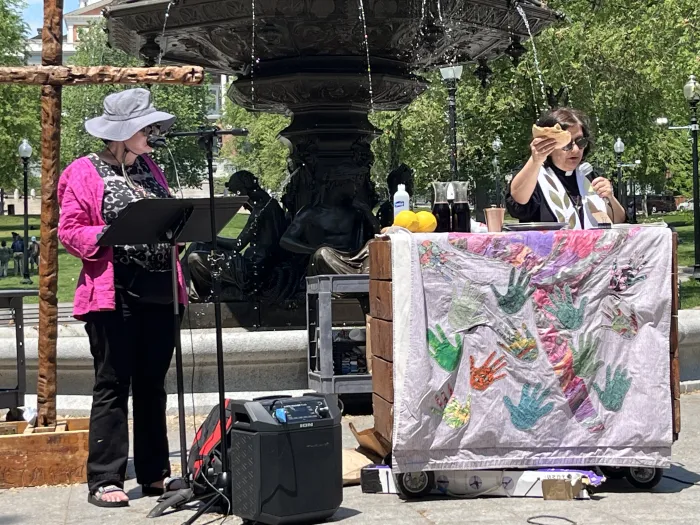
LOUISVILLE — Family members joined the many friends of Sylvia Thorson Smith online and at St. Mark’s Presbyterian Church in Tucson, Arizona, on Saturday for a stirring and fitting memorial service. Watch the 89-minute service here.
A beloved sexuality educator and co-author of a controversial 1991 PC(USA) Special Committee on Human Sexuality report, “Keeping Body and Soul Together: Sexuality, Spirituality and Social Justice,” Thorson Smith died July 8 at age 82 in Tucson. She taught at Wichita State University and at Grinnell College in Grinnell, Iowa, before retiring and moving to Tucson with her late husband, the Rev. Mike Smith.
Officiating the service, the Rev. Tracy Daub of St. Mark’s Presbyterian Church read Isaiah 6:1-8, Isaiah’s vision of God in the Temple, and Song of Solomon 7:10-13. “When was the last time you heard Song of Solomon read at a funeral?” Daub asked. “This sensuous and erotic book of the Bible is certainly an uncommon choice for a funeral or memorial service, but in a way it is so appropriate for Sylvia this memorial service.”
Daub called Thorson Smith “an uncommon woman who lived an uncommon life who embraced uncommon sentiments and beliefs before their time. Some of those uncommon and unconventional beliefs centered on matters of women’s rights and human sexuality.”
“As a matter of faith, Sylvia’s uncommon beliefs were grounded in Scripture and her belief in a God of radical love, a God of expansive inclusion, a God of limitless grace,” Daub said. “Whether it was advocating for women’s rights or the rights of LGBTQ individuals in the church or when working to expand the church’s understanding of a justice-oriented ethic of human sexuality, Sylvia always pushed the Presbyterian Church to live out a fuller understanding of the Scriptures and a fuller understanding of the gospel of love.”
The Song of Solomon passage includes “all those suggestive euphemisms about pomegranates and grapes and vineyards,” Daub noted. “Sylvia believed that the Bible was not anti-sex and that God was not anti-sex, but rather Song of Solomon’s inclusion in the Bible is a tribute to the gift of human sexuality.”
In that particular book, “the woman and the man enjoy a rather egalitarian relationship as they express intense love and longing for each other,” Daub said. “These lovers find beauty not only in each other but everywhere they look. Love transforms what they see around them.”
Thorson Smith “dedicated most of her life working in the Presbyterian Church at the national level, changing attitudes about the human body and sexuality,” Daub said. “Sylvia remained devoted to these causes even when doing so was not popular — even when doing so was met with intense resistance and anger from others, even when she and other advocates faced rejection and failure.”
After attending the interfaith Re-Imagining Conference in 1993 with her husband and then feeling the resulting backlash, Thorson Smith joined with others to form the advocacy organization Voices of Sophia. “Sylvia followed the call to justice and inclusion, responding much like Isaiah did when hearing God’s call to him: ‘Here I am. Send me,’” Daub said.
When Daub visited Thorson Smith as death drew near, the pastor recalled “The Visit,” a poem by Ann Weems. Daub knew Thorson Smith would resonate with the poem’s final line: “Thank you, God. I had a nice time.”
Marla Flentje called her friend “a force of nature and a passionate warrior for social justice.” Flentje read this quote from a theologian following publication of “Keeping Body and Soul Together”: “If the Presbyterian Church approves a controversial statement on sexuality, it will more resemble a Canaanite cult than a Christian church.”
“Good trouble indeed,” Flentje said, with a nod to the late Congressman John Lewis.
“For me, she was my best woman,” Flentje said, adding they’d coined the term for Flentje as her friend was preparing to marry Smith. “Ten years later, she was the best woman at my wedding as well,” Flentje said.
Thorson Smith called Flentje in June and asked, “Can you come?”
“It was a sad and sacred time for me as she neared the end,” Flentje said. “True to her nature, she wanted to talk about me and to make sure [her son] Stefan got the details of this service right.”
“Despite the enormity of her loss, I know you too celebrate the life and legacy of my best woman,” Flentje said.
Dr. Marvin Ellison, the co-author of “Keeping Body and Soul Together,” journeyed from Maine to speak during the service.
“I am a fellow Presbyterian, a retired seminary professor and one of Sylvia’s best gay boyfriends,” Ellison said. The 1991 report they co-authored “was controversial because it was ahead of its time — prophetic and edgy, boldly sex positive, feminist and queer friendly,” Ellison said. “As a savvy feminist, Sylvia understood that when you set out to make significant change, if you’re not catching hell, then probably you’re not doing a very good job of it.”
Several years afterward, Thorson Smith recalled how “the General Assembly committee dealing with our report never actually discussed its content. … Instead, they went behind closed doors and made an agreement to take no action on the report and instead send a pastoral letter to all Presbyterian congregations apologizing for the turmoil that the report had caused,” Ellison said. “Evidently, many good and decent Presbyterians believed that sex and our sex report were simply too hot to handle.”

“All along, Sylvia had grasped that the greatest threat to the church was not conflict, but rather conflict avoidance,” Ellison said. “After all, ministry is where the pain is — wherever injustice must be confronted, wherever silence must be broken, wherever the voices of the marginalized must be heard — we need to stop, listen and learn, and then act as best as we can, because there is where the Spirit is at work, stirring the waters and seeking a faithful response from us.”
Dr. Patrick Evans called himself “the other gay boyfriend.” Evans recalled standing in line alongside Sylvia and Mike waiting to testify before General Assembly committees about LGBTQ-related overtures and enduring some hateful testimony from Presbyterians on the other side of the debate. “Then we’d go to the Witherspoon Dance and rejoice and weep together,” Evans said.
In 2011, the Religious Institute on Sexuality, Justice and Healing commissioned Evans to compose “When Bodies Join and Souls Entwine,” a song that Evans taught to those in the sanctuary. As the composer, Evans had the privilege of naming the tune, and he called it THORSON.
You may freely reuse and distribute this article in its entirety for non-commercial purposes in any medium. Please include author attribution, photography credits, and a link to the original article. This work is licensed under a Creative Commons Attribution-NonCommercial-NoDeratives 4.0 International License.