Ministry on the edge of imagination
Iowa pastor creates AI tools tailored to local ministry

NASHVILLE, Tennessee — “Not every generation gets to live at an intersection of radical new innovation,” the Rev. Michael Gewecke told attendees at the 2026 AI & Church Summit. For Gewecke, the challenge facing churches is not primarily whether artificial intelligence will write sermons or replace pastors. Instead, he argued that church leaders should use imagination to address concrete ministry needs in their own communities. Drawing on Presbyterian ordination vows, he reminded participants that leaders are called to serve “with energy, intelligence, imagination, and love.”

Speaking during an AI Quick Talk session featuring a speed round of church leaders’ diverse perspectives on A.I., Gewecke compared today's technological moment to the transition from steam power to electricity during the Industrial Revolution. Early industrialists initially used electric motors to replicate existing factory systems before realizing electricity allowed them to redesign the entire factory floor.
“Today, I want to submit to you that we are in a moment of radical transformation,” Gewecke said. “We're often at the edge of our imaginations, tempted to organize our work around the old factory of yesterday instead of the new opportunities available to us today.”
Gewecke, who serves the First Presbyterian Church of Spirit Lake, a congregation in rural northwest Iowa, offered several examples from a recent youth mission trip to Florida. When his co-pastor asked how students could share photos and videos of their upcoming youth group without relying on commercial platforms, he decided to build a tool himself.

“Why not just make the tool?” he recalled thinking. Using AI-assisted coding tools, Gewecke created a self-hosted platform where students could upload photos and videos directly to a church-controlled space. Later, when the group needed a way to organize taco orders, he built “a menu app” in about 45 minutes that collected selections capped at $12 per youth and produced a printable order form for the restaurant. “The AI didn't choose to make this,” Gewecke said. “It needed to be given real constraints and real boundaries.”
He described another project developed while his church office manager was away. Rather than constantly monitoring email so that he could be present with the youth on the trip, he built a tool that reviewed incoming messages and notified him if immediate pastoral follow-up was needed. “If there was a pastoral care concern, it would report it to me immediately,” he said, before emphasizing the boundary between artificial and human response, "not write a reply.”
The point, he stressed, was not to promote specific software solutions. “I want to be clear: The tools that I'm describing here were not tools we needed until they arose,” Gewecke said. “I'm simply trying to demonstrate a different posture.”
That posture, he argued, requires church leaders to determine which decisions must remain human while using technology to reduce administrative burdens and meet local ministry needs. “AI can help us translate the local knowledge of our communities into temporary, modest, accountable tools,” Gewecke said. “It cannot replace the responsibility to decide what matters and what's permitted and what should happen next.”
During the discussion that followed, one participant asked whether AI could genuinely create more time for pastors to be present with parishioners. Gewecke considered how the challenge to be present is often not physical absence but related to mental distraction due to outsized administrative tasks. “I don't mean being with people in the room,” he said. “I mean being somewhere else in my mind.”
Another participant raised concerns about job displacement and referenced Rerum Novarum, Pope Leo XIII's landmark encyclical on labor during the Industrial Revolution. Gewecke acknowledged the concern but resisted treating any particular technological future as inevitable. “I do not think that we live in a world in which that is inevitable,” he said.

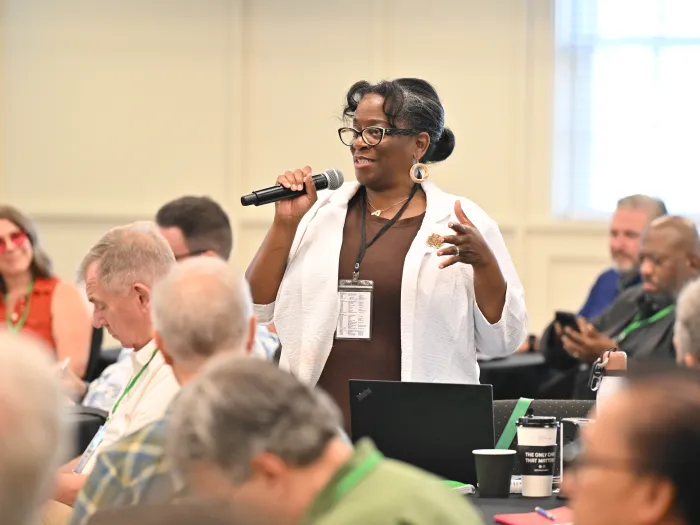
The session concluded with reflections from the audience on how they use AI. Many testimonies reflected the ambiguity of the moment and the desire to discern when AI is helpful versus when it amplifies existing harms or causes new ones. Dr. David Barstow, a ruling elder at The First Presbyterian Church of Corvallis, Oregon, said that he gave a private-access AI agent access to family memories that he shared with his wife so that what he called, “David 2.0” could companion his wife with dementia when he could not be with her. “It’s not a question of whether AI will replace a person,” said Barstow, ”it’s a matter of AI or no one.” Barstow shared in a later output session discussing Pro Human Sunday that he advocates for churches to support The Future of Life Institute, whose mission as stated on its website is “to steer transformative technologies away from extreme, large-scale risks and towards benefiting life.”

The Rev. Dr. Winterbourne Jones, senior pastor of Witherspoon Presbyterian Church in Indianapolis, described using AI-generated imagery to create culturally relevant church materials and help congregants see themselves reflected in educational and worship resources. Jones creates bulletin covers by uploading photos of his African vestments to AI, “so that the people in my congregation can see themselves as part of the sacred story.” He summarized the problem of traditional representation bluntly: “Someone got paid and did not put me in.” Gewecke welcomed the example as another expression of creative ministry.
Gewecke acknowledged throughout the presentation that AI raises significant ethical questions, repeatedly reminding participants that “technology is not Lord. Jesus is Lord.” Yet he challenged church leaders not to wait for perfect certainty before experimenting with new tools. “The frontier of AI can stop today, and the church has a decade to get caught up in all the things that this will enable for us,” he said.
His closing invitation was simple: “Please let your imagination be expanded and see what happens.”
You may freely reuse and distribute this article in its entirety for non-commercial purposes in any medium. Please include author attribution, photography credits, and a link to the original article. This work is licensed under a Creative Commons Attribution-NonCommercial-NoDeratives 4.0 International License.