PC(USA) and partners hold the first National Queer Presbyterian Gathering
PC(USA) and partners hold the first National Queer Presbyterian Gathering

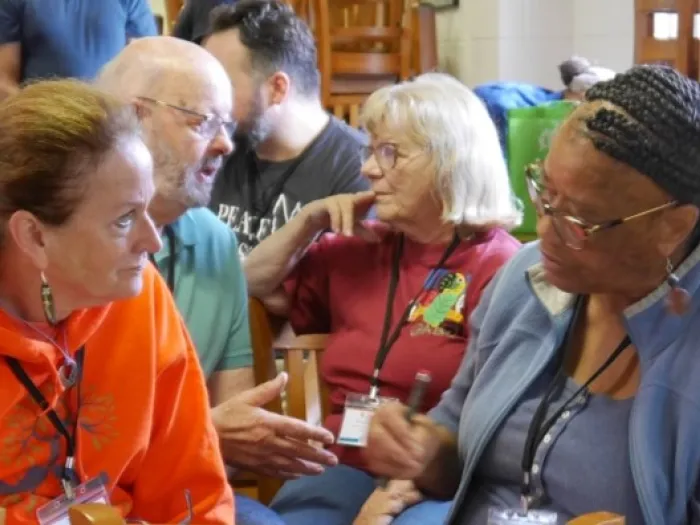
LOUISVILLE — About 80 people registered to attend the National Queer Presbyterian Gathering, which began Tuesday at the Presbyterian Center in Louisville, Kentucky, with candy-powered small group activities and discussions.
The speakers for Tuesday’s opener were conference organizers Samantha Paige Davis, the PC(USA)’s associate for Gender and Racial Justice, and Mikyle Johnson, a mission specialist in Racial Equity and Women’s Intercultural Ministries.
The first-ever event, which runs through Thursday, is being offered by the PC(USA), More Light Presbyterians, Covenant Network of Presbyterians and the PC(USA)’s Advocacy Committee for LGBTQIA+ Equity, abbreviated ACQ+E.

“We’re going to do a lot of prioritizing joy and healing and caring,” Davis told those in attendance. “We are creating an exclusively inclusive space.”
The Rev. Brian Ellison, executive director of Covenant Network of Presbyterians, offered an opening prayer, noting that the group comes before God “in awe of the fullness of this world you have made, a world where fullness of identity, fullness of experience and fullness of truth can be felt and known and seen and experienced, a world where each of us somehow is made in your divine image and filled with your divine truth.”
“We are grateful for what we might learn or hear or experience together,” Ellison told the Almighty. “Send your Spirit into this community, that we might exhibit something of your fullness and your newness of life. Send your Spirit that we might speak truth to one another — hard truths, real truths. God, make something new.”
“This is a time of joy and care, and also of agitation,” Davis told the group. In small groups, participants used the color of the candy they’d selected to share, among other things, two ways they practice solidarity, a joke, an identity important to them, or part of a favorite song.
Among the jokes: “What do you call a person who tells dad jokes who doesn’t have kids yet? A faux pa.” Here’s Johnson’s entry: “Want to hear a joke about pizza? No — it’s too cheesy.”

The leaders shared a handful of community agreements, including “lean into curiosity,” “accept and expect non-closure,” “Vegas rules” (“what happens in Vegas stays in Vegas,” with its companion, “what is learned in this space goes out from this space”), “center the most marginalized” and “productive discomfort.”
“We practice being uncomfortable together, living in a space of agitation,” Davis said. “You might be uncomfortable, and that’s OK.”
The two embarked on an exercise designed to get those present accustomed to stepping outside the lines. “We have been taught ways to practice Christianity, ways that don’t affirm who we are and who God created us to be,” Johnson said. Added Davis: “Multiply that by 1,000 when we interact with the dominant culture. In this safe space, how do I recognize what to do and what’s helpful?”
We lean into curiosity, Davis said. People on the margins often “police themselves” when they have an idea that goes up against the ways of the dominant culture. In antiracism training, “we talk about learning and unlearning,” Davis said. “I’ve done this [boundary-breaking] exercise a million times, and I still can’t get it right the first time. When we talk about oppression and centering the most marginalized, these are actions that help us move forward.”
“It’s OK to fail,” one participant reminded the group.
“We can’t more forward unless we try,” Davis said, “and trying sometimes requires you to fail.”
In pairs, participants engaged in an active listening exercise. Afterward, Davis said that marginalized people “tend to say what is being asked of them or what people are expecting to hear.” Active listening “is also a practice for privileged folks” who may think, “without me, this person is not going to be able to express themselves.”
The two leaders defined terms that will be important during the gathering, including “radical welcome,” for which Angela Davis said this: “If we are afraid to adopt a revolutionary stance — if, indeed, we wish to be radical in our quest for change — then we must get to the root of our oppression. After all, ‘radical’ simply means ‘grasping things at the root.’”
Or, as Audre Lorde put it, “It is not our differences that divide us. It is our inability to recognize, accept and celebrate those differences.”
The two defined “intersectionality” as “the ways systems of oppression overlap to create distinct experiences for people with multiple identity categories.” Prof. Kimberle Crenshaw said, “If you’re standing in the path of multiple forms of exclusion, you’re likely to get hit by both.”
They also offered a definition of “queer” put forward by bell hooks: “Queer as not being about who you’re having sex with (that can be a dimension of it) but queer as being about the self that is at odds with everything around it and has to invent and create and find a place to speak and to thrive and to live.”
“It is about the way we can/choose to/are forced to go against the dominant narrative,” Davis said, including “where we choose to live, who we choose to be with and how we worship.”
Bishop Yvette A. Flunder is plenary speaker for the National Queer Presbyterian Gathering. Check back with pcusa.org for additional reporting.
You may freely reuse and distribute this article in its entirety for non-commercial purposes in any medium. Please include author attribution, photography credits, and a link to the original article. This work is licensed under a Creative Commons Attribution-NonCommercial-NoDeratives 4.0 International License.