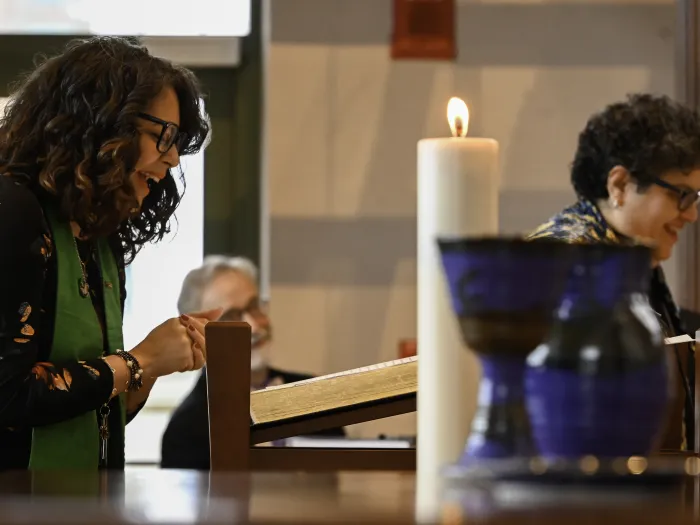
Second Holy Shift webinar focuses on ministry innovation for young adult parents in church
Participants are also urged to focus on the power of imagination

During the September 8 Holy Shift! webinar — the second in a three-part series focused on young adult parents and the church — the Rev. Libby Tedder Hugus called on participants to “dream-storm” about what is “10-percent possible” when it comes to innovating in their ministries. Hugus runs her own coaching business, Resonate Coaching, and facilitated the virtual discussion.
Monday’s webinar was a follow up to the initial Holy Shift webinar on Sept. 4, during which Dr. Josh Packard from Virginia Theological Seminary’s TryTank Research Institute shared data from the Young Adults Research Project, which explored how relationships to religion and spirituality among 25-39-year-olds have changed over recent decades. Over 500 people attended the first Holy Shift! Webinar to learn about the research.

The research project found that the number of religiously-disaffiliated young adults — popularly referred to as “nones” — has nearly doubled in the past 20 years and accounts for a third of the adult population in the United States. Trust in religious institutions is low, even while Jesus remains popular. The vast majority of parents in the study — more than 80% — expressed high confidence in their own ability to impart meaningful values to their children, as opposed to church or other outside influences.
Nearly 150 pastors, Christian educators and other church leaders tuned in to the second webinar to engage in both large-group and small-group discussion, sharing reactions to the data and ideas for ways the church can regain a meaningful place in the lives of young adult parents. For some, the conversation was pertinent in more ways than one.
The Rev. Jordan Davis, who is both a pastor and the mother of a three-year-old, attended both of the first two webinars in the series. She said her interest was partly driven by her church’s desire — like so many other churches — to find that “magic wand” solution for how to effectively reach young families. However, she was also interested because of her own struggles as a mom.
“There are the Sunday mornings that I want to just stay in bed with my daughter and husband, soaking in the family time that is way too hard to come by. Or I want for them to stay home together for that same reason, but I also want them with me at church.”
Davis said she also empathizes with parents who find the austerity of many worship settings daunting while managing their children’s energy and behavior.
“I want to find a way to make that struggle a little less difficult for all of us parents trying find the balance,” Davis said. “I want for our time at church on Sunday to provide what we want and need for our children: a home within a community which loves them, supports and nurtures us as parents, and allows us to just be.”
As the webinar revisited the research data, participants generally agreed that the study confirmed their suspicions about lack or interest in church. But many expressed surprise that institutional trust was as low as reported and that so many young adults trust themselves to impart values to their children. Several named the “huge disparity” between what the church understands to be true and the reality supported by research.
Hugus encouraged attendees to focus on the power of innovation and imagination. She invited them to practice what she called “the 10-percent rule” in response to proposed ideas — that is, determining what about each idea is at least 10 percent possible.
“It lets us tease out what God is inviting us into instead of what we need to solve,” Hugus said.
Participants were separated into smaller breakout groups and given time to engage in some idea generation around what their churches could do in response to the data, which Hugus referred to as “dream-storming.”
When the full group reconvened, many named the challenge of providing meaning and support for young parents without adding more stress, pressure, and responsibility to a demographic that is already chronically busy and overwhelmed.
“We need to make sure what we’re doing enriches parents as well as kids,” said Pastor Nathan Williams. “We need to be meeting the actual needs of parents in the context they’re looking for help in.”
Others emphasized the need to discern whether the resources they offer are truly useful, and how to successfully encourage parents to use them. People noted that working parents are often left out of consideration when churches design “parent-friendly” programming during work hours. One person also named the struggle to innovate new ministries while protecting themselves from burnout.
Despite these challenges, the discussion generated a flurry of creative ideas, including gathering in alternative spaces like playgrounds, schools or coffeeshops, which might feel more accessible or less intimidating to young parents with energetic children. The need to provide space for parents to share the struggles of their specific life stage with others was also lifted up, whether through online groups or dedicated formation classes.

Ultimately, there was a consensus that Christian educators and pastors should take a relational — rather than programmatic — approach. One small group shared a dream that every young family have at least four other people in the congregation who knows them and are looking out for them.
After a second breakout about risk-taking, groups shared energy and enthusiasm around moving away from traditional practices and insular or siloed ministry approaches to better reach young parents where they are. Participants described intergenerational and interchurch possibilities, partnering with local schools and justice organizations, throwing out traditional Sunday morning worship entirely once a month, and making a deliberate effort to include offerings accessible for working parents.
There was a notably hopeful and motivated energy as the webinar concluded.
“I didn't find the magic wand,” Davis said, “But I gleaned some great ideas and definitely some encouragement that — both as a pastor of a growing church and as a parent of an active, passionate, and enthralled-with-God child — I am not alone and there absolutely is hope for all of us.”
The third and final Holy Shift! webinar will take place at 1 p.m. Eastern Time on Sept. 23 and will focus on putting ideas into tangible action. Those who participate in all three webinars will have the opportunity to register for one-on-one coaching as well.
The "Holy Shift!" series is co-sponsored by the Around the Table initiative and 1001 New Worshiping Communities of the PC(USA).
You may freely reuse and distribute this article in its entirety for non-commercial purposes in any medium. Please include author attribution, photography credits, and a link to the original article. This work is licensed under a Creative Commons Attribution-NonCommercial-NoDeratives 4.0 International License.