Addressing politics as the church
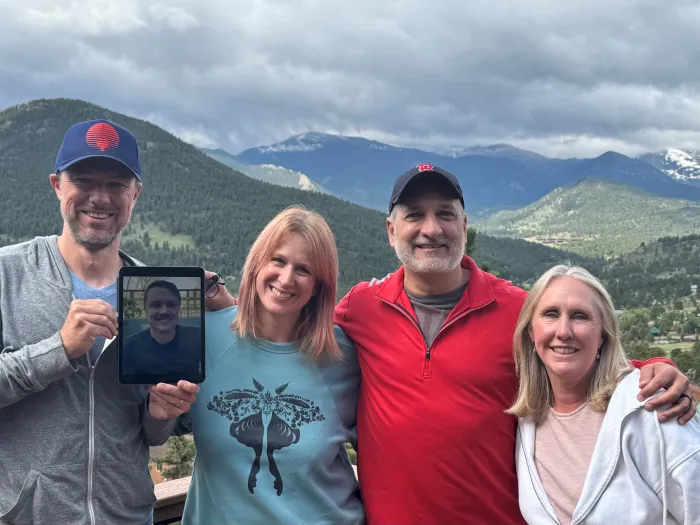
The Rev. Dr. Joe Cobb, the mayor of Roanoke, Virginia, speaks during an engaging webinar put on by Columbia Theological Seminary

LOUISVILLE — Not many American cities have a seminary-trained mayor.
Roanoke, Virginia, is one such city. The Rev. Dr. Joe Cobb, who took office in January after serving on the city council and as vice-mayor, earned a doctorate at Columbia Theological Seminary in Decatur, Georgia, and a Master of Divinity at the Perkins School of Theology in Dallas, Texas.

Cobb was the guest Wednesday as part of CTS’s “What Comes Next: Addressing Politics as the Church” webinar series. Dr. Mark Douglas, Professor of Christian Ethics at CTS, asked Cobb a number of questions before inviting webinar participants to do the same.
Cobb moved to Roanoke in 2001 after surrendering his United Methodist Church credentials when he came out as a gay pastor. He soon found Roanoke to be “a place I could be open and authentic in my real self.” He called his community a place “where people genuinely believe Roanoke is a welcoming and open community.” Cobb directed a local chapter of Family Promise and worked for the Roanoke Symphony. He was ordained into the Metropolitan Community Church and served two congregations, one in Roanoke.
Eight years ago, Cobb had “a cathartic moment. I realized my work as a pastor was coming to an end, but felt called to expand my work in social justice, equity and equality.”
A friend who was running for city council said Cobb’s work uplifted marginalized communities, “and she just kept hounding me about running.” He announced a run for city council in January 2018, and as the top vote-getter became Roanoke’s vice-mayor, the first time he’d ever held public office. Four years later, he won a second term as vice-mayor, then won a close race for mayor last year.
Many Roanoke residents see Cobb as a chaplain for the city, or its public theologian. “That’s partly due to my calling, but also how I am present in my life, the city and the world,” Cobb said. “Twenty-four years ago, I could have never imagined the path I was called to and led on during the course of my life.”
Roanoke is blessed by “a deep commitment from faith communities to be engaged in the community,” Cobb said. Roanoke was one of seven cities to receive a grant to do work on segregation, which historically has been its pattern, Cobb said. “We are a multicultural city, and we came together to hear about the history of segregation and began to build relationships to talk about how we could change that narrative.” During the process, “a number of faith communities stepped up and said, ‘we want to be part of this and we want to address the segregation that might have been a part of our own history.” PC(USA) congregations in Roanoke have been at the forefront of pulpit exchanges and Bible studies with the goal of de-segregating Roanoke’s faith communities, he said.

Douglas asked Cobb, “Given the significance of relationships in your work, what are the impediments you’ve encountered?”
“There is some of that,” Cobb said. When he was seeking his first job in Roanoke, two interviewers asked him why he would want to move to Roanoke. “It was said in a way of ‘why would anyone want to move to Roanoke?’” Cobb told Douglas. The obvious reason was to be closer to his children, but on the city council and now as mayor, “we have to find a pathway to reconciliation, new possibilities and new perspectives.” Faith communities have played a big role bringing that about, he said, as has the city council.
“When people get angry, they can just cancel you. I just have to let them be in that space,” he said. “It’s not about me. It’s about something going on in their life that they have lost control over or power over. They may project that out on me or the city. … Ultimately, it is about recognizing that we are all vulnerable and that ultimately we don’t have control over everything. We do find purpose and meaning recognizing who we are as God’s beloved people. One of our greatest callings is to be in relationship with each other, even if that means giving people space.”
When Cobb first came to Roanoke in 2001, “I was living into my authentic wholeness, claiming my sexual orientation and saying out loud I am a gay man.” A year earlier, a man had come into town and opened fire in a gay bar, killing one person and injuring six others. Tuesday was the 25th anniversary of the tragedy.
“I know people who survived that shooting,” Cobb said. “I had to ask myself, ‘is Roanoke a place where I can be out, live my life in fullness and be a co-parent to my adult children, and have a meaningful public life here?’ To the extent that I could, I would place myself with people who recognized my personhood and my being gay as a gift, not something to be covered with shame.” Throughout three election campaigns, “my being gay has been a very minor issue.”
A prayer for the day
In November 2016, Cobb said he felt “disoriented and disconnected from this country I had grown up in. I felt frustrated by what was happening politically.” He began to start every day with a prayer for the day. “I wrote whatever came to mind,” posting it on his social media accounts. It’s a practice he continues to this day.
“Every day, somebody says, ‘I really like those prayers. They remind me there is good and hope in this world.’” Cobb tells people, “it’s how I start my day. It puts me on the right path.”
Being mayor is about being present, Cobb said. “I spent an hour and a half on the phone with a constituent last week. We didn’t see eye to eye, but he was grateful, and I was too. We learned so much about each other. We took time to get to know each other.”
“It’s nice to get those little wins, but there is so much complexity to what we face at any level of government,” Cobb said. “We start with presence, and follow that with listening and caring, work to find imaginative solutions and then live into them.”
He’s also forged connections through storytelling. For his doctoral degree at Columbia Seminary, Cobb wrote about two cemeteries in Roanoke, including one where 900 remains were relocated outside city limits for the construction of an interchange.
“I spent time in those cemeteries, getting to know people and the history. I realized what’s more valuable is to create opportunities for people connected to those places to share their stories,” Cobb said. “We were able to coalesce those stories and share them, and in the process discover more about ourselves and our community.”
The mayor has frequently appeared on Hoot and Holler, a gathering of storytellers speaking on a chosen topic. “What I love about Hoot and Holler events is we can be vulnerable and tell our truth,” he said. “You can feel everyone leaning in and rising up to meet us at the point of our story.”
He periodically receives small signs that residents appreciate his efforts. In a Roanoke coffee shop, a woman caught his eye and told him, “Mayor, I appreciate what you do.”
“It’s those quiet moments of gratitude — just checking in and asking ‘how can we be there for each other?’” Cobb said. “It can be easy to get caught up in the daily activity of work and feel deflated by one interaction. Right after that, there is an interaction that dispels the weight of the previous encounter.”
“I believe in the power and presence and practice of prayer,” the mayor said. “Somebody shared with me their prayer list and I was on it. It means a lot to me. Goodness knows we need more of that.”
You may freely reuse and distribute this article in its entirety for non-commercial purposes in any medium. Please include author attribution, photography credits, and a link to the original article. This work is licensed under a Creative Commons Attribution-NonCommercial-NoDeratives 4.0 International License.