Palestinian pastor urges transformation like Paul’s
The Rev. Dr. Munther Isaac leads Bible study for the World Communion of Reformed Churches

CHIANG MAI, Thailand — At the 27th General Council’s worship and Bible study Monday, the Rev. Dr. Munther Isaac — a Palestinian pastor, author and theologian based in the West Bank — urged Christians to embrace transformation modeled after the Apostle Paul’s conversion on the road to Damascus.

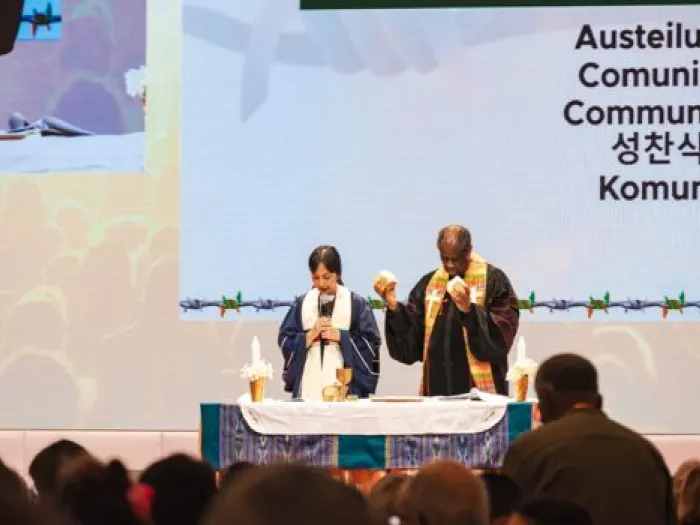
Preaching from 1 Timothy 1:12–17, Isaac reflected on Paul’s gratitude for God’s mercy and how the encounter with Jesus fundamentally changed his life. The service also included members of the Indigenous Caucus, who participated in a symbolic planting of reed sticks “to affirm the holiness of this place, this gathering and this act of faith.” A team of dancers carried the Bible forward before the congregation called out the names of martyrs and saints from their own communities.
Isaac centered his message on four ways Paul was transformed after meeting Christ.
A new view of God
The first change, Isaac said, was in Paul’s understanding of God. “Gone is Paul’s view of a tribal God, the God of violence,” he said. “Instead, Paul encounters a God who seeks people, not to judge them, but to save them.”
A new view of self
Second, Paul’s perception of himself shifted. “Before knowing Christ, Paul was very proud of himself,” Isaac said, drawing laughter as he compared Paul’s Pharisaic pride to boasting about holding a doctorate in theology. Paul’s encounter with Jesus, he added, “shattered supremacy into pieces.” Calling himself the worst of sinners, Paul embodied a “theology of humility” that Isaac said is sorely needed today.
A new view of others
The third transformation was in how Paul viewed others. Before his conversion, Paul looked at people with condescension. But, Isaac reminded the congregation, “When we despise others, let us remember we despise the Creator.” After Damascus, Paul saw every person as an object of God’s love. “May God deliver us from the sin of religious fanaticism,” Isaac said.
A new view of religion
Finally, Paul’s understanding of religion itself changed. “Even Christianity can degenerate into a religion of laws,” Isaac warned. “Paul now positioned himself with the persecuted, not the persecutors.”
Isaac said such transformation is needed now more than ever. “I look at myself and I see the elements of Saul of Tarsus,” he said. “How much we all need — I need — to be transformed.”
He pointed to global and regional suffering — war in Sudan, persecution of Dalits in India, and the ongoing devastation in Gaza — as evidence of humanity’s continued blindness. “Children in Gaza are bombed and killed,” Isaac said. “We have apartheid in Palestine — a Zionist apartheid — and many Christians enable it.”
The war in Gaza, he said, has revealed a painful truth. “Many in the West, including in some churches, do not look at us Palestinians as equals,” Isaac said. “Human rights do not apply to us.”
He criticized silence and complicity among Christians in the face of suffering. “There is overwhelming evidence recognizing what is unfolding as genocide,” he said. “Many in the church chose silence, or worse, chose to defend genocide. Their silence was too loud to ignore.”
Such responses, Isaac said, “turn theology into ideology.” Only a “Damascus-like encounter,” he argued, can shatter violent theologies.
Isaac urged the church “to be shaped by the liberating power of the gospel, not by the politicians and the ideology of the day.” He lamented how difficult it has become to distinguish “the church’s voice from that of political leaders and powers.”
“The church must identify with and be shaped by those on the receiving end of marginality,” he said. “Only when we ourselves are transformed can we be agents of transformation.”
Closing his message, Isaac reminded worshipers that “the One who transformed Saul into Paul is still transforming lives today.”
“We need Christ today more than ever — the Christ who meets us on the road and confronts our blindness, who transforms our hearts of stone into hearts of flesh,” he said. “As new creations in Christ, we can bear witness to hope in a broken and suffering world. Amen.”
The Rev. Jihyun Oh, Stated Clerk of the General Assembly of the Presbyterian Church (U.S.A.) and Executive Director of the Interim Unified Agency, is leading a PC(USA) delegation to the 27th General Council of the World Communion of Reformed Churches meeting in Chiang Mai, Thailand. Read additional reporting here and here.
You may freely reuse and distribute this article in its entirety for non-commercial purposes in any medium. Please include author attribution, photography credits, and a link to the original article. This work is licensed under a Creative Commons Attribution-NonCommercial-NoDeratives 4.0 International License.