A half-century of LGBTQIA+ advocacy in the PC(USA)
Trio helps recount the history of queer advocacy, strategy and witness

LOUISVILLE — This week, part of the National Queer Presbyterian Gathering was devoted to 50 years of advocacy on behalf of LGBTQIA+ Presbyterians.
The Rev. Brian Ellison, the Rev. Ashley DeTar Birt and Melonee Tubb spoke Wednesday during the “Piecing Together Our Power: Queer Advocacy, Strategy and Witness in the PC(USA)” session. Among other roles, Ellison is executive director of Covenant Network of Presbyterians. DeTar Birt is a member of the Advocacy Committee for LGBTQIA+ Equity. Tubb staffs three advocacy committees for the PC(USA), including ACQ+E, as it’s known.

“No one of us has the whole story of queer advocacy in the PC(USA),” Ellison said. “Being who we are has been a form of advocacy, almost from the start.” One example that came to the minds of many in the room is the Rev. David Sindt holding up a sign during the 1974 General Assembly that asked, “Is anyone else out there gay?” That act helped lead to the formation of advocacy groups within the denomination.
Asked who else came to mind, attendees mentioned the Rev. Dr. Janie Spahr, Martha Juillerat, the Rev. Bertram Johnson, the Rev. Dr. Erin Swenson, Chris Glaser, the Rev. Dr. Janet Edwards, Michael Adee (who attended the gathering), Dr. Jim Anderson and others.
“There are so many others whose shoulders we stand on,” Ellison said.
The history of the movement includes the 1991 report of the human sexuality task force, which called for an ethic of justice-love and for full inclusion. Not only was it voted down, so was the minority report. “I think they would have voted to burn all the copies of the report in the parking lot,” Ellison said. A silent protest occurred after the vote.
“Over time, that faithful witness would bear fruit,” Ellison said, in advocacy groups that would become More Light Presbyterians, Covenant Network of Presbyterians, That All May Freely Serve, Presbyterian Welcome, Presbyterian Promise and other regional groups.
Other groups lent their support, including the National Black Presbyterian Caucus, Presbyterian Health, Education and Welfare Association, the Presbyterian Peace Fellowship, the Witherspoon Society and Voices of Sophia.
Advocacy also includes attempts at policy change. After the 1991 human sexuality report was rejected, Amendment B in 1996-97 was approved with ordination requirements including fidelity in marriage between a man and a woman or chastity in singleness. That set the stage for a number of judicial proceedings, Ellison noted.
In 2017, the PC(USA) had no response to The Nashville Statement made by a group called The Council on Biblical Manhood & Womanhood.
Ellison also traced how the PC(USA) has been moving toward a more expansive inclusion. In 1997, 2001 and 2008, the General Assembly voted to remove fidelity and chastity language from the Book of Order, but the measures were not supported by enough presbyteries to gain approval. In 2011, a new ordination standard was adopted, and in 2015 a new definition of marriage was approved, declaring that marriage involves “a unique commitment between two people, traditionally a man and a woman.”
In 2018, the General Assembly passed by consent an overture celebrating the gifts of people of diverse sexual orientations and gender identities in the life of the church. Last year, POL-01 was approved, adding sexual orientation and gender identity to the list of categories to which the church is committed not to discriminate, and requiring examinations for ordination and installation to provide attention to constitutional principles of interpretation.
“And yet,” Ellison said, “let us not pop the champagne corks quite yet.”
Many congregations and mid councils “have moved on without taking practical steps to put their theoretical welcome into action,” he noted. In addition, local option “remains the rule for ordination and marriage.” About one-third of presbyteries “don’t appear to have a queer person pastoring a church.” Thousands of congregations have never had a same-sex marriage or intentionally ordained a queer ruling elder or deacon, he said.
Tubb then discussed the survey results that are detailed here.
DeTar Birt asked participants to consider their own individual advocacy experiences, including “what identities do we carry, and how does that inform our advocacy in the church and in the world?”
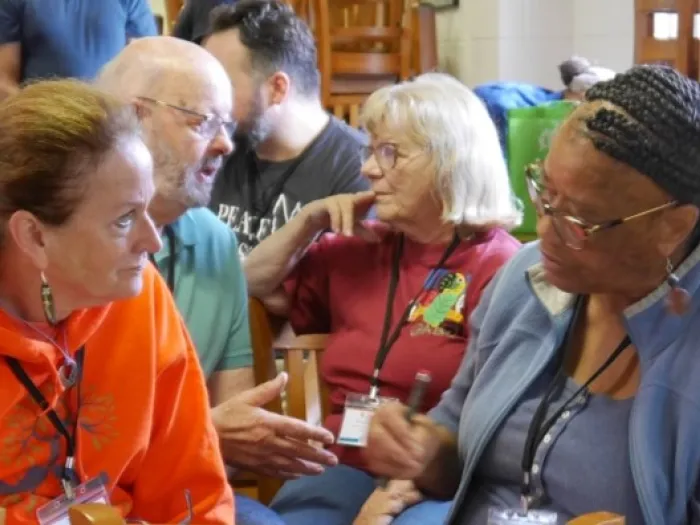
In small groups, they were asked to share:
- A time they felt part of something bigger than themselves
- A time they felt they could bring their full identity to a space
- A time when they felt their faith, their identities and their advocacy roles aligned — or didn’t.
You may freely reuse and distribute this article in its entirety for non-commercial purposes in any medium. Please include author attribution, photography credits, and a link to the original article. This work is licensed under a Creative Commons Attribution-NonCommercial-NoDeratives 4.0 International License.