Challenging us to persevere in Christian witness
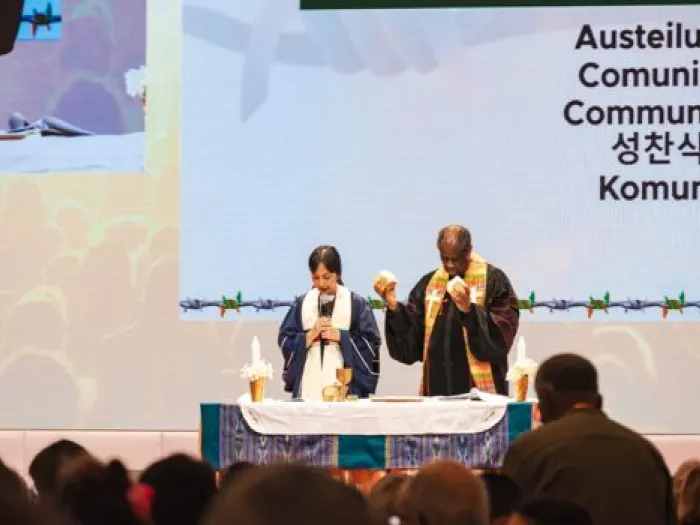
The Rev. Dr. Miriam Spies delivers an inspiring Bible study at the 27th General Council of the World Community of Reformed Churches

CHIANG MAI, Thailand — The Garden of Gethsemane, described in Luke 22, serves as a pivotal backdrop in the hours leading up to Jesus’ arrest — a moment filled with greed, fear, loss and compassion.

On Thursday, the Rev. Dr. Miriam Spies, an ordained minister in the United Church of Canada and a self-described “Crip Theologian,” led a Bible study on this passage, using it to explore disability theology and the call to persevere in Christian witness.
Living with a physical disability, Spies said her faith and lived experience challenge traditional models of inclusion and theological unity. Reflecting on the moment when soldiers came to arrest Jesus, she drew attention to Peter’s reaction — drawing his sword and cutting off the ear of the high priest’s servant — and Jesus’ immediate act of healing.
“In the panic of the moment, the disciples turn away from ‘blessed are the peacemakers’ toward the use of violence,” Spies said.
She cautioned against interpreting the healing solely as a restoration of bodily wholeness. “As a Crip Theologian, I don’t understand the story of Jesus restoring the ear as his concern about the slave’s body being whole,” she said. “Such interpretations of healing are often caught up in an ableist desire for a ‘normal’ body. They may lead people to pray for healing over those who are disabled — as if the goal is to eliminate disabled people rather than acknowledging and claiming our actual bodies. The ableism embedded in such actions is deeply harmful.”
Spies connected the story to present-day systems of oppression, noting that the logic of the empire — both ancient and modern — often treats certain bodies as expendable.
“We see this, here and now, put onto Palestinian bodies, Indigenous bodies, Black and brown bodies, poor bodies, disabled bodies,” she said. “Genocides, maiming, violence, systemic oppression — tools of the empire, of settler colonialism, funded by the Global North — clearly show which bodies do not matter.”
Spies said Jesus’ act of healing the slave’s ear demonstrates God’s incarnational promise that all bodies matter, especially those deemed unworthy or expendable by society.

“Jesus’ restoration of the slave’s ear is a form of reparation, restoring what has been destroyed or harmed,” she said. “We know that so much in our world cries out for this restoration — from harm caused by slavery, colonialism, war, intergenerational trauma and ongoing damage. The use of the sword, the ability to maim another through violence, is not Jesus’ way. His action tells us that, despite structures and systems that would denigrate it, the slave’s body matters. This is part of the solidarity that we call incarnation.”
In her closing remarks, Spies urged Christians to reflect on how they respond to violence and oppression.
“In moments of crisis, how do we persevere in our Christian witness? How do we manage the impulse to respond to violence with violence?” she asked. “In our biblical text, the disciple responds to the threat of violence by cutting off the slave’s ear. Jesus responds by restoring the ear, which speaks not to the need for wholeness but to the need for compassion, reconciliation — even love — as the response to violence.”
The Rev. Jihyun Oh, Stated Clerk of the General Assembly of the Presbyterian Church (U.S.A.) and Executive Director of the Interim Unified Agency, is leading a PC(USA) delegation to the 27th General Council of the World Communion of Reformed Churches. Read additional reporting here and here.
You may freely reuse and distribute this article in its entirety for non-commercial purposes in any medium. Please include author attribution, photography credits, and a link to the original article. This work is licensed under a Creative Commons Attribution-NonCommercial-NoDeratives 4.0 International License.