Women’s advocate describes crisis unfolding in the Democratic Republic of the Congo
‘We feel as a population like we are abandoned’

LOUISVILLE — A sharp contrast exists in the Democratic Republic of the Congo. Though rich in minerals, such as the cobalt used in lithium-ion batteries for many of the world’s electronics and electric cars, the general population of the central African country is living in harrowing conditions because of persistent violence, food insecurity and other issues gripping the DRC.
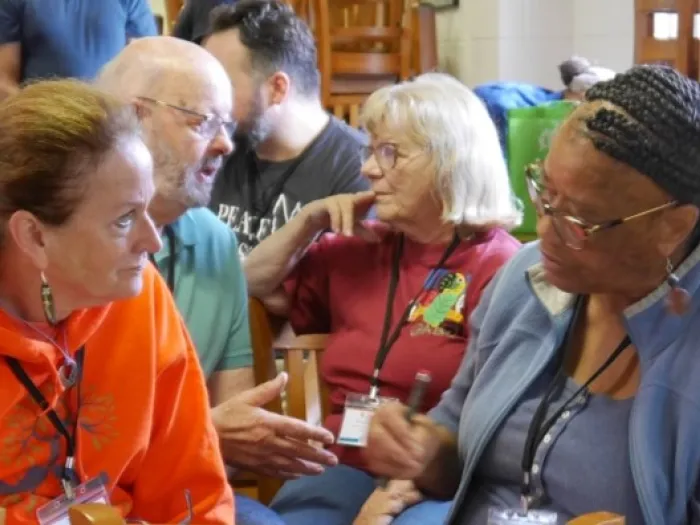
The Rev. Dr. Marthe Maleke Kondemo, a feminist pastor and scholar, shed light on her country’s struggles during a recent visit to the Presbyterian Center in Louisville, where she expressed concern that DRC’s problems are not getting the attention they deserve.
“We feel as a population like we are abandoned,” said Kondemo, General Secretary for Women and Family for the Church of Christ in Congo, an ecumenical Christian organization that brings together more than 100 denominations.

Kondemo was originally scheduled to be part of the Presbyterian delegation to the 69th session of the United Nations Commission on the Status of Women last March, but could not visit until this fall due to visa issues, said Sue Rheem, the Presbyterian Church (U.S.A.)’s representative to the U.N.
Upon arrival, Kondemo was able to engage with PC(USA) ministries in multiple states. She also met with members of the U.N. Security Council, which was arranged by the Presbyterian Ministry at the United Nations, and spoke to local Presbyterians before heading to the Congo Mission Network Conference in Alabama.
“As it happened, her visit coincided with the 30th anniversary of Security Council Resolution 1325 on Women, Peace and Security,” Rheem said. “There was great interest by members of the Security Council to hear from Dr. Maleke about the situation on the ground in Goma and the surrounding region in North Kivu and the impact on the people, particularly women and children, who are suffering greatly from the ongoing conflict.”
In the Louisville presentation, Kondemo explained that many people in DRC, especially those in the eastern portion of the country, are at the mercy of dangerous rebel groups, who destroy villages and engage in violence, including the sexual abuse of women.
“In DRC now, there is a lot of fighting going on,” said Kondemo, who’s also an associate professor at the Higher Pedagogical Institute of Mbandaka. “There currently are over 100 armed groups, each with their own agenda,” including control of mines and mineral resources. “DRC is a very rich country when it comes to mineral resources, and I always say we read (about) it, we study it at school … but the population doesn't live like a country that is rich in mineral resources.”
Scores of people are displaced from their homes because of ongoing conflict, which is partly fueled by the Congolese Revolutionary Army, also known as the March 23 Movement (M23).
“There are currently about 7 million internally displaced people in DRC, with over 5 million in eastern Congo alone, so one of the most devastating conflicts of the last two decades has been the rebellion by a movement that we call M23,” Kondemo said.
While visiting camps in places such as Goma, Kondemo sees the dire living conditions firsthand. In one small dwelling, there may be “20 people living, so children, parents, everyone living in that small house.”

Diseases, such as cholera and measles, plague residents, as does acute hunger. The DRC has one of the highest estimated numbers of food-insecure people worldwide (28 million), according to an August brief from the World Food Programme. That month, WFP distributed in-kind and cash assistance to over 1 million people, yet many food and nutrition gaps remain.
“There is a lot of malnutrition among children and even adults too, especially pregnant women,” Kondemo said.
The country also has an economic crisis that includes bank closures and cash shortages, supply chain disruptions and price increases, Kondemo said, and trying to hold onto money can be difficult due to robberies, roadblocks and carjackings.
Despite efforts to bring about peace, it largely exists only on paper, a U.N. diplomat, Bintou Keita, reported in September. There had been approximately 1,087 civilian deaths since June in the areas of Ituri and North Kivu, and “this toll is growing day by day,” said Keita, Special Representative of the U.N. Secretary-General and Head of the U.N. Organization Stabilization Mission in the DRC.
Kondemo’s presentation included video testimony from multiple women affected by the country’s instability. In one, a displaced woman described living in a camp where bombs fly through the air and going out to get firewood can lead to being raped. Mutilated bodies are found, and fatalities are common among husbands and children. “The life we live in this camp makes us very sad,” the woman said.
Not only is sexual violence rampant, but sometimes the women are also stigmatized as a result of the abuse, Kondemo said. At times, husbands “don’t want them anymore because they were raped, so you find that these women are going through a lot.”
Some women in Kondemo’s presentation described fleeing from place to place amid gunfire, being chased away from camps and discovering that their homes had been burned down.
In another clip, a 13-year-old orphaned girl with young siblings described how she sometimes has to beg for food because her father died, and her mother was poisoned. “Since this war, we have been suffering,” she said.
The Church of Christ in Congo helps to provide hope by offering programs to help women turn skills, such as sewing, baking and cooking, into entrepreneurial pursuits to make money and to boost their self-esteem.

“Most of them, they know to do all these things, but they don’t know how to really plan and make it a business, so we are teaching them,” Kondemo said.
Other efforts include a microcredit program, birth control training and agricultural assistance.
“We also have a program for advocacy that we also do, and we are building a center in Kinshasa now that is also one of our big projects, a women's center,” she said. Along with being used for various activities, it will include a room where women can come when they are tired, and they can engage with a trained person who can “listen to them and talk to them.”
On the agricultural front, “we have that project where we are trying to buy seeds,” and also assisting with access to land and teaching about agro-ecology, Kondemo said. “There are churches who are giving us land where we can work on that, but there are other places where you just have to buy a piece of land.”
Kondemo’s Louisville and New York visits were impactful.
Valery Nodem, associate for international hunger concerns for the Presbyterian Hunger Program, said, “When conflicts and war hit, when poverty and hunger are widespread, and when basic infrastructure is missing, women and children suffer the most and experience sexual violence, displacement, lack of justice and economic barriers. Learning from Rev. Maleke about the situation on the ground was very important. Her work to build women’s economic self-reliance, promote gender and social justice, peace and democracy generates a lot of hope for millions of Congolese women.”
Clare Balsan, an advocacy advocate for the Presbyterian Ministry at the United Nations, said, “It was a privilege to get to accompany Rev. Marthe as she met with diplomats and church members alike to share about the situation in her home country. The work that Rev. Marthe and the Church of Christ in Congo are doing to create a just and lasting peace in DRC is inspiring and serves as a powerful example of how the Church and global Christian community can work to bring God's Shalom to Earth.”
You may freely reuse and distribute this article in its entirety for non-commercial purposes in any medium. Please include author attribution, photography credits, and a link to the original article. This work is licensed under a Creative Commons Attribution-NonCommercial-NoDeratives 4.0 International License.