What President Lincoln can teach us about our nation’s current travails
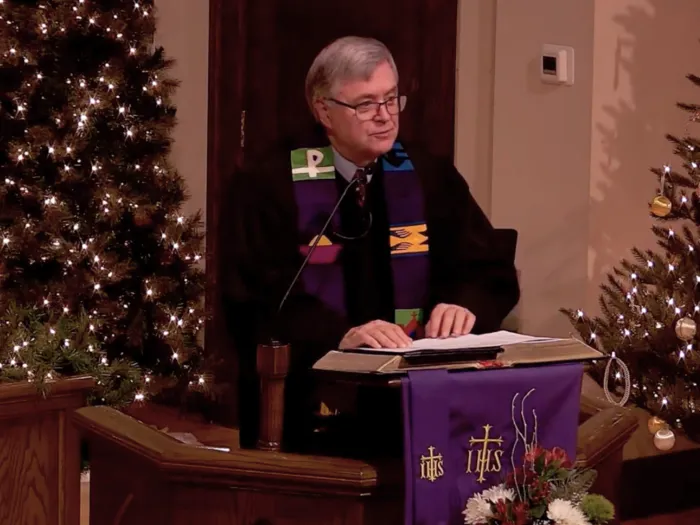
The Rev. Dr. Ted Smith of the Candler School of Theology delivers a riveting sermon at New York Avenue Presbyterian Church

LOUISVILLE — The Rev. Dr. Ted Smith, who teaches preaching and ethics at Emory University’s Candler School of Theology, used “Meditation on the Divine Will,” a little-known snippet written by President Abraham Lincoln during a grim time both for his family and the nation as the centerpiece of a McClendon Scholar presentation during worship Sunday at New York Avenue Presbyterian Church in Washington, D.C. View the worship service here. Smith begins preaching on Isaiah 55:6-9 and 1 Peter 4:12-19 at the 28:26 mark.
The fact that the District of Columbia is being patrolled by armed National Guard troops came up early in Smith’s sermon.

“It’s difficult to know how to make sense of this moment in time … to know what it means to offer a faithful response to the love of God, here and now, in the District of Columbia today,” said Smith, an ordained pastor in the PC(USA). “With the gutting of so many norms and institutions, it can feel like it must be the end of the world, and some things are coming to an end.” But for better or for worse, “it seems like history is going to continue after these days, and so I don’t want to see this as an end time … I rather see it as a difficult and decisive middle time. I’ve come to think of it as a time of trial.”
The summer of 1862 was surely that for Lincoln, who regularly worshiped at New York Avenue Presbyterian Church, just three blocks from the White House. He and his wife had recently lost their son Willie. It was also a perilous time for the North, which had suffered its second defeat at Bull Run. Politically, Lincoln found himself caught between abolitionism and the border state politicians “he needed for his coalition who were ready to preserve the Union, but let’s preserve slavery with it,” Smith noted. “It was a time of trial for the people who preceded us in this space.”
This was the backdrop for Lincoln scratching out these words, which were not published until his personal secretary, John Hay, released them as President Theodore Roosevelt’s Secretary of State during a 1903 appearance with Roosevelt celebrating New York Avenue Presbyterian Church’s centennial:
“The will of God prevails. In great contests each party claims to act in accordance with the will of God. Both may be, and one must be, wrong. God cannot be for and against the same thing at the same time. In the present civil war it is quite possible that God’s purpose is something different from the purpose of either party — and yet the human instrumentalities, working just as they do, are of the best adaptation to effect [God’s] purpose. I am almost ready to say that this is probably true — that God wills this contest, and wills that it shall not end yet. By [God’s] mere quiet power, on the minds of the now contestants, [God] could have either saved or destroyed the Union without a human contest. Yet the contest began. And, having begun [God] could give the final victory to either side any day. Yet the contest proceeds.”
Smith said he learned of the fragment and its connection to New York Avenue Presbyterian Church through this article by John O’Brien, the Lincoln historian at the church.
Smith called Lincoln’s paragraph “so compact, so perfect, that it both invites and defies exposition. What do you say about this to make it better?” But Smith did lay out three themes “that run through it”:
- “The will of God prevails” are “five words and six syllables hewn from granite,” Smith said. “That’s the conviction within which everything else unfolds.” The God Lincoln describes “is not some distant watchmaker who is watching everything unwind according to predetermined laws.” Instead, it’s “a more personal God, a God with some very specific intentions and a peculiar and terrible sense of timing.” This God reaches into the inner lives of people with what Lincoln calls “[God’s] mere quiet power.” “This God is personal, particular, relational,” Smith said. “When Lincoln says, ‘the will of God prevails,’ he means this God.”
- God’s ways are not our ways. “Instead of claiming God’s support for his own side, which is tempting for us preachers to do and even more tempting perhaps for presidents to do … Lincoln risks a radical reading of the signs of the times,” Smith said. “It is from this distance between the Divine and our plans that Lincoln pursues a politics of principle, and he takes a side because he is human. That is his role. That is our role — to take a risk, to take a side. But Lincoln knows God’s purposes transcend our earthly parties and plans, for God’s ways are not our ways.”
- It matters what we humans do. “This is some very complicated phrasing here, phrasing I think Lincoln picked up from New York Avenue’s pastor at the time, [the Rev. Dr.] Phineas Gurley,” Smith said. Gurley made “a similar argument at much greater length” during an 1863 sermon, arguing that “man proposes, but God disposes,” Smith said. That’s to say, “we humans act, and we’re accountable for our actions, but we do not control the impact of our actions in the world. … God gathers human instrumentalities — even a civil war, even the governance of a tyrant, even a cross … and shapes them towards God’s purposes.
“To say ‘the will of God prevails’ does not mean we lift our hands up and say, ‘Jesus, take the wheel.’ No. this strong trust in the providence of God sets us free for bold and faithful action,” Smith said. “It’s the kind of action you can only take when you know it’s not all up to you. That’s the way this sense of providence worked for Lincoln.”

Just a few weeks after penning this meditation, Lincoln released the preliminary Emancipation Proclamation. “He was ready to do something bold and faithful — not because he was confident God was on his side, but because he trusted God to take his best attempt at faithful action and turn it toward redemption,” Smith said. “It matters what we do.”
Two weeks after Lincoln composed “Meditation on the Divine Will,” a delegation of Quakers led by Eliza Gurney came to visit him in the White House. “Now, lots of clergy came to Lincoln all the time, mostly to tell him what to do,” Smith said. Gurney and her colleagues came to offer care “to a brother who was bearing an unbearable burden.” She led the group in reflecting on the day’s epistle passage, 1 Peter 4:12-19.
“This community addressed in 1 Peter, they’re losing jobs. They are enduring threats of violence” and threats of “social ostracism. They are living under a tyrannical empire” and “suffering for living Christian lives. You understand. I know you do,” Smith told those in worship Sunday.
For years afterward until his death in 1865, Lincoln exchanged warm letters with Gurney, and “he began to use the language of ‘fiery trial’” from the King James Version of that passage “to describe the suffering that he and the nation were living through. She helped him see it as an ordeal.”
“We are not alone in this suffering,” Peter is saying here, according to Smith. “On the contrary, it is exactly the suffering that comes to a Christian in a time of trial that binds us more deeply in communion with Jesus, or more accurately that binds Jesus more tightly to us.”
Any fiery trial “is not set by some distant God who’s like a divine proctor of a cosmic [Scholastic Aptitude Test]. ‘Will they pass? Let’s see.’ No. The fiery trial arises from what it means to follow Jesus in a world that God gives over for a time —for a season — to the powers and principalities that killed him. Jesus does not set this exam for us. Jesus undergoes it with us.”
“Different ones of us bear this ordeal in different ways,” Smith said. Some lose their jobs. Many “have to do our jobs very carefully so we don’t lose our jobs. Others are snatched from the streets by masked men without due process and taken literally God knows where. Sisters and brothers experiencing homelessness are treated literally like dirt that must be washed away to make the city great again.”
“Many of us suffer the losses of friendships and family ties, on and on,” Smith said. “The fire of this ordeal burns hot, and it is spreading.”
Smith said he would “not presume to tell you, this church, what to do in this fiery trial. You know so much more about what you are called to do in this moment than I do. … If I were to tell you what to do, the sermon would be out of date before I could finish it.”
Instead, Smith invited those in worship “into a way of seeing” shaped by the convictions that run through the church back through Lincoln and “the old-school Presbyterianism of Phineas Gurley to the Quaker faith of Eliza Gurney, through the apostolic vision of 1 Peter back to Isaiah and all the prophets who have yearned for justice, a way of seeing shaped by these convictions: the will of God prevails. God’s ways are not our ways. And still it matters what we do — not because we can redeem the world if we just get it right, but because God gathers our actions into God’s own great work of redemption.”
“In the meantime, my friends — and this is a very, very mean time — even in this meanest of times, we can rejoice in the deep communion that we share with Jesus in the suffering that comes from trying to follow him,” Smith said. “Be faithful. Be brave. Know that Jesus is with you and the will of God prevails. Alleluia, and amen.”
Learn more about the McClendon Scholars Program at New York Avenue Presbyterian Church here.
You may freely reuse and distribute this article in its entirety for non-commercial purposes in any medium. Please include author attribution, photography credits, and a link to the original article. This work is licensed under a Creative Commons Attribution-NonCommercial-NoDeratives 4.0 International License.