Iliff School of Theology scholar rounds out ‘Faithful Futures’ summit with a frank assessment
Dr. Miguel A. De La Torre isn’t high on the ethical potential of artificial intelligence

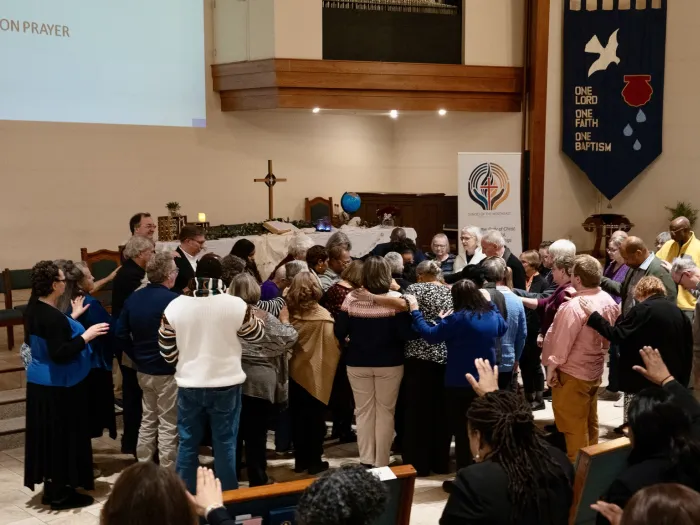
LOUISVILLE — Dr. Miguel A. De La Torre closed last week’s “Faithful Futures” summit on Friday with a talk on the ethics of artificial intelligence followed by a summary of where we might be headed. The summit, offered by the PC(USA)’s Office of Innovation and the Evangelical Lutheran Church in America, the United Methodist Church and The Episcopal Church, was held online and at Westminster Presbyterian Church in Minneapolis.
The Professor of Social Ethics and Latinx Studies at the Iliff School of Theology, De La Torre warned that “we face a future when artificial intelligence not guided by ethical considerations can usher in great harm.”

It may not be the kind of harm Hollywood envisioned in such films as “2001: A Space Odyssey” or the “Terminator” franchise. “I am not one of those AI doomsayers,” De La Torre said. “Even if I am wrong, such deliberations detract from our immediate concern: AI as it exists in the here and now, and the present ethical responses arising from the marginalized.”
There are troubling signs, De La Torre said. Algorithms are being used by some judges and parole officers to help determine the likelihood of recidivism. “Such tools reproduce and reinforce the social biases and discriminatory practices already existing in the judicial system,” he said.
He said the schoolhouse to prison pipeline “is being technologically advanced” by facial recognition and predictive analysis to flag high-risk K-12 students, “when high-risk continues to denote students of color,” he said. “Before they even act, students of color are being watched.”
AI sexism can be harmful or even lethal to women. Deepfake creations of nonconsensual explicit images “can be used to cyberbully women” and worse, “and are nearly impossible to scrub off porn sites.”
AI is even being used to allow grieving people to “communicate” with loved ones who have died. “Reminiscent of seances, they are profit-generating ventures preying on those who are grieving,” he said. Delaying grief can lead to greater suffering and increased isolation, he said.
De La Torre wondered: Who gets to determine what is prosocial about AI practices and what is malicious?
“Even if they are prosocial, they can harm societal trust and diminish the value of digital material,” he said.
The economics of AI
De La Torre noted that when the automobile replaced the horse and buggy, entire industries, including blacksmiths and carriage manufacturers, were decimated. “Certain jobs disappeared, but newer jobs were created, contributing to the strengthening of the middle class,” he said.
But AI isn’t having the same effect. One entrepreneur predicts that by 2030, half of entry-level white-collar AI workers could be replaced.
“It’s not just a lost opportunity,” De La Torre said. “It’s the loss of climbing the ladder, wrecking careers before they begin.” The World Economic Forum says that in the next five years, 4 in 10 employers plan to reduce their workforce because of AI.
“The coming tsunami of unemployment will ravage communities,” he said. “In the final analysis, technology should not entrench systemic inequality. For AI to be liberative, community votes must be included in the [AI] design process.”

“It seems hopeless, doesn’t it,” De La Torre said, adding that he’d torn up the conclusion of his lecture after attending the summit’s first three days. “I am hopeless, and after researching this paper, I am even more hopeless.”
In this country, we have developed a system of governance, he said, “where we have to go to the police department to get a permit to protest the police department.”
“I can make a sign of protest and go on a march, take a picture and post it on Facebook and say, ‘look how active I am in the cause,’ knowing that nothing changes,” he said. “Any resistance I can think of, [technology companies] are 10 steps ahead of me. It is hopeless. We are not going to change the future.”
“As an ethicist,” he asks himself, “what is the ethical act I must engage in when it is hopeless?”
We might imagine that if we do not make waves, maybe we’ll survive, he said. “But when I have nothing to lose, that’s when I become the most dangerous. There is no hope, so I might as well do something. Most social movements began when people realized they were already walking dead people.”
“When everything is stacked against you, the only ethical imperative is to subvert the system, to be the trickster,” he said, a role that’s dear to communities including Latino-a and Native Americans.
“I’m not going to win,” he said, “but I might get to something that’s a little more just.”
“I don’t struggle to get an extra ruby in my crown. I struggle because in the struggle I define the faith I need to have — and more importantly, I define my own humanity,” he said. “I struggle because I have no other choice because of who I am and the community I belong to.”
The struggle “is beyond good and evil,” he said. “It is an ambiguity in which most of us are forced to live. The choice is between something wrong and something worse.”
During a question-and-answer time following his talk, De La Torre urged those present not to waste their time speaking truth to power. “Power knows what the truth is. Let’s speak truth to the powerless,” he said. “Humanizing those who are normally kept silent is a step forward” as is “enfleshing ethics into the lives of individuals through storytelling.”
“It is a lot easier to have an ethics of right and wrong. I am suggesting an ambiguous ethics, one that moves beyond good and evil,” De La Torre said. In the Bible, Satan is “the ultimate trickster.”
“When he tried to trick Jesus in the wilderness, Jesus learned about his own ministry,” De La Torre asserted. “The Bible is full of tricksters, but we lose that in order to have right and wrong.” What we really need is community, he said, “to hold us accountable to each other.”
You may freely reuse and distribute this article in its entirety for non-commercial purposes in any medium. Please include author attribution, photography credits, and a link to the original article. This work is licensed under a Creative Commons Attribution-NonCommercial-NoDeratives 4.0 International License.